

How to handle negative reviews in 2026: 95% missed boost
Learn how 95% of South African businesses miss trust-building opportunities by ignoring negative reviews. Step-by-step guide to respond effectively, avoid legal risks, and boost revenue by 5-9% through proven reputation management strategies.
Start reading
Negative reviews strike fear into the hearts of South African business owners, yet 95% of businesses fail to respond, leaving revenue and trust on the table. Ignoring criticism doesn’t make it disappear. Instead, it broadcasts to potential customers that you don’t care about their experience. This guide walks you through proven methods to transform negative feedback into a competitive advantage, protecting your brand while building loyalty in an increasingly review-driven marketplace.
Table of Contents
- Prerequisites: What You Need Before You Start
- Step-by-Step Process To Handle Negative Reviews
- Common Mistakes And Failure Points
- Legal Considerations And Safety Warnings
- Expected Outcomes And Measuring Success
- Enhance Your Brand With Expert Web Solutions From Cloudfusion
- FAQ
Key takeaways
Point | Details |
|---|---|
Response rate gap | 95% of South African businesses ignore reviews, missing trust-building opportunities that drive 5-9% revenue gains. |
Response framework | Empathetic, personalized replies within 24-48 hours rebuild trust and prevent reputation damage from escalating online. |
Common pitfalls | Emotional reactions, generic templates, and ignoring fake reviews waste resources and harm credibility with customers. |
Legal awareness | South African defamation laws require factual, professional language to avoid legal claims while resolving disputes publicly. |
Success metrics | Track response times under one week, aim for 0.5 star rating increases annually, and monitor reduced repeat complaints. |
Prerequisites: what you need before you start
Before you craft your first response, you need the right infrastructure and training. Many businesses rush into reactive damage control without proper preparation, leading to inconsistent messaging and missed opportunities.
First, implement monitoring tools with real-time alerts. Google My Business, Facebook, and industry-specific platforms all require separate tracking. Set up email or SMS notifications so you catch reviews within hours, not days. Your monitoring system should flag keywords like “disappointed,” “terrible,” or “never again” for immediate attention.
Next, train your team on empathetic communication. Generic responses feel robotic and insincere. Staff members must understand how to acknowledge specific complaints, express genuine regret, and offer tailored solutions without sounding scripted. Role-play exercises help teams practice staying professional when customers use harsh language or make unfair accusations.
Understand South African defamation laws before publishing any response. Defamation claims require publication, identification, and damaging falsehood, with truth serving as a defense. Your responses must remain factual and avoid inflammatory language that could expose you to legal action. When in doubt, consult legal counsel before responding to particularly hostile reviews.
Develop clear escalation processes for complex issues. Not every problem resolves with a public comment. Some situations require phone calls, management involvement, or in-person meetings. Define thresholds that trigger escalation, such as threats of legal action, claims of physical harm, or disputes exceeding a certain rand amount.
Finally, deploy tools to identify fake reviews. Nearly 30% of online reviews lack authenticity, wasting time and skewing your response strategy. Look for suspicious patterns like multiple reviews from new accounts in short timeframes, overly generic language, or reviews mentioning services you don’t offer. Review authenticity verification tools help separate genuine feedback from competitor sabotage or bot attacks. Understanding legal and security compliance frameworks protects your business as you navigate these challenges.
Pro Tip: Create response templates as starting points, but customize each reply with specific details from the customer’s experience. Templates save time without sacrificing personalization.
Tool Category | Purpose | Example Platforms |
|---|---|---|
Review monitoring | Real-time alerts across platforms | Google Alerts, ReviewTrackers, Mention |
Authenticity verification | Identify suspicious review patterns | Fakespot, ReviewMeta, manual analysis |
Communication training | Build empathetic response skills | Internal workshops, role-play scenarios |
Legal consultation | Navigate defamation risks | South African legal advisors specializing in digital law |
Step-by-step process to handle negative reviews
With your foundation in place, follow this systematic approach for every negative review that appears.
Start by monitoring continuously. Set alerts to notify you immediately when reviews arrive. Speed matters because 53% of customers expect responses within one week, yet 87% of businesses fail to meet this standard. The faster you respond, the more you demonstrate that customer concerns matter to you.
Acknowledge the reviewer quickly with a personalized message. Use their name if available and reference specific details from their complaint. Avoid phrases like “We’re sorry you feel that way,” which sound dismissive. Instead, validate their experience: “Thank you for bringing this to our attention, Sarah. I understand how frustrating it must have been when your order arrived damaged.”
Apologize sincerely without becoming defensive. Even if you believe the customer misunderstood something or shares partial blame, focus on the gap between their expectations and their experience. Your apology demonstrates accountability and often defuses anger before it spreads to other potential customers reading the thread.

Provide a practical solution or compensation. Vague promises like “We’ll do better” accomplish nothing. Offer specific remedies: a refund, replacement, discount on future purchases, or expedited resolution. Make the offer public so other readers see your commitment, but invite the reviewer to contact you privately to arrange details.
Invite offline discussion for complex problems. Some disputes involve sensitive information, multiple parties, or require lengthy explanation. Public forums aren’t appropriate for these situations. Say something like: “I’d like to resolve this properly. Please email me directly at [contact] or call [number] so we can discuss this in detail and find the best solution.”
Follow up after resolution to confirm satisfaction. Once you’ve addressed the issue offline, circle back publicly if appropriate. A brief comment like “Thank you for speaking with me. I’m glad we could resolve this to your satisfaction” shows other readers that you close the loop. You can also privately request that satisfied customers update their original review to reflect the resolution. Implementing timely and personalized responses throughout this process strengthens customer relationships while demonstrating transparency to potential buyers. For additional strategies, explore resources on handling reviews to protect sales.
Pro Tip: Document every interaction in your CRM system. Track response times, resolution methods, and outcomes to identify patterns and improve your process over time.
“The goal isn’t to win an argument. It’s to rebuild trust with the unhappy customer while demonstrating to prospective customers that you handle problems professionally and fairly.”
Common mistakes and failure points
Even well-intentioned businesses stumble when managing negative reviews. Recognizing these pitfalls helps you avoid them.
Ignoring reviews represents the most damaging mistake. Only 5% of South African businesses respond to online reviews, signaling to customers that their feedback doesn’t matter. Silence looks like indifference or guilt. Every ignored review is a missed opportunity to demonstrate accountability and convert critics into advocates.
Emotional or defensive replies escalate conflict instead of resolving it. When business owners take criticism personally, they write responses that argue, blame customers, or make excuses. These reactions damage your brand more than the original complaint. Prospective customers reading the thread will side with the reviewer and question your professionalism.
Generic, copy-paste responses destroy credibility. Customers immediately recognize template replies that could apply to anyone’s complaint. These responses feel impersonal and suggest you didn’t actually read the review. Each response must reference specific details from the original complaint to prove you’re paying attention.
Failing to verify review authenticity wastes resources and misleads your improvement efforts. With nearly 30% of reviews being fake, you might spend hours crafting responses to fabricated complaints or adjusting operations based on false feedback. Invest time upfront to distinguish genuine customers from malicious actors.
Common mistakes to avoid:
- Waiting weeks to respond, missing the window when engagement matters most
- Using identical language across multiple responses, revealing template dependence
- Arguing with reviewers or questioning their honesty publicly
- Offering compensation without setting clear boundaries or terms
- Neglecting to flag obviously fake reviews with platform administrators
- Responding only to negative reviews while ignoring positive ones
For more guidance on avoiding these pitfalls, review common reputation mistakes and explore pro tips for reputation management.
Mistake | Impact | Solution |
|---|---|---|
No response | Lost trust, missed revenue opportunities | Set up monitoring alerts and commit to responding within 48 hours |
Emotional reaction | Escalated conflict, brand damage | Implement approval workflows; never respond while angry |
Generic templates | Reduced credibility, customer frustration | Personalize every response with specific complaint details |
Ignoring fake reviews | Wasted resources, skewed insights | Use verification tools and report suspicious patterns |
Legal considerations and safety warnings
Responding to negative reviews carries legal risks that South African businesses must navigate carefully.
Defamation in South Africa requires three elements: publication to a third party, identification of the claimant, and a statement that is both false and damages reputation. Truth serves as an absolute defense, and statements made in the public interest receive protection. When crafting responses, stick to verifiable facts about your business policies and the customer interaction. Avoid making counter-accusations or sharing private information about the reviewer.
Careful, professional language minimizes legal exposure. Never call a reviewer a liar, accuse them of fraud, or make statements you cannot prove. Instead of writing “This customer is lying,” say “Our records show a different sequence of events.” The difference matters in court.
Deleting negative reviews may reduce visibility but doesn’t eliminate legal risk. Some platforms allow business owners to remove reviews, but deletion can backfire by making you look guilty of the alleged misconduct. Additionally, deleted reviews may have already been screenshot or archived elsewhere. Focus on responding effectively rather than erasing criticism.
Keep detailed records of all communications. Save copies of reviews, your responses, and any private correspondence with customers. Document timestamps, the substance of phone conversations, and resolution steps taken. These records prove good faith efforts if disputes escalate to legal action. Understanding legal compliance requirements helps you navigate these complex situations.
Legal safeguards:
- Consult with legal counsel before responding to threats of litigation
- Avoid disclosing customer personal information in public responses
- Stick to objective facts rather than subjective interpretations
- Document every interaction with timestamps and summaries
- Report reviews that contain defamatory statements about your business
“In South African law, truth is an absolute defense against defamation claims. Focus on factual, verifiable statements in your responses, and avoid inflammatory language that could create new liability.”
Expected outcomes and measuring success
Tracking metrics helps you evaluate whether your review management strategy actually improves business outcomes.
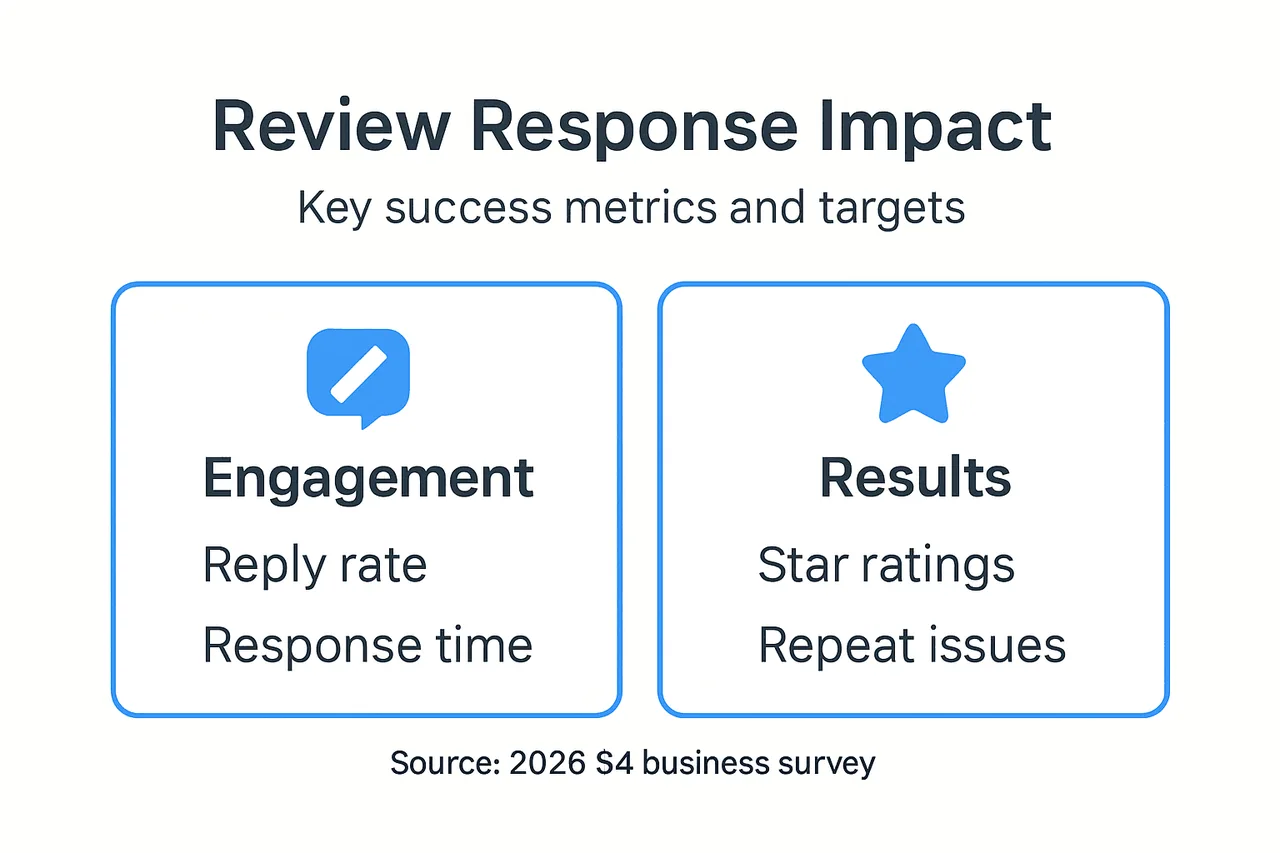
Timely and empathetic replies increase customer trust and brand loyalty. When you respond professionally to criticism, you signal to all readers that you stand behind your products and services. This transparency builds confidence among prospective customers who research your business before purchasing.
Track response times and aim for engagement within one week. Most customers expect replies within seven days, so meeting this standard differentiates you from competitors. Monitor your average response time monthly and celebrate improvements. Set internal goals to respond within 24-48 hours for optimal impact.
Monitor star ratings for steady improvement. A 0.5 star increase within a year represents realistic progress for most businesses. Higher ratings correlate directly with revenue because customers filter search results by rating thresholds. Small improvements compound over time as positive reviews accumulate and negative experiences get resolved.
Reduced repeat complaints indicate effective resolution and customer retention. If you see the same issues appearing in multiple reviews, your operational processes need adjustment. When repeat complaints decrease, you’ve successfully addressed root causes rather than just managing symptoms.
Revenue can increase by 5-9% from a one-star rating improvement, making reputation management a direct driver of growth. Track revenue alongside rating changes to quantify the financial return on your review management efforts. Many businesses discover that systematic review handling generates better ROI than traditional advertising.
Key performance indicators:
- Average response time to negative reviews
- Percentage of negative reviews receiving responses
- Star rating trends over monthly and quarterly periods
- Number of reviewers who update ratings after resolution
- Revenue correlation with rating improvements
- Customer retention rates among those who left negative feedback
Metric | Baseline | 6-Month Target | 12-Month Target |
|---|---|---|---|
Average response time | 10 days | 3 days | 24-48 hours |
Response rate | 5% | 50% | 95%+ |
Average star rating | 3.2 | 3.5 | 3.7+ |
Repeat complaints | High | Moderate | Low |
For comprehensive strategies to manage online reputation and track these metrics effectively, establish clear benchmarks aligned with your business goals.
Enhance your brand with expert web solutions from Cloudfusion
Your reputation management strategy only works if customers can find and engage with your business online. A professional, well-designed website serves as the foundation for all digital interactions, giving you control over your brand narrative and customer experience.
Cloudfusion specializes in professional web design services tailored to South African businesses. We build platforms that integrate seamlessly with review management tools, display testimonials effectively, and provide customers with easy contact channels for resolving concerns before they escalate to public complaints.
Our custom website development approach ensures your online presence reflects your commitment to customer satisfaction. Partner with Cloudfusion to strengthen your digital foundation and convert engagement into sustainable growth.
FAQ
What is the best time frame to respond to a negative review?
Respond within 24-48 hours for optimal impact. Most customers expect engagement within one week, but faster responses demonstrate greater attentiveness and often prevent negative sentiment from spreading.
How can I tell if a review is fake?
Look for patterns like multiple reviews from new accounts in short periods, overly generic language lacking specific details, or mentions of services you don’t offer. Verification tools help identify suspicious activity, and you can cross-reference reviewer profiles across platforms.
Is it safe to apologize in a public response?
Yes, if your apology focuses on the customer’s experience rather than admitting legal fault. Say “I’m sorry your order arrived damaged” instead of “We’re sorry we broke your item,” which could imply liability in disputes.
Can deleting negative reviews hurt my business?
Deletion may reduce immediate visibility but can backfire by appearing defensive or guilty. It doesn’t eliminate legal risk since reviews may have been saved elsewhere. Focus on responding effectively rather than removing criticism.
Should I always offer compensation to upset customers?
Evaluate each case individually based on the complaint’s validity and your company policies. Offering practical solutions like refunds or replacements often resolves issues, but indiscriminate compensation can encourage abuse and set unsustainable expectations.