

Step-by-step digital marketing: Your complete growth guide
Learn how to build, execute, and refine a digital marketing strategy step by step. This guide covers STEP analysis, journey models, KPIs, and execution frameworks for measurable business growth.
Start reading
TL;DR:
- A structured, evidence-backed digital marketing plan builds momentum and aligns every action with business goals.
- Conducting a STEP analysis before planning helps understand external factors influencing marketing strategies.
- Continuous measurement and agile refinement using journey models ensure campaigns adapt to modern customer behaviour.
Most business owners and marketing managers know they need a digital marketing strategy, but knowing where to start is a different matter entirely. Many organisations jump between tactics, running social media campaigns one month, experimenting with paid ads the next, and wondering why results never compound. The reality is that scattered effort rarely builds momentum. What does build momentum is a structured, evidence-backed process that aligns every action with measurable business outcomes. This guide walks you through exactly how to build, execute, and refine a digital marketing strategy that delivers consistent, scalable growth.
Table of Contents
- Why a step-by-step digital marketing plan matters
- Preparation: Analyze before you act
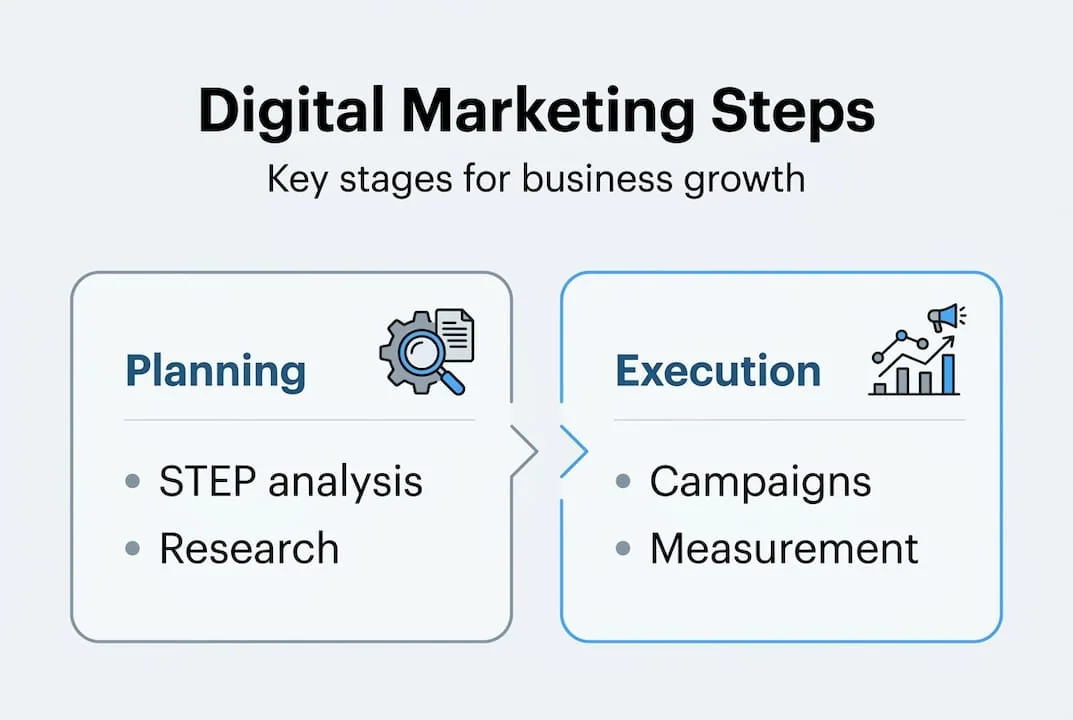
- Execution: Implementing effective digital marketing steps
- Verification: Measuring results and refining your approach
- What most digital marketing guides get wrong
- How Cloudfusion can accelerate your digital marketing journey
- Frequently asked questions
Key Takeaways
| Point | Details |
|---|---|
| Start with analysis | A STEP/STEEPLE assessment ensures context-driven decisions from day one. |
| Follow sequential steps | A clear plan avoids wasted resources and keeps teams aligned from preparation to execution. |
| Measure and adapt | Set KPIs, use data, and adapt your approach to accelerate digital marketing growth. |
| Choose flexible frameworks | Intent-based and loop models better fit today’s digital customer journeys. |
Why a step-by-step digital marketing plan matters
Without structure, digital marketing becomes expensive guesswork. Businesses that approach marketing tactically rather than strategically tend to waste budget on channels that do not align with their audience, their goals, or the competitive landscape. A defined, stepwise plan changes this by giving every team member a shared reference point for decisions.
One of the most overlooked starting points is external environment analysis. STEEPLE/STEP frameworks provide the critical context that makes digital marketing strategy viable, accounting for social shifts, technological disruption, economic pressures, and regulatory changes that affect how your audience behaves online. Skipping this step means building campaigns on assumptions rather than evidence.
Another issue is that many organisations still rely on linear funnel thinking, mapping customers from awareness to purchase in a straight line. Today’s customer journeys rarely work that way. Intent-based models and loop models, such as See-Think-Do-Care and AAARRR, better reflect how modern buyers move between discovery, consideration, and loyalty in non-sequential patterns. Understanding the challenges in digital marketing today makes this shift in thinking even more urgent.
Why structured plans consistently outperform ad hoc tactics:
- Alignment: Every campaign connects directly to business goals
- Clarity: Teams understand priorities and resource allocation
- Measurement: Defined steps make it easier to isolate what is working
- Agility: A plan gives you a baseline to pivot from, not just react to
| Approach | Planning depth | Outcome predictability | Resource efficiency |
|---|---|---|---|
| Stepwise strategy | High | High | Optimised |
| Ad hoc tactics | Low | Low | Poor |
| Hybrid (unstructured) | Medium | Inconsistent | Variable |
Pro Tip: At the start of each year, run a STEP analysis before setting your marketing budget. It takes two to three hours and will surface risks and opportunities that most competitors will miss entirely.
Now that you have seen the importance of organisation, let us clarify the first actions every digital marketer should take.
Preparation: Analyze before you act
With a plan in mind, the next essential step is thorough preparation and research. Acting without adequate analysis is one of the most common and costly mistakes in digital marketing. The businesses that consistently outperform their competitors are not necessarily those with the largest budgets. They are the ones who invest time in understanding their environment before spending a single rand on execution.

The STEP framework, which stands for Social, Technological, Economic, and Political factors, gives you a structured way to scan the macro environment. STEEPLE/STEP analysis ensures your strategy accounts for social, technological, economic, and legal factors that directly influence consumer behaviour and channel effectiveness. Knowing that a regulatory shift is coming, for example, could change your content strategy entirely.
For improving your online presence, this analysis should feed directly into your channel selection and messaging decisions.
Key data points to collect during your preparation phase:
- Market size and growth trajectory in your sector
- Competitor channel mix and content positioning
- Audience search intent and platform behaviour
- Current and emerging regulations affecting your industry
- Technological shifts, such as AI adoption or mobile-first indexing changes
A structured preparation process looks like this:
- Gather quantitative and qualitative data across all STEP categories
- Identify emerging trends that could shift audience behaviour
- Spot threats such as new competitors or tightening regulations
- Prioritise action items based on business impact and likelihood
| STEP factor | Example insight | Strategic implication |
|---|---|---|
| Social | Rising demand for video content | Invest in short-form video channels |
| Technological | AI-generated search results | Prioritise authoritative, structured content |
| Economic | Budget tightening in target sector | Emphasise ROI and cost-effectiveness in messaging |
| Political | New data privacy legislation | Review consent and data collection processes |
Pro Tip: Do not underestimate legal and ethical marketing strategies considerations. Review regulatory changes annually, particularly around data privacy and advertising standards.
‘Don’t skip analysis; it’s what separates guesswork from growth.’
Execution: Implementing effective digital marketing steps
With your groundwork in place, here is how to roll out your strategy step by step. Execution is where strategy becomes tangible, but it is also where most plans lose coherence. Without clear sequencing, teams duplicate effort, miss deadlines, and produce messaging that feels inconsistent across channels.
Modern execution must account for nonlinear customer journeys, where intent-based models like See-Think-Do-Care and loop models like AAARRR outperform traditional linear funnels. These models help you map content and channel efforts to where your audience actually is, not where you assume they should be.
For proven growth tactics and enterprise growth strategies, the execution sequence below applies across business sizes, though the tools and budgets will vary.
Step-by-step execution process:
- Define specific, measurable goals aligned to business objectives
- Select channels based on your STEP analysis and audience intent data
- Craft core messaging frameworks and brand voice guidelines
- Develop content mapped to each stage of the See-Think-Do-Care journey
- Deploy campaigns with defined budgets, timelines, and ownership
- Measure performance against your pre-defined KPIs from week one
- Iterate based on data, not assumptions, at least every four weeks
Top tools and platforms by category:
- SEO and content: Ahrefs, SEMrush, Surfer SEO
- Paid media: Google Ads, Meta Ads Manager, LinkedIn Campaign Manager
- Email marketing: Klaviyo, Mailchimp, HubSpot
- Analytics: Google Analytics 4, Hotjar, Looker Studio
- Social media management: Buffer, Sprout Social, Hootsuite
- CRM and automation: HubSpot, Salesforce, ActiveCampaign
The critical discipline here is alignment. Every campaign asset, every piece of content, and every paid placement must connect back to the goals you defined in step one. Without that thread, execution becomes activity for activity’s sake.
Verification: Measuring results and refining your approach
Once campaigns have run, your next focus is on measurement and agile improvement. Measurement is not the end of the process. It is the beginning of the next cycle. Businesses that treat reporting as a tick-box exercise rather than a strategic input consistently underperform those that use data to drive real decisions.
See-Think-Do-Care models support more accurate measurement by aligning KPIs to journey stages, ensuring you are not just tracking surface-level metrics like impressions while neglecting downstream conversion and retention signals.
Tracking the right technology trends also matters here, as new measurement tools and AI-driven analytics are changing what is possible to track and optimise.
KPIs by journey stage:
- See (awareness): Impressions, reach, brand search volume
- Think (consideration): Engagement rate, time on site, content downloads
- Do (conversion): Lead volume, cost per acquisition, conversion rate
- Care (retention): Repeat purchase rate, Net Promoter Score, churn rate
| Basic metric | Advanced KPI | Why it matters |
|---|---|---|
| Page views | Engaged sessions per user | Depth of interest, not just traffic volume |
| Click-through rate | Revenue per click | Actual commercial value of traffic |
| Social followers | Share of voice | Competitive positioning in your market |
| Email open rate | Revenue per email sent | True ROI of email campaigns |
Essential analytics tools:
- Google Analytics 4 for behavioural data
- Google Search Console for organic performance
- Meta Business Suite for paid and organic social
- CRM dashboards for pipeline and revenue attribution
Pro Tip: Always link your results back to your original STEP analysis or journey model. Optimising in isolation, without that strategic context, leads to short-term gains and long-term misalignment.
Run formal quarterly reviews where you reassess goals, channel performance, and competitive positioning. Markets shift faster than annual cycles can capture, and agile strategy requires agile measurement.
What most digital marketing guides get wrong
Having learned how to verify your strategy, it is worth reflecting on what most guides consistently miss. The uncomfortable truth is that step-by-step frameworks are only as good as the context you apply them in. Most guides present a universal checklist as if a fintech startup in Johannesburg and a manufacturing firm in Cape Town share the same strategic needs. They do not.
The fatal flaw in cookie-cutter approaches is that they ignore market-specific dynamics, industry regulations, and the technological maturity of your audience. A tactic that drives growth in one sector can actively damage brand trust in another. Following a considered perspective on ethical digital marketing is not optional. It is a competitive differentiator.
What separates genuinely effective strategy from borrowed checklists is continual analysis and realignment. The STEP framework and journey models are not one-time exercises. They are living tools that should evolve as your market does. Businesses that revisit and adapt their frameworks quarterly will consistently outpace those that set their strategy once and execute mechanically.
‘The most dangerous marketing plan is one that worked last year and has not been questioned since.’
How Cloudfusion can accelerate your digital marketing journey
To ensure exceptional results, partner with specialists who bring your strategy to life. Cloudfusion offers tailored digital solutions designed to close the gap between strategy and execution. Whether you need custom web development that supports your conversion goals, scalable mobile application development to reach audiences on every device, or reliable web hosting packages that keep your digital presence fast and secure, Cloudfusion brings the technical depth to match your strategic ambitions. Contact us today to request a free consultation and take the next deliberate step toward measurable digital growth.
Frequently asked questions
What is the first step in digital marketing planning?
The first step is conducting a STEP/STEEPLE analysis to assess the external environment, ensuring your strategy is grounded in real market context rather than assumptions.
How do I measure digital marketing success?
Measure KPIs aligned to each journey stage, including traffic, engagement, leads, conversions, and retention, then use those insights to refine your next campaign cycle.
Should I use a linear funnel or a journey loop in my strategy?
Journey loop models like See-Think-Do-Care typically outperform linear funnels because they reflect how modern customers actually move between discovery, evaluation, and loyalty.
How often should I review my digital marketing plan?
Review your plan formally at least once a year, and ideally after every major campaign, to ensure your strategy stays aligned with market shifts and business priorities.