

Mindfulness for Professionals: Boosting Productivity and Wellbeing
Mindfulness for professionals improves focus, reduces stress, and enables better decision-making. Learn key practices, workplace integration, risks, and misconceptions.
Start reading
Feeling the weight of constant deadlines and email overload is a daily reality for corporate leaders in South African tech firms, American offices, British consultancies, and European start-ups. Mindfulness promises relief, yet confusion about what it actually means—fuelled by myths like ‘emptying your mind’ or ‘just meditation’—holds many back. This article explains present-centred awareness and clears up misconceptions, so you can apply mindfulness confidently for stress management and sharper productivity.
Table of Contents
- Mindfulness Defined And Common Misconceptions
- Types Of Workplace Mindfulness Practices
- Why Your Organisation Needs Both
- Key Benefits For Corporate Executives
- Practical Integration In High-Pressure Environments
- Risks, Pitfalls And What To Avoid
Key Takeaways
| Point | Details |
|---|---|
| Mindfulness Definition | Mindfulness is present-moment awareness with acceptance and non-judgment, differing from the misconception that it is solely meditation. |
| Addressing Misconceptions | Common myths about mindfulness, such as it being a quick fix or the need to empty the mind, hinder its adoption in corporate settings. |
| Distinct Approaches | Organisations may utilise Mindfulness-Based Programs for structured learning or Mindfulness-Informed Interventions for flexible integration into daily routines. |
| Practical Benefits for Executives | Mindfulness enhances decision-making, leadership presence, stress management, and emotional intelligence, crucial for effective leadership in high-pressure environments. |
Mindfulness Defined and Common Misconceptions
Mindfulness means present-moment awareness without judgment. It sounds straightforward, but the definition has caused considerable confusion across research and practice settings.
What Mindfulness Actually Is
Psychological science defines mindfulness as present-centred awareness with an allowing and equanimous attitude towards body sensations, emotions, cognition, and the external environment. This differs from the traditional Buddhist perspective, which emphasises memory, present-centred awareness, and ethical practice.
For professionals managing high-pressure roles, mindfulness involves noticing what’s happening right now—your thoughts, feelings, bodily sensations, and surroundings—without trying to change or judge them. You simply observe with curiosity and acceptance.
Researchers have identified that present-centered awareness definitions vary considerably across studies, which impacts how we measure and apply mindfulness in workplace settings.
Common Misconceptions Holding Professionals Back
Three myths consistently prevent executives from adopting mindfulness practices:
-
Mindfulness is only meditation. Many believe you must sit quietly for hours. In reality, mindfulness can happen whilst walking, working, listening to colleagues, or even eating lunch.
-
You need to empty your mind. This is perhaps the most damaging myth. Your mind won’t go blank, and that’s fine. Mindfulness isn’t about stopping thoughts; it’s about changing your relationship with them.
-
It’s a quick fix. Mindfulness requires consistent practice. Expecting results after one session sets you up for disappointment and abandonment.
These myths about mindfulness have driven away countless busy professionals who otherwise could benefit.
Why Definitions Matter in Corporate Settings
When mindfulness lacks a clear definition, organisations apply it inconsistently. Training programmes become unclear. Sceptics dismiss it as pseudoscience. Practitioners struggle to know if they’re “doing it right.”
A solid understanding prevents wasted investment and ensures your team can actually benefit from the practice.
Mindfulness is present-moment awareness with acceptance and non-judgment—not meditation, not emptying your mind, and not a quick fix.
Pro tip: Start by practising five-minute mindful moments during your workday—notice three things you see, hear, and feel without judging them. This builds the foundation before attempting formal meditation.
Types of Workplace Mindfulness Practices
Not all mindfulness approaches work the same way in corporate settings. Organisations use two distinct types of interventions, each with different structures and outcomes.
Mindfulness-Based Programs (MBPs)
Mindfulness-Based Programs are structured, formal courses that follow established curricula. The most recognised example is Mindfulness-Based Stress Reduction (MBSR), a standardised eight-week program originally developed at medical centres.
These programs include:
- Weekly group sessions (typically two to three hours)
- Guided meditation and body scan exercises
- Homework assignments and daily practice requirements
- Clear progression and measurable learning outcomes
MBPs work well for organisations with dedicated time budgets and committed participants. They produce consistent, researched results across mental health, stress reduction, and resilience metrics.
Mindfulness-Informed Interventions (MIIs)
Mindfulness-Informed Interventions take a more flexible approach. These programs weave mindfulness principles into existing workplace activities—team meetings, leadership training, wellness initiatives—without requiring formal meditation practice.
MIIs might look like:
- Mindful listening exercises during team discussions
- Brief breathing techniques before high-stakes presentations
- Mindfulness integrated into onboarding or executive coaching
- Informal awareness practices embedded in company culture
These interventions suit busy professionals better. You don’t need to block out hours, and workplace mindfulness programs increasingly require adaptation to your organisation’s unique culture and workload.
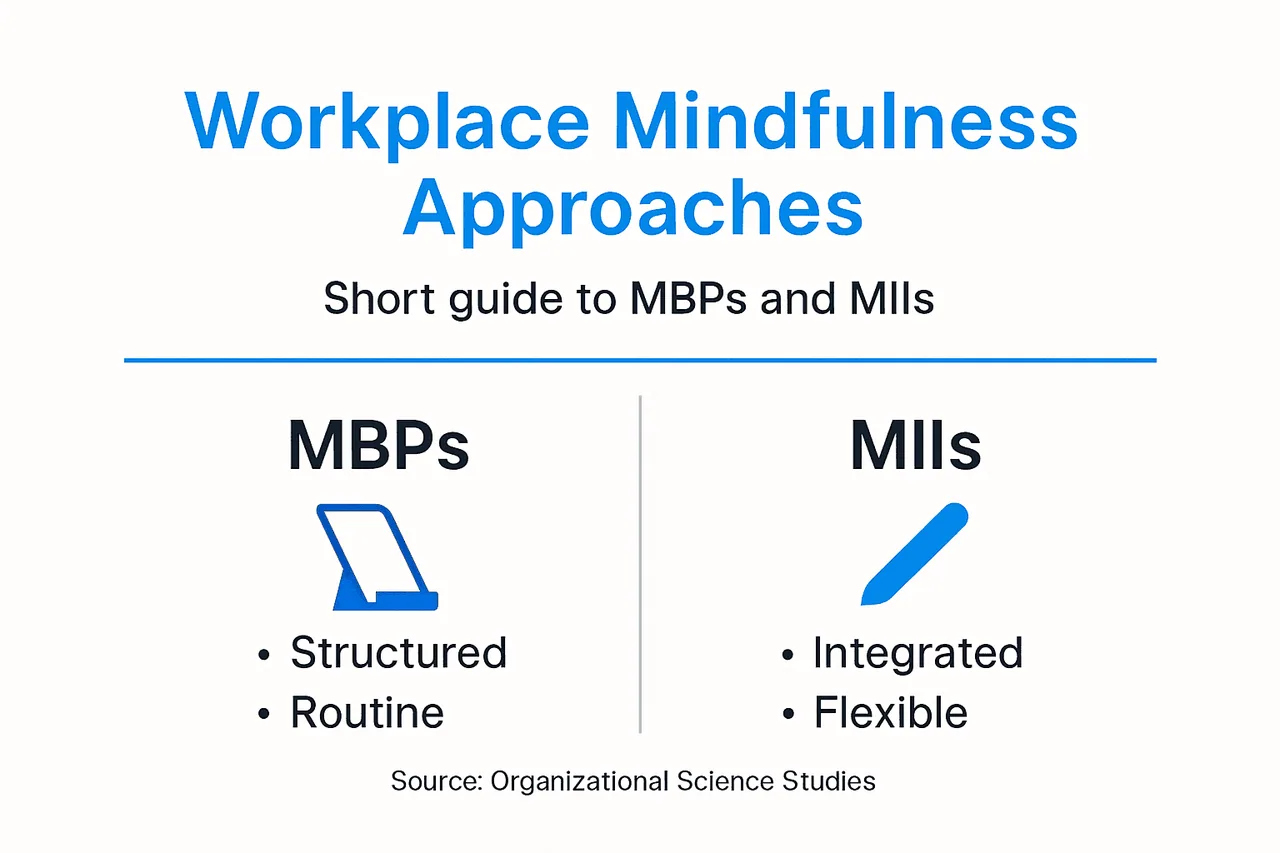
To clarify the differences, here is a side-by-side comparison of Mindfulness-Based Programmes (MBPs) and Mindfulness-Informed Interventions (MIIs):
| Aspect | MBPs (Structured Programmes) | MIIs (Integrated Interventions) |
|---|---|---|
| Format | Formal courses with set curricula | Embedded in daily work routines |
| Time Commitment | Weekly sessions, homework, daily practice | Few minutes, flexible integration |
| Measurement | Progress tracked, research-backed outcomes | Harder to measure, more adaptive |
| Best For | Dedicated, highly-engaged participants | Busy teams needing flexibility |
Why Your Organisation Needs Both
Research shows both MBPs and MIIs improve employee wellbeing, though through different mechanisms. MBPs build deep practice; MIIs create sustainable habit change across the whole team.
The best strategy combines structured learning with daily informal application. Executives gain from formal programs; teams benefit from integrated practices.
Successful workplace mindfulness balances structured programs with informal practices adapted to your organisation’s actual rhythms and demands.
Pro tip: Start by introducing one five-minute mindfulness practice into a regular meeting—perhaps a breathing exercise before decisions or a silent two-minute pause after intense discussions—to test what resonates with your team culture.
Key Benefits for Corporate Executives
Executives face relentless pressure—decisions with million-rand consequences, competing stakeholder demands, and the weight of leading teams through uncertainty. Mindfulness directly addresses these pressures by reshaping how you process information and lead.
Enhanced Decision-Making Under Pressure
When stress peaks, your brain defaults to reactive patterns. You make faster decisions, but not better ones. Mindfulness interrupts this cycle by creating space between stimulus and response.
Practising executives report:
- Clearer thinking when facing complex problems
- Reduced impulsive choices that require damage control later
- Better pattern recognition across business challenges
- Improved ability to evaluate risks versus opportunities
Mindfulness training improves executive decision-making by building focus and presence—the exact qualities that separate good decisions from great ones.

Stronger Leadership Presence and Influence
Leadership isn’t just what you say; it’s how present you are when you say it. Distracted executives lose credibility. Mindful leaders command attention naturally because they’re genuinely there.
This translates to:
- Team members feeling heard during feedback conversations
- Clients perceiving greater confidence and trustworthiness
- Improved ability to manage difficult conversations
- Enhanced capacity to influence without authority
Your presence becomes your most powerful leadership tool.
Stress Management and Burnout Prevention
Executive burnout doesn’t announce itself; it creeps in through accumulated tension and emotional exhaustion. Mindfulness provides active stress regulation rather than passive recovery.
Regular practice lowers cortisol levels, improves sleep quality, and builds emotional composure so high-pressure decisions don’t deplete you. Leaders practising mindfulness report sustained energy across demanding quarters.
Building Emotional Intelligence
Mindfulness strengthens emotional intelligence, which directly shapes team morale and organisational culture. You become more aware of your emotional triggers, better able to regulate your responses, and more attuned to what others feel.
This shifts how teams perceive leadership—less command-and-control, more collaborative and empathetic.
Here is a quick summary of how mindfulness benefits corporate executives in key leadership domains:
| Leadership Domain | Mindfulness Benefit | Practical Outcome |
|---|---|---|
| Decision-Making | Builds response awareness | Fewer knee-jerk reactions |
| Leadership Presence | Increases focus on others | Greater trust and credibility |
| Stress Management | Regulates stress hormones | Higher energy, less burnout |
| Emotional Intelligence | Enhances self-regulation | Improved conflict management |
Mindfulness transforms executives from reactive managers into present, purposeful leaders who make better decisions and inspire genuine followership.
Pro tip: Practise a three-minute breathing exercise before important meetings or presentations—box breathing works well (four counts in, hold four, out four, hold four)—to reset your nervous system and enter conversations with full presence.
Practical Integration in High-Pressure Environments
Knowing mindfulness helps is one thing. Actually practising it when deadlines loom and emails pile up is another. The key is embedding techniques into your existing rhythm, not adding more tasks.
Start Your Day with Intention
Most executives dive straight into email and meetings. Instead, begin with two minutes of intention-setting before opening your inbox.
Ask yourself:
- What matters most today?
- How do I want to show up as a leader?
- What challenges will test me, and how will I respond?
This simple pause sets your mindset for the entire day. You’re not reacting to whatever lands first; you’re leading from purpose.
Breathing Techniques for In-the-Moment Calm
When tension spikes during calls or presentations, deep breathing techniques instantly regulate your nervous system. The 4-7-8 technique works particularly well: inhale for four counts, hold for seven, exhale for eight.
This takes 90 seconds. Your cortisol drops. Your clarity returns. Your voice steadies.
Single-Tasking Instead of Multitasking
Multitasking destroys focus under pressure. When you’re juggling five things, none get your best thinking.
Instead, give each task your full attention for defined blocks:
- Strategic decisions: 60 minutes of uninterrupted focus
- Email and admin: designated windows, not constant interruption
- Client calls: no secondary tasks, just presence
This approach actually saves time whilst improving quality.
Mindful Communication During Conflict
High-pressure environments breed miscommunication. Before responding in tense conversations, pause for three breaths. This tiny gap lets you choose your words rather than react emotionally.
Practise active listening—truly hearing what someone says rather than planning your response. This diffuses tension and builds trust.
Building Sustainable Practice
Mindfulness-Based Stress Reduction programs show sustained benefits when organisations create supportive environments that reinforce practice. Individual effort matters, but cultural reinforcement makes it stick.
Seek peer groups, regular reminders, or brief check-ins that keep practice alive during chaos.
Integration isn’t about finding perfect time for meditation—it’s about weaving presence into the work you’re already doing.
Pro tip: Schedule three two-minute breathing breaks into your calendar just like meetings—morning, midday, and afternoon—and protect them fiercely; this consistency builds the neural pathways that make mindfulness automatic under pressure.
Risks, Pitfalls and What to Avoid
Mindfulness isn’t a universal solution. When implemented poorly or applied without understanding, it can backfire—creating frustration, disengagement, or unintended consequences in your organisation.
The McMindfulness Trap
Commercialised mindfulness often strips away depth, becoming little more than a quick stress-relief fix. Organisations purchase surface-level programs, employees attend half-heartedly, and nothing changes.
Avoid this by:
- Choosing well-designed, research-backed programs
- Training facilitators properly, not just hiring any wellness vendor
- Ensuring programs respect mindfulness’s ethical foundations
- Building in accountability rather than treating it as optional
Authentic mindfulness interventions adapted to your organisation’s needs work far better than generic off-the-shelf solutions.
Individual Variability and Adverse Reactions
Mindfulness doesn’t work identically for everyone. Some people find meditation deeply uncomfortable or triggering, particularly those with trauma histories or certain mental health conditions.
Implementing a one-size-fits-all approach ignores this reality. Instead, offer multiple pathways—breathing exercises, body awareness, movement-based practices—allowing people to choose what suits them.
The Accountability Problem
Paradoxically, certain mindfulness practices may reduce accountability in management roles. Managers who over-emphasise acceptance and non-judgment sometimes become passive about performance issues or team problems.
Mindfulness shouldn’t replace decisive leadership. It should sharpen it by improving clarity, not dissolving it into passivity.
Cultural Misappropriation Without Context
Mindfulness originates from Buddhist ethical traditions. Extracting the technique whilst ignoring its values can feel exploitative to practitioners and misses essential depth.
Respect the heritage by learning its context, not just its mechanics.
Organisational Context Matters
High-stress environments where nothing else changes—deadlines remain impossible, staffing inadequate, expectations unrealistic—won’t benefit from mindfulness. You’re teaching people to stay calm whilst drowning.
Mindfulness works best alongside structural improvements: reasonable workloads, clear boundaries, supportive management.
Mindfulness is powerful, but it’s not magic. Without proper design, authentic delivery, and organisational support, it becomes a band-aid masking deeper problems.
Pro tip: Before launching any mindfulness program, conduct an anonymous survey asking employees what would actually reduce their stress—often the answer isn’t meditation but workload reduction, clearer priorities, or better communication from leadership.
Unlock Greater Productivity and Wellbeing with Tailored Digital Solutions
The article highlights how mindfulness helps professionals manage stress, enhance decision-making, and maintain emotional balance in high-pressure environments. If demands on your focus and energy are creating obstacles for your leadership and team performance, the key pain points are clear: finding time-efficient strategies that integrate into busy work rhythms and cultivating presence without added complexity. Mindfulness-informed practices emphasise flexible, embedded approaches rather than rigid routines, matching the reality of corporate life.
This is where Cloudfusion stands out as your strategic partner. By combining our expertise in web design and development with customised digital tools, we help you streamline workflows and build an online presence that supports mindfulness values like clarity, simplicity and purposeful action. Whether you want to enhance internal communication, implement scalable software solutions or create an engaging platform that reflects your organisation’s culture mindful of wellbeing—the time to act is now. Explore how our custom software and digital transformation services empower your teams to stay focused and lead with intention.
Ready to take the next step towards a balanced and productive work environment tailored to your unique business needs Visit https://cloudfusion.co.za and request a personalised web design and development quotation to begin your journey today.
Frequently Asked Questions
What is mindfulness and how can it benefit professionals?
Mindfulness is present-moment awareness without judgment. It helps professionals boost productivity by enhancing focus, improving decision-making, and managing stress, ultimately leading to better overall wellbeing.
Do I need to meditate to practice mindfulness at work?
No, mindfulness isn’t limited to meditation. You can practice mindfulness during daily activities such as walking, listening to colleagues, or even eating lunch, making it accessible amidst a busy work schedule.
How can mindfulness improve my decision-making under pressure?
Mindfulness creates space between stimulus and response, allowing you to think clearly and make informed decisions rather than reacting impulsively, which is particularly valuable in high-pressure situations.
What are the differences between Mindfulness-Based Programs (MBPs) and Mindfulness-Informed Interventions (MIIs)?
MBPs are structured, formal courses with set curricula that require a significant time commitment, while MIIs integrate mindfulness principles into daily work activities without requiring formal meditation practice, making them more flexible for busy professionals.