

Prioritize Tasks: Boost Productivity 25% in 2026
Learn proven task prioritization frameworks that boost productivity by 25%. Step-by-step guide for business leaders to improve team focus and project delivery.
Start reading
Business leaders and project managers face mounting pressure as teams juggle competing demands. Poor task prioritization leads to 40% of projects missing critical deadlines, wasting resources and eroding team morale. This guide provides proven frameworks, step-by-step processes, and measurable outcomes to help you transform scattered efforts into focused execution that drives results.
Table of Contents
- Introduction To Task Prioritization
- Prerequisites For Effective Prioritization
- Understanding Task Prioritization Frameworks
- Step-By-Step Task Prioritization Process
- Common Mistakes And How To Avoid Them
- Tools And Technologies For Task Prioritization
- Alternative Approaches And Their Tradeoffs
- Expected Outcomes And Metrics For Success
- Take Your Task Management To The Next Level With Cloudfusion
- FAQ
Key Takeaways
Point | Details |
|---|---|
Structured frameworks deliver results | The Eisenhower Matrix increases productivity by up to 25% through focused task organization. |
Foundation matters first | Clear business goals and stakeholder alignment prevent costly misalignments. |
Common errors are preventable | Poor communication causes 40% of missed deadlines; frameworks fix this. |
Process beats chaos | Step-by-step prioritization improves resource focus and team clarity. |
Outcomes are measurable | Track task completion rates, delivery timelines, and sorting time reductions. |
Introduction to Task Prioritization
Task prioritization organizes work by urgency, importance, and strategic value. Without it, teams scatter efforts across low-impact activities while critical initiatives stall.
Ineffective prioritization creates tangible business costs:
- Resource waste as teams work on tasks that don’t advance strategic goals
- Missed deadlines from unclear priorities and poor time allocation
- Reduced productivity when urgent but unimportant tasks consume valuable hours
- Team burnout from constant firefighting instead of proactive planning
Prioritizing tasks aligns your team’s daily work with organizational objectives. When everyone understands which tasks matter most and why, execution accelerates. Teams complete high-value work first, projects stay on schedule, and strategic goals become achievable.
The right prioritization approach transforms how your organization operates. You shift from reactive task management to proactive strategic execution. Resources flow to initiatives that deliver measurable business impact, and your team gains clarity about where to focus their energy.
Prerequisites for Effective Prioritization
Before implementing any prioritization framework, establish these foundational conditions.
Your business objectives must be crystal clear. Teams cannot prioritize effectively when strategic goals remain vague or constantly shift. Document your top three to five business priorities and communicate them consistently.

Assess your resource availability honestly. Understanding team capacity, budget constraints, and time limitations prevents overcommitment. Prioritization without resource awareness creates unrealistic expectations.
Stakeholder alignment requires active communication channels. When executives, project managers, and team members operate from different priority lists, projects derail. Establish regular check-ins and shared visibility into priorities across departments.
Team training on prioritization frameworks accelerates adoption. Invest time explaining why you’re implementing new methods and how they benefit individual contributors. When teams understand the rationale, they embrace the process.
Pro Tip: Schedule stakeholder alignment sessions before launching new projects. Investing two hours upfront to align priorities prevents weeks of rework from misaligned expectations. These sessions surface conflicting assumptions early when they’re easiest to resolve.
For comprehensive guidance on managing digital projects, explore proven frameworks that integrate prioritization into your workflow.
Understanding Task Prioritization Frameworks
Several proven frameworks help business leaders organize tasks effectively. Each offers distinct advantages depending on your project type and team dynamics.
The Eisenhower Matrix increases task completion rates by focusing on urgent and important tasks first, improving productivity by up to 25%. This framework categorizes every task into four quadrants: urgent and important, important but not urgent, urgent but not important, and neither urgent nor important. Teams tackle quadrant one tasks immediately, schedule quadrant two work proactively, delegate quadrant three items, and eliminate quadrant four activities. The simplicity makes it ideal for daily individual and team task management.
The MoSCoW method classifies requirements as Must Have, Should Have, Could Have, or Won’t Have. Agile teams use this approach to prioritize features in product development. Must Have items are non-negotiable for project success, Should Have features are important but not critical, Could Have elements are nice additions if time permits, and Won’t Have items are explicitly excluded from the current scope.
RICE scoring ranks tasks numerically by calculating Reach times Impact times Confidence divided by Effort. This data-driven approach works well when you can quantify how many users a feature affects, the magnitude of impact, your confidence in estimates, and the effort required. Product teams favor RICE when prioritizing roadmap items.
Framework | Best For | Key Strength | Limitation |
|---|---|---|---|
Eisenhower Matrix | Daily task management | Simple, visual urgency vs importance | Subjective urgency assessment |
MoSCoW | Agile project scoping | Clear stakeholder communication | Requires disciplined scope control |
RICE | Product roadmap planning | Data-driven objectivity | Needs reliable metrics |
Pro Tip: Match frameworks to your project type. Use Eisenhower for operational tasks, MoSCoW for project scope definition, and RICE for product feature prioritization. Forcing the wrong framework onto your workflow creates friction instead of clarity.
Explore decision making frameworks to complement your prioritization process with structured evaluation methods. For deeper understanding, review this Eisenhower Matrix guide with practical application examples.
Step-by-Step Task Prioritization Process
Implementing prioritization systematically ensures consistent results across your organization.
- Define clear prioritization objectives aligned with business goals. Specify what success looks like: faster project delivery, higher revenue impact, or improved customer satisfaction. Your criteria must connect directly to strategic outcomes.
- List all tasks comprehensively and categorize them according to your chosen framework. Capture everything from major project milestones to routine maintenance activities. Incomplete task lists undermine prioritization by creating blind spots.
- Apply the prioritization framework to rank tasks objectively. Use your established criteria to score or categorize every item. This step removes emotion from decisions and creates defensible priorities.
- Communicate priorities clearly to teams and stakeholders for buy-in. Share not just what the priorities are, but why they matter and how they connect to business objectives. Transparency builds trust and commitment.
- Review and adjust priorities regularly based on progress feedback and changes. Market conditions shift, projects evolve, and new information emerges. Weekly or biweekly reviews keep priorities current and relevant.
Each step reinforces alignment, transparency, and agility. Alignment ensures everyone works toward shared objectives. Transparency prevents priority conflicts and hidden agendas. Agility allows you to respond to changing business conditions without chaos.
For detailed implementation guidance, consult our digital project management guide covering end-to-end project execution best practices.
Common Mistakes and How to Avoid Them
Even experienced leaders fall into predictable prioritization traps. Recognizing these patterns helps you avoid costly errors.
Neglecting stakeholder communication creates misalignment that derails projects. When executives, project managers, and team members operate from different priority lists, work gets duplicated or critical tasks get missed entirely. Fix this by establishing regular priority sync meetings where all stakeholders review and confirm current priorities together.
Over-prioritizing urgent tasks at the expense of important strategic work leads to burnout and strategic neglect. Firefighting feels productive in the moment but prevents progress on initiatives that drive long-term success. Balance urgency and importance using the Eisenhower Matrix to protect time for quadrant two activities.
Ignoring task dependencies results in project delays and resource conflicts. You cannot complete task B until task A finishes, yet teams work on B first because it seems more urgent. Map dependencies explicitly before finalizing priorities to create realistic sequences.
Common failure in prioritization arises from inadequate stakeholder communication, leading to 40% of projects missing critical deadlines.
Proven fixes include:
- Schedule weekly stakeholder alignment calls to surface conflicts early
- Use visual dependency maps to make task relationships explicit
- Block calendar time for important but not urgent strategic work
- Create escalation paths for priority conflicts that require executive decisions
Learn from common project mistakes to avoid and apply those lessons to your prioritization process. Review the PMI communication impact study for research-backed strategies.
Tools and Technologies for Task Prioritization
Digital tools automate prioritization workflows and improve team visibility into current priorities.
Modern task management software provides features specifically designed to support prioritization. Automated scoring applies your chosen framework consistently across all tasks. Drag-and-drop interfaces let teams reorder priorities visually. Real-time dashboards show everyone what’s most important right now.
Integration with project tracking and communication tools creates seamless updates. When priorities shift, notifications alert affected team members automatically. Comments and attachments keep context attached to each task, reducing time spent searching for information.
Measurable benefits include:
- 35% reduction in time spent manually sorting and organizing tasks
- Improved accuracy in priority assignment through consistent framework application
- Better resource allocation as managers see capacity and priorities in one view
- Reduced errors from outdated priority information
- Enhanced team visibility into why certain tasks take precedence
Tool Category | Key Features | Best For | Automation Level |
|---|---|---|---|
Project Management Platforms | Kanban boards, Gantt charts, dependency tracking | Cross-functional teams | Medium |
Task Management Apps | Priority tagging, due dates, assignments | Individual contributors | High |
Collaboration Suites | Shared task lists, commenting, file attachments | Remote teams | Medium |
Custom Solutions | Tailored workflows, API integrations, reporting | Enterprise needs | Very High |
Explore remote work productivity tools that enhance distributed team coordination. Our digital project management tools guide covers platform selection criteria. For team collaboration options, review collaborative task management tools with comprehensive feature comparisons.
Alternative Approaches and Their Tradeoffs
Beyond the major frameworks, alternative prioritization methods suit specific project types and team structures.
Kanban prioritization manages continuous workflow by limiting work in progress and pulling tasks through stages as capacity becomes available. Teams using Kanban focus on flow efficiency rather than strict deadline adherence. This approach excels for ongoing operational work and support teams handling unpredictable incoming requests.
Tradeoffs exist between simplicity and structure. Kanban offers flexibility but requires discipline to prevent priority drift. The Eisenhower Matrix provides clear urgency guidance but may oversimplify complex strategic decisions. MoSCoW delivers stakeholder clarity yet demands rigorous scope management to prevent category inflation.
Method | Flexibility | Complexity | Deadline Focus | Team Size Fit |
|---|---|---|---|---|
Kanban | Very High | Low | Low | Small to Medium |
Eisenhower | High | Low | High | Any |
MoSCoW | Medium | Medium | Medium | Medium to Large |
RICE | Low | High | Medium | Medium to Large |
Key considerations:
- Kanban works best for teams with continuous workflow and variable task arrival
- Eisenhower suits leaders managing diverse responsibilities across multiple projects
- MoSCoW fits projects with clear scope boundaries and engaged stakeholders
- RICE serves product teams with quantifiable metrics and feature roadmaps
Understand Agile and Kanban usage patterns to determine whether flow-based prioritization matches your team dynamics.
Expected Outcomes and Metrics for Success
Structured prioritization delivers measurable improvements you can track and optimize over time.
You’ll typically see productivity improvements within six weeks of implementing consistent prioritization frameworks. Task completion rates improve by 20 to 25% as teams focus on high-value work instead of busywork. On-time project delivery increases by 15 to 20% because clearer priorities prevent scope creep and resource conflicts.
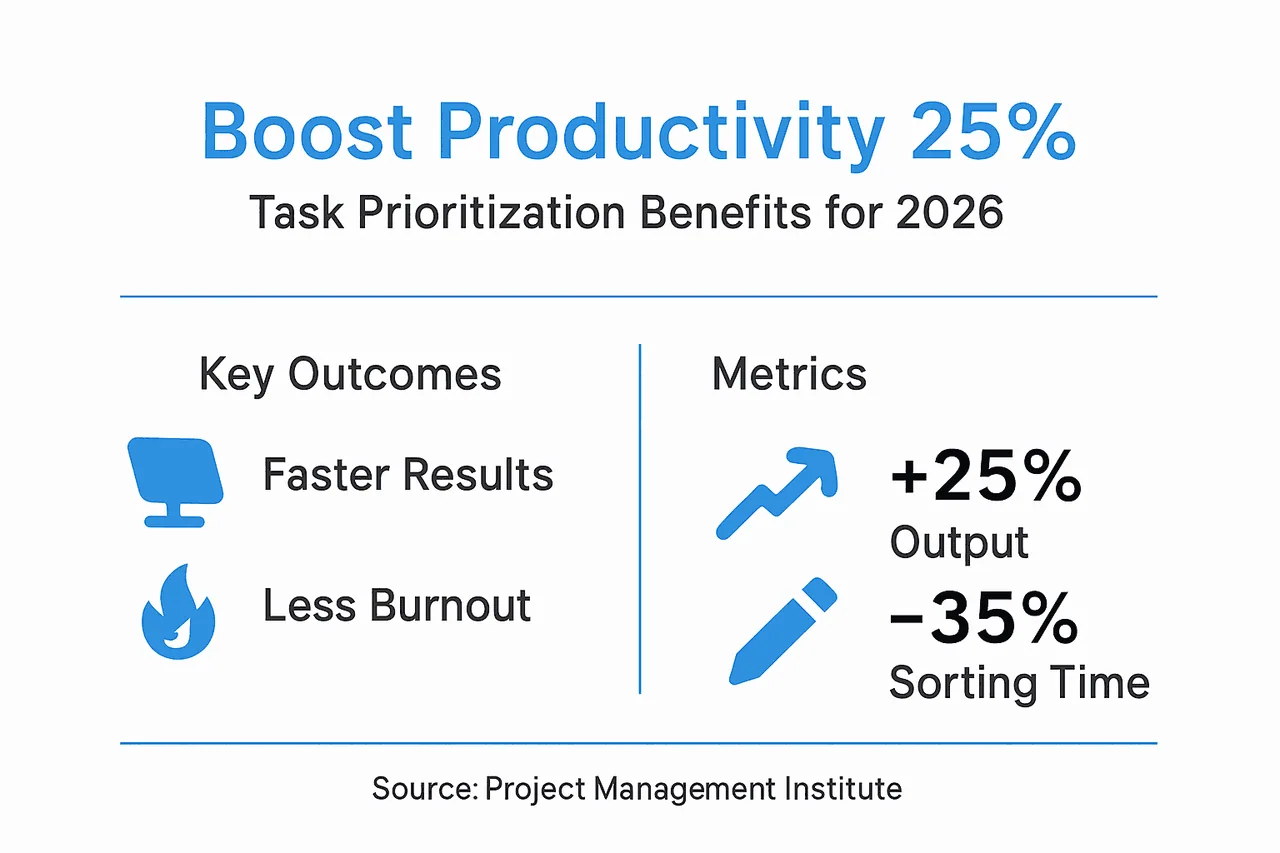
Time spent sorting and organizing tasks decreases by up to 35% when frameworks automate classification. Team members spend less time debating what to work on next and more time executing.
Beyond productivity metrics, prioritization reduces team burnout and improves morale. When everyone understands why certain tasks take precedence, they feel less stress about competing demands. Clear priorities create psychological safety because team members know their work aligns with organizational goals.
The Eisenhower Matrix alone can boost productivity by 25% through focused attention on urgent and important tasks.
Track these key metrics:
- Task completion rate measured weekly
- Percentage of projects delivered on schedule
- Time from task creation to prioritization assignment
- Stakeholder satisfaction scores regarding priority clarity
- Team member confidence in daily task selection
- Reduction in priority-related escalations and conflicts
Monitor productivity improvement metrics to benchmark your progress against industry standards and identify optimization opportunities.
Take Your Task Management to the Next Level with Cloudfusion
Implementing effective task prioritization requires more than frameworks. You need technology that embeds these methods into your daily workflow.
Cloudfusion builds custom website development services and web application solutions tailored to your team’s prioritization needs. Our developers create intuitive interfaces that make prioritization frameworks accessible to every team member, from executives to individual contributors.
We integrate task management with your existing tools to provide unified visibility across projects. Custom dashboards surface priority conflicts before they cause delays. Automated workflows apply your chosen frameworks consistently without manual intervention.
Explore our productivity boosting tools to discover how technology transforms task management from a daily burden into a competitive advantage.
FAQ
What is the best task prioritization framework for large teams?
MoSCoW often works best for large teams because its clear Must Have, Should Have, Could Have, Won’t Have categories facilitate stakeholder collaboration and resource allocation across complex projects. RICE scoring also suits data-driven product teams managing feature roadmaps.
How often should task priorities be reviewed and adjusted?
Review priorities at least weekly and adjust as project conditions or resources change to stay aligned with goals. Regular review improves responsiveness and reduces risks from outdated priorities that no longer reflect business reality.
What are the risks of ignoring task dependencies in prioritization?
Ignoring dependencies causes project delays, resource conflicts, and missed deadlines affecting up to 30% of mid-sized projects. Proper dependency mapping ensures realistic prioritization that accounts for task sequences and prevents teams from starting work before prerequisites are complete.
Can software tools fully automate task prioritization?
While software automates scoring and sorting, human judgment remains vital to align priorities with strategic goals and adjust for context. Automation accelerates processes but doesn’t replace leadership decisions about strategic direction and stakeholder trade-offs.