TL;DR:
- Bespoke software is designed to align precisely with a business’s workflows, offering enhanced security, scalability, and operational efficiency. Unlike generic platforms, custom solutions enable seamless integration, future growth, and significant productivity gains, providing a sustainable competitive advantage. Successful implementation requires active organizational involvement, iterative collaboration, and strategic planning to fully realize long-term benefits.
Many businesses assume pre-packaged software is a practical, cost-effective shortcut to digital operations. The reality is far more complex. Generic platforms force your processes into rigid moulds, creating inefficiencies, security gaps, and integration headaches that quietly erode productivity and profitability over time. A bespoke software company takes a fundamentally different approach, designing and engineering solutions that align precisely with your workflows, your data structures, and your strategic goals. This guide breaks down exactly how custom software creates measurable advantages in security, scalability, and operational efficiency, giving your business a sustainable competitive edge.
Table of Contents
- What makes a bespoke software company different
- Security best practices and why they matter
- Building for scalability and future growth
- How bespoke companies drive efficiency and productivity
- Our perspective: What most businesses overlook when choosing a bespoke software company
- Unlock tailored digital solutions with Cloudfusion
- Frequently asked questions
Key Takeaways
| Point | Details |
|---|---|
| Security must come first | Ignoring security can cost millions; start with best practices from day one. |
| Think scalability early | Modular designs and microservices help your business adapt and grow seamlessly. |
| Maximize productivity | Smart software practices like code sharing and automation deliver measurable efficiency gains. |
| Tailored solutions pay off | Bespoke providers align digital tools precisely with your unique workflow and goals. |
| Partner for long-term value | Choose a bespoke software company that prioritizes transparent collaboration and ongoing support. |
What makes a bespoke software company different
Having set the stakes, let us explore what sets bespoke software companies apart from traditional providers.
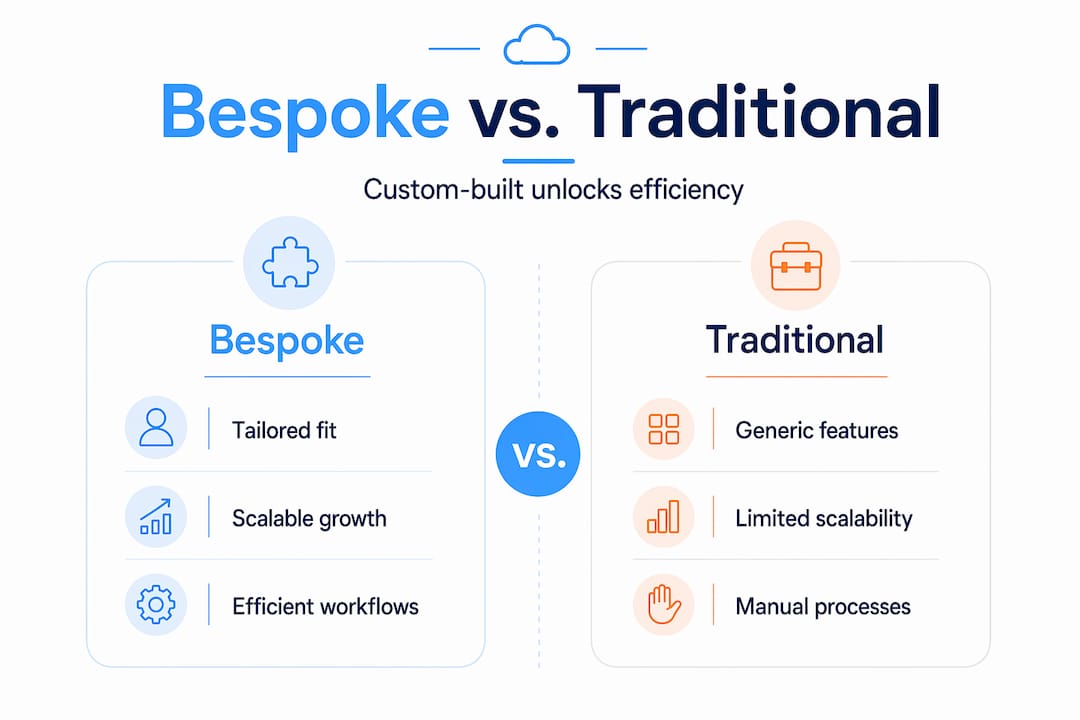
A bespoke software company designs, develops, and maintains software built entirely around a specific organisation’s needs, rather than adapting a generic product to fit. This is not merely a preference for custom aesthetics. It is a fundamental difference in how technology serves your business. Off-the-shelf platforms are engineered to satisfy a broad market segment, which means they inevitably include features you will never use and lack the ones you genuinely need. A bespoke partner starts with your business model and works outward from there.
Understanding the custom software benefits becomes clearer when you examine real business scenarios. A logistics company managing complex route optimisation, vehicle tracking, and client billing across multiple regions cannot rely on a generic project management tool. A healthcare provider juggling patient records, appointment scheduling, and regulatory compliance across different provinces needs software that reflects those exact workflows. Off-the-shelf tools create workarounds. Bespoke solutions eliminate them.
The following comparison illustrates the core structural differences between these two approaches:
| Factor | Bespoke software | Off-the-shelf software |
|---|---|---|
| Security | Custom-hardened, built to your specific threat model | Generic security protocols, shared vulnerabilities |
| Adaptability | Fully modifiable as your business evolves | Limited by vendor update cycles and feature roadmaps |
| Integration | Native integration with existing systems and APIs | Dependent on third-party plugins, often unstable |
| Long-term ROI | Higher initial investment, lower ongoing licensing costs | Lower upfront, but cumulative licensing fees are significant |
| Workflow alignment | Designed around your exact processes | Your processes must adapt to the software’s structure |
| Support | Dedicated, relationship-based partnership | Ticket-based, generalised vendor support |
The case for bespoke becomes particularly compelling when you factor in how custom solutions drive efficiency and growth over a multi-year horizon. The key advantages include:
- Tailored workflows that mirror your operational processes rather than forcing your team to adjust their behaviour
- Seamless integration with existing platforms, whether those are ERP systems, payment gateways, or industry-specific databases
- Scalable architecture that grows with your user base, transaction volume, and feature requirements
- Ownership and independence from vendor decisions, price increases, or discontinuation risks
- Ongoing, collaborative support from a team that knows your system’s architecture intimately
Security best practices and why they matter
Security is one of the most critical factors that differentiate bespoke solutions from generic alternatives, and it is one that too many businesses treat as an afterthought rather than a foundational requirement.
When you build software from the ground up, you have the opportunity to integrate security protocols at every layer of the system, from database access controls and encryption standards to authentication logic and API security. Off-the-shelf platforms, by contrast, present a shared attack surface. Vulnerabilities discovered in widely-used platforms affect every business using that software, making them high-value targets for attackers who invest in learning the architecture of popular tools.
The average data breach cost reached $4.45 million in 2023, underscoring why security must be integrated from day one rather than retrofitted after deployment.
That figure is not an abstract statistic. It represents legal costs, regulatory penalties, reputational damage, customer churn, and operational recovery time. For small to mid-sized businesses, a breach of that magnitude is often existential. For large enterprises, it represents a serious disruption to operations and shareholder confidence.
Investing in website security best practices during the design phase is dramatically more cost-effective than patching vulnerabilities after they have been exploited. A secure VPS setup at the infrastructure level is one foundational element, but application-level security requires an equally deliberate approach.
Essential security practices that every bespoke development engagement should address include:
- End-to-end encryption for all data at rest and in transit, using current cipher standards
- Role-based access control (RBAC) to ensure users can only interact with data and functions relevant to their role
- Regular penetration testing and security audits conducted by independent assessors
- Secure coding standards enforced through automated static analysis tools integrated into the development pipeline
- Incident response planning documented before launch, not after an event occurs
- Dependency management to monitor third-party libraries for known vulnerabilities
Pro Tip: Before launching any custom software, commission a formal risk assessment that maps your data flows, identifies threat vectors, and validates your access control logic. This single investment can prevent security oversights that would cost orders of magnitude more to remediate after the fact.
Common pitfalls to avoid include deferring security audits to post-launch, using default credentials in staging environments that persist to production, and underestimating the importance of securing third-party API connections. These are not hypothetical mistakes. They represent patterns that appear repeatedly in post-breach investigations.
Building for scalability and future growth
Securing your software is only half the battle. Making it future-proof is equally important, and this is where architectural decisions made early in a project have lasting consequences for your business.

Scalability, in the context of business software, refers to the system’s ability to handle increasing workloads, users, data volumes, and feature complexity without requiring a complete rebuild. This is not a feature you can add later. It is a structural quality that must be designed in from the start.
The recommended approach, as reinforced by modular and microservices architecture, is to decompose your application into independently deployable services. Rather than building a single monolithic application where every component is tightly coupled, microservices allow individual modules to be scaled, updated, or replaced without affecting the rest of the system. This architectural pattern is particularly valuable for businesses anticipating rapid growth or operating in markets where regulatory or competitive conditions change frequently.
Understanding scalable software solutions requires recognising how architectural choices affect real-world costs and agility. The following table illustrates typical cost and capability differences between scalable and standard approaches:
| Growth scenario | Standard monolithic architecture | Modular / microservices architecture |
|---|---|---|
| User base doubles | Requires full infrastructure upgrade | Scale only affected service modules |
| New feature added | Risk of breaking existing functionality | Deploy new service independently |
| Third-party integration | Often requires core system modification | Add integration at service boundary |
| Regulatory change | Widespread codebase refactoring | Modify only the relevant module |
| Cost at 3-year mark | Higher, due to technical debt accumulation | Lower, due to targeted maintenance |
For businesses serious about future-proofing their software investment, the following steps provide a practical framework:
- Define your growth trajectory upfront. Provide your development partner with realistic projections for user numbers, transaction volumes, and geographic expansion so architecture decisions reflect your actual needs.
- Adopt a cloud-native hosting strategy. Cloud environments offer elastic resource allocation that aligns spending with actual demand rather than peak-load estimates.
- Build abstraction layers for third-party dependencies. This ensures that replacing a payment gateway, analytics platform, or communication service does not cascade through your entire codebase.
- Implement automated testing pipelines. Continuous integration and continuous delivery (CI/CD) systems allow you to release updates confidently and frequently without manual regression testing overhead.
- Schedule regular architecture reviews. As your business evolves, periodic reviews ensure your software architecture still aligns with operational realities and emerging technology capabilities.
Pro Tip: Plan explicitly for integrations with third-party platforms before writing a single line of code. The cost of retrofitting an integration designed around a poorly-structured internal API is dramatically higher than designing the API correctly from the outset. Adaptive governance frameworks that incorporate regular technology reviews can also help your organisation stay aligned as the digital landscape shifts.
How bespoke companies drive efficiency and productivity
Scalable solutions go hand in hand with productivity, which is where bespoke software companies truly excel. The productivity gains from well-engineered custom software are not theoretical. They are measurable, and the data from software engineering research is revealing.
Empirical productivity benchmarks from software development studies indicate that specific engineering practices deliver quantifiable improvements. Mock types contribute approximately 14% productivity improvement. Auto-memoization (a technique where the system caches the results of expensive function calls to avoid redundant computation) delivers around 33% improvement. Code sharing across projects and teams produces time savings exceeding 50%, potentially saving thousands of development hours across the lifecycle of a product. These figures are not abstract. They translate directly into faster time-to-market, lower development costs, and higher-quality software delivered to your users.
A bespoke software company that applies these engineering disciplines to your project is not merely building code. It is engineering a productive system that compounds value over time. Exploring software productivity strategies and understanding how they apply to your specific project scope allows you to set realistic, evidence-based ROI targets before committing to a development engagement.
The business efficiency benefits of working with a skilled bespoke partner manifest across several dimensions:
- Reduced manual workload through automation of repetitive, rule-based tasks that consume staff time without adding strategic value
- Faster product launches enabled by reusable code components, modern development frameworks, and streamlined testing pipelines
- Competitive advantage derived from software capabilities that are unique to your business and cannot be replicated by competitors using the same generic platforms
- Lower error rates because workflows are designed around your actual processes rather than generic assumptions about how businesses operate
- Better decision-making through dashboards and reporting tools that surface the specific metrics your leadership team needs, rather than generic analytics designed for a hypothetical average user
Empirical benchmarking also helps your business set realistic expectations. Before a project begins, a competent bespoke software company should provide productivity baselines and milestone targets, giving you objective criteria to evaluate progress and hold your development partner accountable.
Our perspective: What most businesses overlook when choosing a bespoke software company
Before wrapping up, here is an insider view on practical selection criteria that rarely appear in vendor comparison articles but consistently separate successful engagements from disappointing ones.
Most businesses evaluate bespoke software companies on the visible criteria: portfolio quality, technology stack expertise, pricing, and team size. These factors matter. But the variables that most consistently determine project success are the ones that are harder to assess before signing a contract.
Organisational readiness is one of the most underestimated factors. Custom software development requires sustained, active involvement from your internal team. This means clear business process documentation, timely decision-making on feature priorities, and genuine executive commitment to the project’s strategic goals. Development partners can build exceptional software, but they cannot substitute for clarity on your end. Businesses that approach bespoke development expecting a passive, hands-off experience routinely end up with software that does not align with their evolving operational reality.
The quality of ongoing collaboration matters more than the initial specification document. Requirements change. Market conditions shift. Users interact with software in ways that no specification can fully anticipate. A bespoke partner who builds an iterative, feedback-driven process into the engagement structure will produce substantially better outcomes than one who delivers to a fixed spec and considers the project closed. Ask prospective partners how they handle scope evolution, what their sprint review processes look like, and how they incorporate user feedback post-launch.
Consider how custom software saves time not just in operations, but in the development process itself when the right partner relationship is in place. The compounding value of a long-term development partnership, where your partner accumulates deep institutional knowledge about your systems and business context, is significant. Short-term engagements optimised for initial cost often result in higher total expenditure as new teams repeatedly rebuild contextual understanding.
Pro Tip: During the evaluation process, prioritise partners who ask difficult questions about your business goals and challenge your assumptions over those who immediately validate every requirement. A development partner willing to push back constructively is one who is invested in your success, not merely in winning the contract.
Unlock tailored digital solutions with Cloudfusion
If you are ready to take the next step, here is how Cloudfusion can support your business goals. Cloudfusion operates as a full-service digital solutions provider, combining custom web development expertise with mobile app development capabilities and a robust suite of cloud infrastructure services. Whether your business requires a purpose-built web platform, a native mobile application, or a migration to scalable cloud hosting, Cloudfusion brings the technical depth and collaborative methodology to deliver results that align with your operational and strategic objectives. Our web hosting packages further ensure that your bespoke software is supported by a reliable, secure, and performant infrastructure foundation from day one. Reach out to our team to discuss your requirements and receive a tailored consultation.
Frequently asked questions
How do bespoke software companies ensure data security?
They integrate security best practices from the very start of development, including encryption, role-based access control, and formal risk assessments, specifically addressing the average breach cost of $4.45 million that makes early investment essential.
Is bespoke software scalable for growing businesses?
Yes, and it is precisely the architectural approach that makes this possible. Microservices architecture allows individual components to scale independently, meaning your software grows with your business without requiring a complete system rebuild.
What productivity gains can I expect from a bespoke solution?
Productivity improvements are quantifiable. Engineering benchmarks show gains of 14% from mock types, 33% from auto-memoization, and over 50% from code sharing, translating into measurable reductions in development time and operational costs.
How does a bespoke software company tailor a solution to my needs?
The process begins with a detailed analysis of your current workflows, system integrations, pain points, and strategic objectives, producing software that addresses your exact operational challenges rather than adapting your processes to fit a generic platform.
How long does it take to develop bespoke software?
Development timelines depend on project complexity, integration requirements, and the number of features in scope, but iterative delivery models typically release core functionality in stages, allowing your business to realise value progressively rather than waiting for a single final launch.
Recommended