

Unlock ROI with custom development services in 2026
Discover how custom development services deliver 3.7x ROI, reduce edge-case failures by 68%, and drive digital transformation for your business in 2026.
Start reading
TL;DR:
- Custom development addresses rare edge cases that cause most production failures, enhancing system robustness.
- Over 18 months, custom solutions deliver 3.7 times higher ROI and lower long-term costs than off-the-shelf software.
- Investing in structured QA, ongoing maintenance, and AI tools ensures long-term operational efficiency and strategic value.
Most businesses assume their software fails because of obvious bugs or poor design choices. The uncomfortable reality is that edge cases, those rare but high-impact scenarios your off-the-shelf platform never anticipated, are responsible for the majority of production failures. When a generic solution encounters an unexpected input or an unusual user workflow, it breaks. Custom development services are built precisely to anticipate these moments, and the financial and operational case for investing in them is far stronger than most decision-makers realise. This article maps the full picture: from ROI mechanics and quality assurance to planning frameworks and digital transformation outcomes.
Table of Contents
- Why custom development services outshine off-the-shelf solutions
- Handling edge cases and quality assurance in custom development
- Planning, discovery, and ongoing maintenance for custom development
- Driving efficiency and digital transformation through custom development
- The uncomfortable truth about custom development ROI
- Connect with trusted custom development experts
- Frequently asked questions
Key Takeaways
| Point | Details |
|---|---|
| Superior ROI | Custom development delivers 3.7 times ROI after 18 months, outpacing off-the-shelf solutions. |
| Risk reduction | Advanced QA and edge-case handling prevent up to 68% of software failures and downtime. |
| Strategic planning | Effective discovery, QA integration, and annual maintenance planning drive sustainable project success. |
| Efficiency gains | AI can accelerate development speed in mature projects by 30-40%, increasing efficiency. |
| Operational flexibility | Custom platforms offer scalable solutions free from vendor lock-in and licensing limitations. |
Why custom development services outshine off-the-shelf solutions
Most people assume the upfront cost of custom development is its biggest disadvantage. That assumption ignores the long-term financial reality. Investing in custom software consistently yields stronger returns once you account for licensing fees, vendor lock-in penalties, and the operational cost of fitting your business processes into a rigid platform.
Research shows that custom dev yields 3.7x ROI at 18 months, with total cost of ownership (TCO) falling below off-the-shelf alternatives after just 14 months. The Total Economic Impact (TEI) methodology captures not only direct savings but also intangible benefits like reduced risk exposure, faster employee onboarding, and eliminated workaround processes.
“Custom development consistently outperforms packaged software on long-term ROI because it eliminates the compounding costs of licensing, integration workarounds, and vendor dependency that erode value over time.”
Understanding custom solutions also means recognising what off-the-shelf platforms cannot offer: the ability to scale precisely as your business grows, without paying for features you do not need or being blocked by features that do not exist. Pricing custom development for your specific context requires evaluating these factors carefully.
Here is a direct comparison of the two approaches across core business metrics:
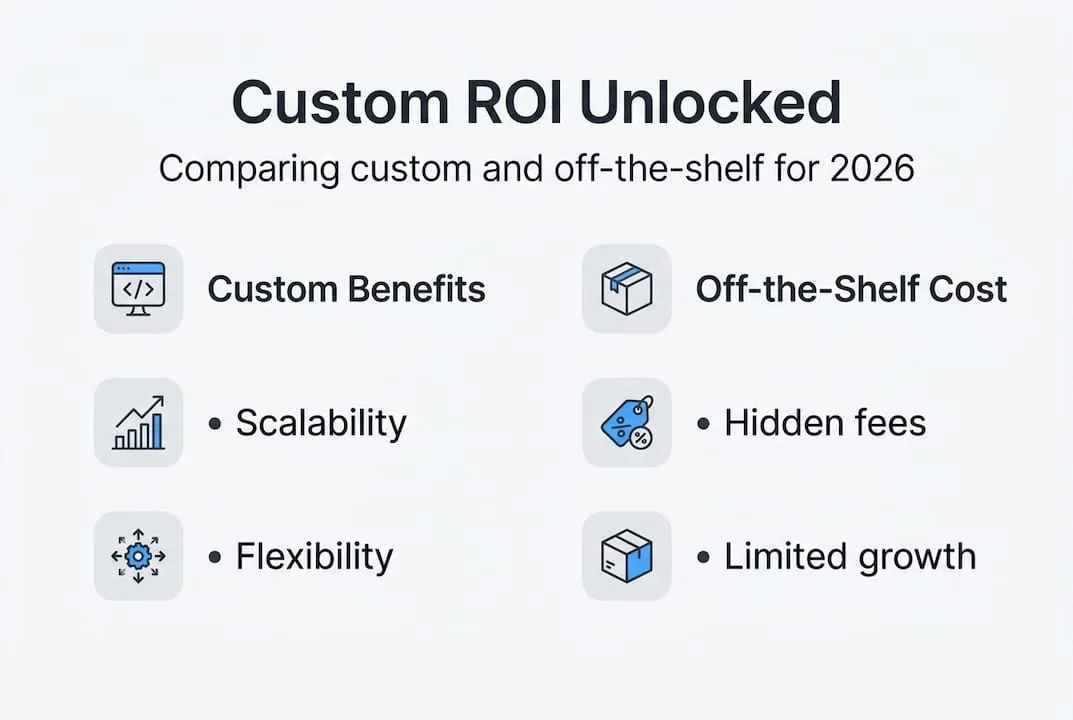
| Metric | Custom development | Off-the-shelf solution |
|---|---|---|
| Upfront cost | Higher | Lower |
| Long-term TCO | Lower after ~14 months | Higher due to licensing |
| Scalability | Fully tailored | Limited by vendor roadmap |
| Vendor lock-in | None | High |
| Edge case handling | Proactive and built-in | Reactive or absent |
| Integration flexibility | Unlimited | Constrained by APIs |
The advantages of custom software extend well beyond cost. Consider these operational benefits:
- Operational efficiency: Workflows are designed around your processes, not the other way around.
- Risk reduction: Edge cases cause 68% of failures in no-code and off-the-shelf platforms; custom solutions address these proactively.
- Adaptability: Your platform evolves with your business strategy, not your vendor’s product timeline.
- Competitive advantage: Proprietary functionality cannot be replicated by competitors using the same packaged tool.
Pro Tip: When calculating ROI for a custom project, always quantify intangible benefits such as risk mitigation, reduced employee frustration, and avoided compliance penalties. These often account for 30-40% of total value delivered.
Handling edge cases and quality assurance in custom development
Edge cases are the scenarios that fall outside normal operating parameters: an unusual data input, an unexpected user action, or a system interaction that the original developers never anticipated. They are not exotic problems. They are the leading cause of production failures, and addressing business needs at this level of detail is what separates robust custom platforms from fragile generic ones.
Effective QA in custom development follows a structured approach:
- Define boundary conditions using Boundary Value Analysis (BVA), which tests the limits of acceptable inputs rather than just the middle range.
- Apply Equivalence Partitioning to group inputs into valid and invalid classes, reducing redundant test cases while maximising coverage.
- Implement defensive programming with null checks, input validation, and graceful error handling throughout the codebase.
- Achieve 70-80% automated unit test coverage to catch regressions before they reach production.
- Run fuzz testing to expose vulnerabilities by feeding random or malformed data into your system.
- Plan fail-over scenarios so that when edge cases do occur, the system degrades gracefully rather than crashing entirely.
Best practices for edge cases confirm that AI-powered QA tools now accelerate development by 30-40% in mature codebases, compressing timelines without sacrificing reliability. This is a significant shift in how solving business problems through software is approached in 2026.
Statistic: AI-assisted QA accelerates development by 30-40% in mature codebases, making advanced testing strategies more accessible and cost-effective than ever before.
The Gartner Software Engineering Score provides a maturity benchmarking framework that helps organisations identify gaps in their QA practices. Teams that score lower on engineering maturity consistently experience higher rates of edge-case failures and unplanned downtime. Addressing these gaps early, ideally during the discovery phase, prevents costly remediation later.
Key defensive strategies your development team should embed from day one:
- Prioritise high-impact edge cases based on business risk, not just technical frequency.
- Automate regression testing so that new features do not break existing functionality.
- Document known edge cases in a shared repository accessible to both developers and QA engineers.
- Budget for estimation pitfalls by adding contingency time for edge-case resolution.
Pro Tip: Embed QA from the discovery phase, not after development begins. Teams that integrate quality thinking from the first stakeholder workshop reduce post-launch defects by a measurable margin and avoid costly rework cycles.

Planning, discovery, and ongoing maintenance for custom development
Strategic planning is where custom development projects either gain momentum or lose it. The discovery phase is not a formality. It is the most valuable investment you can make before a single line of code is written. Saving time with custom software starts with getting this phase right.
A structured discovery process follows these steps:
- Stakeholder alignment: Map all business units affected by the new system and document their core requirements and pain points.
- Process analysis: Audit existing workflows to identify inefficiencies the new platform must resolve.
- Technical feasibility assessment: Evaluate infrastructure constraints, integration requirements, and data migration complexity using software feasibility best practices.
- Scope definition: Establish clear boundaries for the initial build, separating must-have features from future-phase enhancements using estimating project scope methodologies.
- Risk register creation: Document known risks, including edge-case scenarios, third-party dependencies, and regulatory requirements.
Once deployed, your custom platform requires ongoing investment to remain robust. The Gartner Score for Software Engineering benchmarks confirm that high-maturity engineering teams consistently allocate 15-20% of the original build cost annually for maintenance and improvement.
| Maintenance activity | Recommended annual budget allocation |
|---|---|
| Bug fixes and security patches | 5-7% of build cost |
| Performance optimisation | 3-5% of build cost |
| Feature enhancements | 4-6% of build cost |
| Infrastructure and scaling | 2-4% of build cost |
| QA and regression testing | 1-3% of build cost |
For custom software solutions in South Africa, this maintenance discipline is particularly important given the pace of regulatory change and evolving digital infrastructure. Best practices for edge cases also recommend scheduling quarterly edge-case audits as part of your maintenance cycle.
Pro Tip: Treat your annual maintenance budget as a strategic investment, not an operational expense. Platforms that receive consistent care outperform neglected systems on uptime, security posture, and user satisfaction metrics.
Driving efficiency and digital transformation through custom development
Custom development is not simply about building a better website or application. It is the foundational layer of a genuine digital transformation strategy. When your platform is designed around your operational model, every workflow improvement compounds over time, creating measurable gains in productivity, customer experience, and revenue.
Statistic: AI accelerates development by 30-40% in mature codebases, enabling teams to deliver more functionality in less time while maintaining quality standards.
Leveraging AI for digital solutions within your custom platform unlocks efficiencies that generic tools simply cannot replicate. Consider what becomes possible when your software is built for your specific context:
- Automated decision-making: Custom logic engines process business rules faster and more accurately than manual workflows.
- Real-time data integration: Proprietary dashboards pull from multiple data sources simultaneously, giving leadership accurate operational visibility.
- Scalable architecture: Systems designed with microservices or cloud-native frameworks scale on demand without expensive re-platforming.
- Reduced manual intervention: Bespoke automation eliminates repetitive tasks, freeing your team for higher-value work.
- Faster compliance adaptation: When regulations change, your development team modifies your system directly rather than waiting for a vendor update.
For accurate project estimation in transformation initiatives, organisations must account for both the build phase and the ongoing optimisation cycles that generate compounding returns. Real-world digital transformation scenarios consistently show that businesses with custom platforms respond to market changes 40-60% faster than those constrained by packaged software limitations.
Pro Tip: Leverage AI-assisted development frameworks early in your project lifecycle. Even a 20% reduction in development time on a large-scale custom build translates directly into cost savings and faster time-to-value for your business.
The uncomfortable truth about custom development ROI
Industry benchmarks and headline ROI figures are useful starting points, but they mask a critical reality: most custom development projects that underperform do so not because of poor code quality, but because of unresolved edge cases and inadequate QA investment. The 3.7x ROI at 18 months figure assumes a project that was built and maintained correctly. It does not reflect the average project. It reflects the well-managed one.
Business leaders who focus exclusively on license cost avoidance or headline efficiency savings are measuring the wrong things. True ROI in custom development builds on advanced QA practices, continuous improvement cycles, and a disciplined approach to edge-case resolution. These are not optional enhancements. They are the mechanisms through which value is actually delivered and protected.
The top custom software benefits are only realised when your organisation commits to the full discipline of custom development, from discovery through to ongoing maintenance. Anything less produces a system that looks custom but performs like a generic one. The difference between a 3.7x return and a failed project often comes down to whether your team treated QA as a strategic function or an afterthought.
Connect with trusted custom development experts
If the insights in this article have clarified the strategic case for custom development, the next step is connecting with a team that can translate that clarity into a working solution. Cloudfusion delivers custom web development and mobile app development solutions designed around your specific business requirements, operational workflows, and growth objectives. Our approach integrates discovery, QA, and ongoing maintenance from the outset, ensuring your platform delivers measurable ROI rather than theoretical projections. Request a web development quotation today and take the first step toward a custom platform built for long-term performance.
Frequently asked questions
How long does a typical custom development project take?
Most projects require 3-6 months from discovery to deployment, depending on complexity and scope. The Gartner Software Engineering Score benchmarks indicate that teams with higher engineering maturity consistently deliver within this range.
What hidden costs should I plan for with custom development?
Beyond the initial build, budget for annual maintenance at 15-20% of build cost, covering security patches, performance optimisation, and feature enhancements. Long-term TCO falls below off-the-shelf alternatives after approximately 14 months.
How does custom development prevent business downtime?
By proactively handling edge cases and embedding QA from the discovery phase, custom solutions reduce production failures significantly. Proactive edge-case handling prevents up to 68% of the failures common in no-code and generic platforms.
Can AI frameworks accelerate custom development?
Yes. AI accelerates development by 30-40% in mature codebases, reducing manual effort, compressing timelines, and improving overall project ROI without compromising quality standards.