

UX design strategies to boost your website's business value
Discover effective UX design website strategies to enhance user experience, boost conversions, and maximize your business value today!
Start reading
TL;DR:
- Designing for edge cases improves user retention, conversions, and brand credibility.
- Incorporating structured discovery techniques Identifies critical vulnerabilities and real-world user scenarios.
- AI supports routine tasks but human judgment remains essential for complex, ethical UX decisions.
Most business websites are built around an illusion: the idea that users follow a clean, predictable path from landing page to conversion. The reality is far more disruptive. Users arrive with incomplete information, encounter errors, lose connectivity mid-session, and navigate your site in ways your team never anticipated. Designing for edge cases is now the standard for modern UX, and businesses that continue to optimise only for the ideal journey are quietly haemorrhaging retention, conversions, and brand credibility. This guide delivers the advanced principles and frameworks your organisation needs to build a website that performs when it matters most.
Table of Contents
- Why traditional UX ‘happy path’ thinking falls short
- Uncovering critical edge cases for enterprise websites
- How AI and automation reshape the future of UX design
- Building an advanced UX design strategy for business growth
- Why designing for real-world users is the only way to win
- Elevate your website with expert UX solutions
- Frequently asked questions
Key Takeaways
| Point | Details |
|---|---|
| Edge cases drive user experience | Designing for disruptions and exceptions rather than just the standard journey results in better business outcomes. |
| AI complements, not replaces, human UX | Automation handles routine tasks but human judgment is vital for complex user needs and ethical design decisions. |
| Advanced UX is a business asset | A strategic approach to UX directly increases user retention and conversion rates. |
| Continuous testing ensures success | Regularly evaluating your UX with real users and real-life situations future-proofs your digital investment. |
Why traditional UX ‘happy path’ thinking falls short
The term “happy path” refers to the ideal user journey, the scenario where everything goes right. A user lands on your site, finds exactly what they need, completes the desired action without friction, and exits satisfied. It is a clean narrative that makes for compelling UX presentations, but it does not reflect how people actually use digital products.
“Most design still assumes a perfect user in a perfect context, but edge cases are the main journey, not the exception. Interruptions, errors, and non-standard flows make up the majority of real-world interactions.”
Consider how often your users are multitasking, navigating your site on a slow mobile connection, switching between devices mid-session, or recovering from a browser crash. These situations are not rare outliers. They are the norm. When your UX design only accounts for the happy path, you are essentially designing for a minority of your actual visitors.
The business cost of this oversight is significant. Users who encounter a confusing error page, an empty search result with no guidance, or a form that loses their data upon validation failure do not simply try again. They leave. They form negative brand associations. In competitive markets, one friction point at the wrong moment can redirect an enterprise procurement decision or a significant consumer purchase elsewhere. Reviewing UX design principles confirms that resilience in design directly correlates with measurable business outcomes.
Common edge case scenarios that businesses routinely overlook include:
- Empty states: What does a user see when a dashboard has no data yet, or a search returns zero results? Leaving this blank is a missed engagement opportunity.
- Error recovery: When a form submission fails, does your site explain why and preserve the user’s input? Or does it wipe the fields and leave the user stranded?
- Session interruptions: If a user is timed out mid-checkout or mid-application, is there a clear path to resume?
- Accessibility failures: Screen readers, keyboard-only navigation, and high-contrast mode users encounter broken experiences on sites designed without inclusive UX principles.
- Slow or offline connectivity: Progressive loading and offline-first design are not optional for global or mobile-heavy audiences.
Executives who view UX as a line item rather than a strategic investment miss a critical point. Robust UX, built on user experience best practices, functions as infrastructure. It reduces support costs, increases conversion rates, and builds brand equity. The return on investment from designing for real-world scenarios consistently outperforms surface-level visual redesigns.
Uncovering critical edge cases for enterprise websites
Understanding why traditional methods fall short is valuable, but the more pressing question is: what specific issues must you address for your site to genuinely thrive? The answer lies in a structured approach to edge case discovery and remediation.

Research on designing for edge cases identifies incomplete data, errors, empty states, shared accounts, slow connections, and accessibility needs as frequently occurring scenarios that are often the primary user journeys rather than rare disruptions. This reframes the entire design mandate. You are not adding edge case coverage as an afterthought. You are building your core UX around resilience from the start, incorporating graceful degradation, clear error messaging, and intuitive recovery paths.
| Design consideration | Happy path approach | Edge case requirement |
|---|---|---|
| Form submission | Assumes valid input | Clear inline validation, error preservation, retry guidance |
| Search results | Assumes relevant results found | Empty state with suggestions, spelling correction |
| Page load | Assumes fast connection | Skeleton screens, progressive loading, offline fallback |
| Account access | Assumes single user, single device | Shared account logic, multi-device session management |
| Data display | Assumes full, clean data | Handles partial data, null values, formatting errors |
| Accessibility | Assumes standard vision and input | Screen reader support, keyboard navigation, contrast compliance |
To uncover the edge cases most relevant to your enterprise website, follow this structured audit process:
- Map all user entry points. Go beyond your homepage. Identify every page users can land on from search, email, social, or direct links, and evaluate each independently.
- Analyse support tickets and live chat logs. The questions users ask your team represent design failures. These are documented edge cases waiting to be resolved.
- Run session recordings and heatmap analysis. Tools like session replay software reveal where users hesitate, rage-click, or abandon flows entirely.
- Conduct accessibility audits using automated tools and manual testing. WCAG 2.1 compliance is a legal and commercial imperative, not a best-effort consideration.
- Test on real devices in degraded network conditions. Many enterprise sites are tested on fast office Wi-Fi, which is not representative of your full user base.
- Interview or survey users who did not convert. Their reasons for leaving contain actionable UX intelligence that internal teams rarely capture.
Investing in custom web design UX that incorporates these discovery methods produces significantly better outcomes than iterating on aesthetics alone. For growing businesses, UX strategies for SMEs and enterprise teams alike, web usability audits grounded in real usage data are the most reliable path to measurable improvement.
Pro Tip: Involve your customer support and sales teams directly in edge case discovery workshops. They interact with frustrated users daily and hold a detailed map of where your current UX breaks down. This intelligence is far more specific than analytics data alone can provide.
How AI and automation reshape the future of UX design
Once you know how to identify and address edge cases, the next strategic consideration is technological. Artificial intelligence is transforming UX design workflows at a significant pace, and business leaders must understand precisely where automation adds value and where human expertise remains irreplaceable.
AI accelerates routine UX tasks, but human judgment, ethical reasoning, and the ability to navigate complex edge cases remain outside the current capabilities of automated systems. Rather than reducing the need for skilled designers, AI is shifting what designers focus on, creating new roles oriented around oversight, strategy, and nuanced problem-solving.
| UX task | AI capability | Human expertise required |
|---|---|---|
| A/B testing and iteration | High: automated testing at scale | Interpreting results and setting strategic direction |
| Accessibility compliance checks | Medium: automated WCAG scanning | Manual testing with real assistive technology users |
| Personalisation logic | High: behavioural pattern recognition | Ethical boundaries, privacy compliance, brand alignment |
| Error message writing | Low: generic suggestions | Contextual tone, legal accuracy, empathy |
| User research synthesis | Medium: pattern identification in data | Nuanced interpretation of qualitative findings |
| Edge case identification | Low: limited to known patterns | Creative anticipation of novel scenarios |
The risks of over-automating UX design in sensitive or complex workflows are real and underappreciated by many organisations. Consider the following:
- Automated personalisation can exclude. Recommendation algorithms that optimise for the majority user behaviour often produce experiences that alienate edge case users, including accessibility-dependent users or those with non-standard interaction patterns.
- AI-generated content lacks contextual empathy. Error messages, onboarding copy, and support flows require human authorship to maintain trust, particularly in financial, legal, or healthcare contexts.
- Automation scales both good and bad design decisions. If the underlying UX logic is flawed, AI-driven automation will replicate and amplify those flaws across every user touchpoint.
Leveraging AI in website development effectively requires a clear-eyed view of what automation can and cannot do. For deeper perspectives on the evolving intersection of design and technology, UI/UX insights offer a valuable ongoing resource.
Pro Tip: The most competitive organisations are blending AI-driven efficiency with human design oversight in a structured review cadence. Establish a monthly process where your UX team evaluates AI-generated design changes against qualitative user feedback, specifically targeting edge case performance rather than average-user metrics.
Building an advanced UX design strategy for business growth
With a clear understanding of edge cases and the role of AI, the next imperative is translating these insights into a structured, repeatable strategy that drives measurable business outcomes. UX design must operate as a strategic business function, not a project-based deliverable.
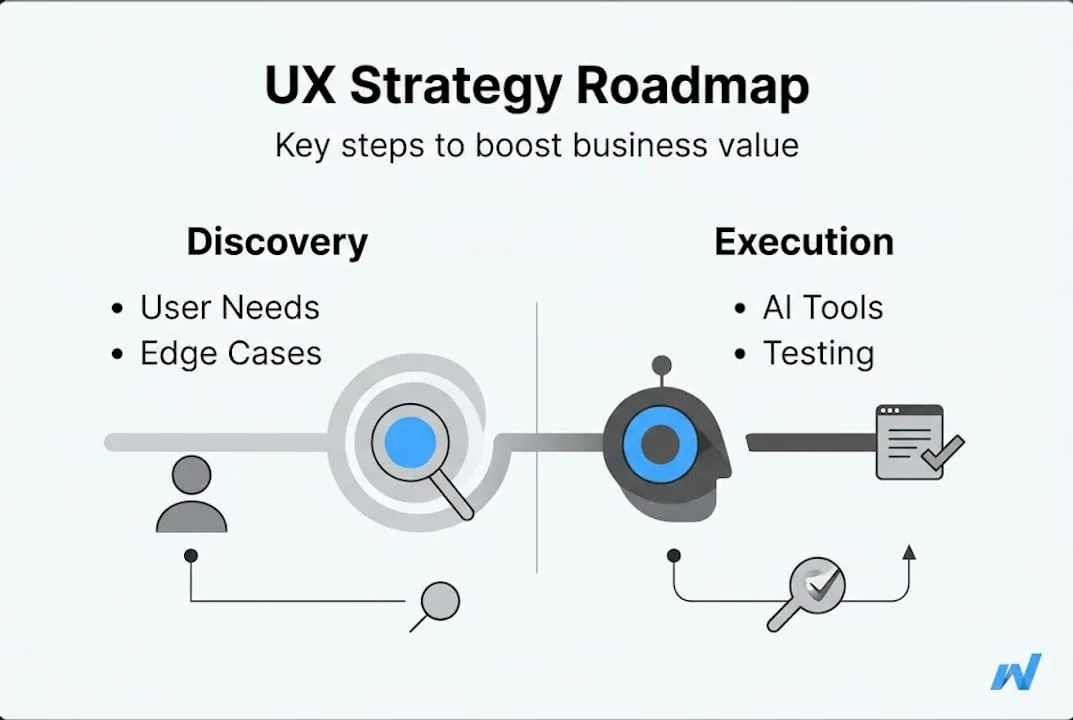
Research consistently confirms that edge cases such as incomplete data, errors, empty states, shared accounts, slow connections, and accessibility needs represent the primary user journeys for a significant proportion of your audience. Designing for these scenarios first, rather than retrofitting them after launch, produces faster time-to-value and lower remediation costs.
Follow this roadmap to implement UX as a strategic business priority:
- Establish UX governance. Appoint a senior stakeholder with direct responsibility for UX outcomes and tie their performance metrics to user retention, task completion rates, and conversion improvement.
- Define your UX baseline. Before investing in new design work, measure your current state: bounce rates by entry point, form abandonment rates, error frequency, and accessibility compliance scores.
- Prioritise edge case coverage in your design brief. Every new feature or page redesign must specify edge case requirements alongside the primary happy path, including empty states, error states, loading states, and exception handling.
- Implement continuous user testing. Move beyond one-time usability studies. Establish an ongoing testing programme that includes users across varied devices, connection speeds, and accessibility needs.
- Align UX investment with business KPIs. Quantify the impact of UX improvements in revenue terms. A 15% reduction in checkout abandonment or a 20% improvement in form completion rates translates directly to business value that justifies sustained investment.
- Review and iterate on a quarterly basis. Technology, user behaviour, and competitive benchmarks evolve continuously. Your UX strategy must adapt at the same pace.
Future-proofing your UX strategy requires attention to the following critical dimensions:
- Inclusive design as a default: Build accessibility into every design decision from the outset, not as a compliance exercise but as a commercial advantage that expands your addressable audience.
- Performance-first architecture: Page speed and loading resilience directly influence both UX quality and search engine rankings, making them dual business priorities.
- Omnichannel consistency: Users increasingly move between desktop, mobile, and tablet within a single journey. Your UX must deliver coherent, stateful experiences across all touchpoints.
- Data-informed empathy: Use quantitative analytics to identify friction and qualitative research to understand its cause, combining both to design solutions that resonate with real users.
For organisations ready to formalise their approach, resources on UX for online business and specific guidance on user-friendly website elements offer practical frameworks. Achieving effective website UX at scale requires sustained executive commitment, not just design team initiative.
Pro Tip: Continually test your UX with actual customers in edge situations, not just with internal stakeholders or professional testers. Real users on real devices in real conditions will surface issues that controlled testing environments consistently miss, and those discoveries represent your highest-value optimisation opportunities.
Why designing for real-world users is the only way to win
Here is an uncomfortable truth that many digital transformation programmes avoid confronting: the most sophisticated technology stack and the most polished visual design will consistently underperform if your UX strategy is built around a fictional user. The perfect user who arrives with complete information, a stable connection, and a clear goal represents a fraction of your actual audience.
The businesses winning in digital right now are those that have operationalised a simple but powerful mindset: edge cases are the main journey, and designing for them is not optional. It is the competitive differentiator. Errors, interruptions, accessibility requirements, and non-standard flows are not design problems to be minimised. They are design opportunities to be captured.
Executive buy-in is the critical variable. When leadership frames UX investment purely as a cost of website maintenance rather than a driver of business performance, design teams are constrained to surface-level improvements. The organisations that treat authentic user journeys as central to their digital strategy, and commit resources accordingly, are the ones achieving measurable gains in retention, conversion, and long-term brand value. If your current digital roadmap does not explicitly address edge case design, it is already behind. Revisiting mastering modern UX as a strategic framework is a logical and immediate next step.
Elevate your website with expert UX solutions
The principles outlined in this article require more than good intentions. They require expert execution, technical depth, and a partner who understands how to align UX strategy with tangible business results. At CloudFusion, we design and build custom web development solutions that prioritise real-world user journeys, not idealised ones. Our work spans edge case architecture, accessibility compliance, performance optimisation, and branding solutions that reinforce trust at every touchpoint. If your organisation is ready to build a website that performs under real conditions and drives measurable commercial outcomes, request a web design quotation and let our team show you what advanced UX design looks like in practice.
Frequently asked questions
What are UX edge cases and why do they matter?
UX edge cases are unexpected situations such as errors, empty states, and shared accounts that occur far more frequently than assumed, and designing for them first with graceful degradation and clear recovery paths greatly improves user satisfaction and business ROI.
Can AI fully replace human UX designers?
No. While AI accelerates routine tasks, human designers are still essential for ethical judgment, empathy-driven copy, and handling novel or complex user scenarios that fall outside established patterns.
How does better UX design help business growth?
Robust UX reduces friction across user journeys, improves retention rates, and directly increases conversions, making it one of the highest-return digital investments an organisation can make.
What is the ‘happy path’ in UX design?
The happy path is the idealised user journey where everything proceeds without errors or interruptions, but as research confirms, most real-world users encounter exceptions that must be explicitly designed for to avoid abandonment.
How can I start improving my company’s web UX?
Begin by auditing your site for the most common edge case scenarios, including error states, empty results, and accessibility gaps, and ensure your design addresses failures as deliberately as it handles the ideal user flow.