

UX web design strategies that boost results for SMEs
Discover proven UX web design strategies that help SMEs increase revenue, reduce bounce rates, and improve user satisfaction without enterprise-level budgets.
Start reading
TL;DR:
- Investing in UX design can boost SME revenue by up to 32% according to studies.
- Core UX principles include usability, accessibility, and user satisfaction to grow engagement and loyalty.
- Regular UX audits and metrics tracking help SMEs continuously improve site performance and user experience.
Most small and medium-sized enterprises assume that sophisticated UX web design is a luxury reserved for large corporations with deep pockets. That assumption is costing them revenue. A McKinsey study found that top-performing companies investing in UX see up to 32% revenue growth compared to competitors who neglect it. For SMEs operating in competitive markets, this is not a marginal gain — it is a transformational opportunity. The good news is that effective UX web design does not require enterprise-level budgets. It requires strategic clarity, disciplined execution, and a genuine understanding of your users’ needs and expectations.
Table of Contents
- What is UX web design and why does it matter for SMEs?
- Foundational UX design principles for business websites
- Common SME UX mistakes and how to fix them
- How to measure UX success: Metrics and continuous improvement
- What most SME leaders get wrong about UX web design
- Get expert support for your UX web design transformation
- Frequently asked questions
Key Takeaways
| Point | Details |
|---|---|
| UX drives revenue growth | Effective UX web design can increase SME revenue by as much as 32%. |
| Focus on key principles | Prioritize grids, clear typography, accessibility, and fast load times for impactful design. |
| Start with quick wins | Small fixes like shipping transparency and site speed can deliver rapid improvements. |
| Measure user experience | Use frameworks like HEART to monitor and enhance UX over time. |
| Expert help accelerates success | Professional UX support turns strategy into results, streamlining the process for SMEs. |
What is UX web design and why does it matter for SMEs?
UX web design, or user experience web design, is the practice of building websites that are intuitive, accessible, and satisfying to use. It goes well beyond aesthetics. At its core, UX web design encompasses three interconnected pillars: usability (how easily visitors can complete tasks), accessibility (how effectively the site serves users of all abilities), and user satisfaction (how positively visitors feel about their interaction with your brand online).
For SMEs, understanding these pillars is not merely academic. UX web design leads to measurable business growth through better user engagement and retention, which translates directly into more leads, more sales, and stronger brand loyalty. Reviewing web design essentials can help you identify where your current site may be falling short.
“Good UX is not about making things look pretty. It is about removing friction so that users can achieve their goals effortlessly — and that directly impacts your bottom line.”
Many SME owners mistakenly believe that a visually appealing website is sufficient. In reality, a site can look polished and still frustrate users with confusing navigation, slow load times, or inaccessible content. Exploring UX fundamentals for 2026 reveals how rapidly user expectations are evolving and why keeping pace matters.
Here are the most common UX pitfalls SMEs encounter:
- Unclear or missing calls-to-action (CTAs): Visitors do not know what step to take next.
- Slow page load times: Every additional second of load time increases bounce rates significantly.
- Poor mobile responsiveness: A site that works on desktop but breaks on mobile alienates the majority of users.
- Information overload: Cluttered pages overwhelm visitors and reduce conversion rates.
- Inaccessible design: Failing to meet basic accessibility standards excludes a significant portion of potential customers.
- Hidden contact information: Users who cannot quickly find how to reach you will simply leave.
The strategic implication is clear. Investing in UX web design is not a discretionary expense for SMEs — it is a foundational business decision that directly influences revenue, customer retention, and competitive positioning.
Foundational UX design principles for business websites
With a solid understanding of what UX web design is and why it matters, the next step is identifying the core principles your business website must embody. Grids, limited type scales, WCAG accessibility, and fast load times are core mechanics for intuitive interfaces that keep users engaged and reduce frustration.
A responsive grid system, typically spanning 3 to 12 columns depending on screen size, provides the structural backbone of any well-designed site. It ensures content reflows correctly across devices, from desktop monitors to mobile screens. Paired with a simple typographic scale (limiting your site to two or three font sizes and weights), a grid creates visual hierarchy that guides users naturally through your content.
Colour contrast is another non-negotiable element. The Web Content Accessibility Guidelines (WCAG) require a minimum contrast ratio of 4.5:1 for normal text, ensuring readability for users with visual impairments. Compliance is not just ethical — it broadens your potential audience and reduces legal risk.
Animations and micro-interactions, when used subtly, can improve engagement by providing visual feedback that confirms user actions. Overusing them, however, creates distraction and slows perceived performance. The rule is simple: if an animation does not serve a functional purpose, remove it.
Load time is perhaps the most critical technical benchmark. Aim for a site that loads in under three seconds. Research consistently shows that users abandon sites that take longer, regardless of how compelling the content might be. You can explore user-friendly features and effective design methods to identify practical optimisations for your current setup.

| Principle | Recommended approach | SME benefit |
|---|---|---|
| Responsive grid | 3 to 12 column layout | Consistent experience across all devices |
| Typographic scale | 2 to 3 font sizes and weights | Improved readability and visual hierarchy |
| Colour contrast | WCAG minimum 4.5:1 ratio | Broader audience reach and accessibility compliance |
| Animation use | Subtle, functional only | Better engagement without performance cost |
| Load time | Under 3 seconds | Reduced bounce rates and higher conversions |
Tracking your UX performance against the HEART framework for UX metrics gives you a structured way to evaluate whether these principles are delivering results.
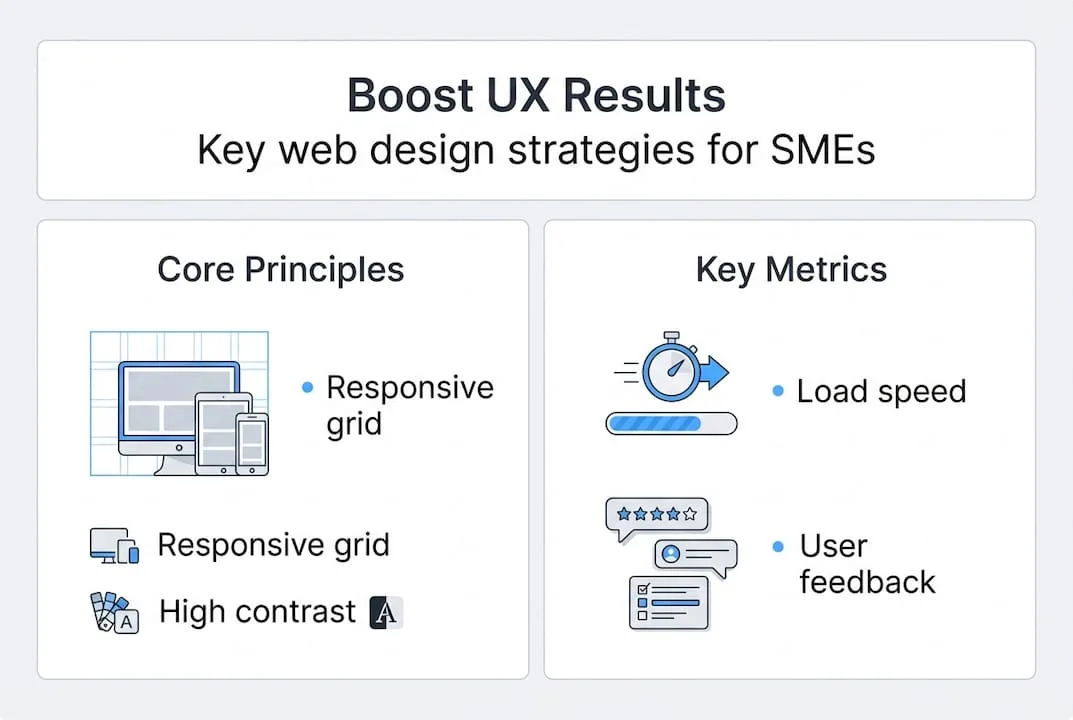
Pro Tip: Always test your grid layout and font choices on at least three different devices, including a mid-range Android phone, before publishing any new page. What looks clean on a high-resolution screen often breaks on older or smaller devices that your customers are likely using.
Common SME UX mistakes and how to fix them
Having reviewed foundational UX principles, it is equally important to understand where most SMEs go wrong in practice. Identifying these missteps early saves time, budget, and customer trust.
Here are the five most impactful UX mistakes SMEs make, along with practical fixes:
- Unclear CTAs: Buttons labelled “Click here” or “Submit” provide no context. Replace them with action-oriented, benefit-driven text like “Get your free quote” or “Start your project today.”
- Slow load times: Large uncompressed images and excessive third-party scripts are the primary culprits. Implement lazy loading, compress images, and audit your scripts regularly. Reviewing speed optimization tips provides a structured starting point.
- Missing accessibility features: No alt text on images, poor keyboard navigation, and low colour contrast exclude users and hurt search rankings. Conduct an accessibility audit using free tools like WAVE or Google Lighthouse.
- Information overload: Presenting every service, product, and piece of content on a single page overwhelms visitors. Prioritise your most important conversion paths and simplify navigation to three to five primary menu items.
- Hidden contact information: If users cannot find your phone number or email within seconds, they will leave. Place contact details prominently in the header and footer, and consider a persistent chat widget for high-traffic pages.
Stat: Shipping transparency can cut exit rates by half. Being upfront about timelines, pricing, and processes on your website builds trust and keeps users engaged longer.
Beyond these five fixes, website performance tips offer deeper technical guidance for SMEs looking to systematically improve site speed and stability.
Pro Tip: A focused UX audit does not need to take weeks. Set aside two hours to walk through your site as a first-time visitor, noting every point of confusion or friction. Most high-impact issues become obvious within the first 30 minutes of honest, structured review.
How to measure UX success: Metrics and continuous improvement
After addressing UX problems, the next challenge is knowing whether your improvements are actually working. Measurement transforms UX from a subjective exercise into a data-driven discipline that supports smarter business decisions.
UX metrics fall into two broad categories. Qualitative metrics capture the why behind user behaviour: session recordings, usability testing, and customer feedback surveys. Quantitative metrics capture the what: bounce rates, conversion rates, task completion rates, and time on page. Both are essential for a complete picture.
For SMEs, the HEART framework offers actionable metrics for monitoring user experience across five dimensions:
- Happiness: User satisfaction scores and net promoter scores (NPS)
- Engagement: Session depth, pages per visit, and interaction frequency
- Adoption: New user registrations, feature uptake, or first-time purchases
- Retention: Returning visitor rates and subscription renewals
- Task success: Completion rates for key actions like form submissions or purchases
For measuring user experience effectively, SMEs do not need expensive enterprise tools. Several accessible platforms provide robust data:
- Google Analytics 4: Free, powerful quantitative data on user behaviour and conversions
- Hotjar: Heatmaps and session recordings that reveal where users click, scroll, and drop off
- Google Lighthouse: Free performance and accessibility auditing built into Chrome
- Typeform or Google Forms: Lightweight tools for gathering qualitative user feedback
| Framework | Primary focus | Best for SMEs when… |
|---|---|---|
| HEART framework | Holistic UX health across 5 dimensions | You want structured, goal-oriented measurement |
| Traditional analytics | Traffic, bounce, and conversion data | You need quick performance benchmarks |
| Usability testing | Direct user behaviour observation | You are redesigning a key page or flow |
Building continuous improvement into your operations means scheduling a monthly UX review, tracking at least two HEART metrics per quarter, and acting on findings rather than archiving them. Reviewing web design metrics trends helps you stay aligned with evolving benchmarks and industry standards.
What most SME leaders get wrong about UX web design
Here is an uncomfortable truth: most SME leaders chase UX trends instead of fixing the basics. They invest in chatbots and personalisation engines while their contact page is buried three clicks deep and their site takes six seconds to load on mobile. The biggest UX returns are almost always hiding in plain sight.
Most SMEs skip UX audits, missing fast wins like increased shipping transparency and clearer navigation. These are not glamorous improvements, but they are the ones that reduce churn and increase conversions at minimal cost.
The real UX priorities for SMEs are not about innovation — they are about removing friction. Clarity beats cleverness every time. A straightforward pricing page outperforms an interactive product configurator if users cannot figure out how to use it. We have seen SMEs transform their conversion rates simply by rewriting their CTAs and making their phone number visible on every page.
Strategic UX investment, even at a modest scale, prevents customer churn and fuels sustainable growth. Explore the real UX priorities that deliver measurable results for businesses at every stage.
Get expert support for your UX web design transformation
Understanding UX web design strategy is one thing — executing it effectively across your entire digital presence is another. At Cloudfusion, we bridge that gap for SMEs by providing end-to-end support, from initial UX audits and strategic planning through to design, development, and post-launch optimisation. Our custom web development solutions are built specifically around your industry, your users, and your business objectives. If you are ready to move from insight to action, request a web design and development quotation and let our team help you build a site that performs as well as it looks.
Frequently asked questions
What is UX web design and how does it help my business?
UX web design is the process of building websites that are easy and enjoyable to use, which leads to higher customer satisfaction, stronger engagement, and increased revenue. UX improvements lead to measurable growth in user engagement and revenue for businesses of all sizes.
Which UX metrics should SMEs track?
SMEs should prioritise metrics covering user task success, engagement depth, and customer satisfaction, ideally structured through the HEART framework. The HEART framework is recommended for actionable, goal-oriented UX measurement that connects directly to business outcomes.
How can I quickly improve my website’s UX on a small budget?
Begin with a structured audit targeting high-impact items: page load speed, navigation clarity, and transparency around your services or pricing. Quick audits and transparency fixes can halve user exit rates without requiring significant budget.
What is the optimal website load time for retaining users?
Your website should load in under three seconds to minimise drop-off and create a strong first impression. Websites should load in under three seconds for best engagement across all device types and connection speeds.
Recommended
- Top mobile-friendly website features to boost SME growth
- Enhancing User Experience Through Effective Website Design
- Embracing User Experience (UX) Design for Online Business Success
- Unique Benefits of Bespoke Web Design for Your Business
- Web Design Tips for Improving Online Presence in a Local Town
- SSR vs SPA: welke aanpak past bij jouw project? | Coding Agency