

Web design explained: definitions, principles, and business value
Learn what web design really means, the core principles that drive results, and how to choose the right approach to grow your business online.
Start reading
TL;DR:
- Web design encompasses user experience, content, branding, and technical usability, not just visuals.
- User-centered, data-backed design increases trust and can generate up to 3.4 times more revenue.
- Choosing the right approach depends on business goals, audience, and scalability needs.
Your website is often the first interaction a potential client has with your business, and that first impression is shaped entirely by design. Not just colour schemes or logos, but the entire experience of navigating, trusting, and engaging with your digital presence. Businesses see 3.4x revenue with professional design compared to those that neglect it. Yet many organisations still treat web design as a cosmetic afterthought rather than a strategic asset. This article will clarify what web design truly means, outline the principles that drive measurable results, compare the major approaches available today, and give you a practical framework for making design decisions that serve your business goals.
Table of Contents
- Defining web design: Beyond visuals
- Core principles: Usability, user experience, and trust
- Modern web design approaches and philosophies
- Choosing the right design for your business goals
- Implementing web design: Steps and pitfalls to avoid
- Why true business web design means more than following trends
- Take the next step: Professional web design solutions
- Frequently asked questions
Key Takeaways
| Point | Details |
|---|---|
| Web design = strategy | Effective web design is a strategic tool driving trust and business growth. |
| User focus wins | Prioritizing user experience leads to more revenue and customer loyalty. |
| Choose proven processes | Data-backed, scalable design approaches outperform chasing short-term trends. |
| Align design with goals | Every design decision should support your business objectives and audience needs. |
| Avoid imitation traps | Resist copying competitors—focus on authentic, user-driven solutions for lasting value. |
Defining web design: Beyond visuals
Most people assume web design is about making a site look attractive. That assumption is understandable, but it misses the larger picture. Web design is the discipline of planning and creating the complete experience a visitor has on your website, covering visual layout, information architecture, content strategy, branding, and technical usability. Each of these components works together to communicate your business’s credibility and guide users toward a desired action.
Think about user-centred web design as the operating philosophy behind every effective site. It places the needs, expectations, and behaviours of your target audience at the centre of every design decision, rather than defaulting to what looks impressive in a portfolio. This shift in thinking is what separates sites that generate leads from sites that generate confusion.
A key concept worth understanding here is prototypicality, which refers to how closely a website matches the conventions users already expect. A site that follows familiar navigation patterns, clear calls to action, and recognisable layout structures builds trust faster because it reduces cognitive effort. Visitors do not have to figure out how your site works; they can focus on what you offer.
Modern web design has also moved away from rigid, pixel-perfect layouts toward intent-driven, scalable design systems that adapt across devices and contexts. This is a significant evolution. Rather than designing a single fixed layout, businesses now invest in design systems that maintain consistency while remaining flexible enough to serve users on mobile, tablet, and desktop equally well.
Here are the core components that define web design in practice:
- User interface (UI): The visual elements users interact with, including buttons, menus, typography, and colour
- User experience (UX): The overall journey a visitor takes through your site, including ease of navigation and task completion
- Content design: How information is structured, written, and presented to support user intent
- Branding: Visual and tonal consistency that reinforces your business identity
- Technical usability: Page speed, accessibility, and cross-device compatibility
“Web design is no longer about how a site looks. It is about how it works, how it feels, and how reliably it delivers value to the people who use it.”
You can explore the foundational elements further through our web design essentials resource library, which covers everything from layout principles to conversion-focused design strategies.
Core principles: Usability, user experience, and trust
With a baseline definition in place, let us look at the principles that make or break an effective business website. Usability sits at the heart of every high-performing site. A site that is difficult to navigate, slow to load, or confusing in its structure will lose visitors regardless of how visually striking it appears.
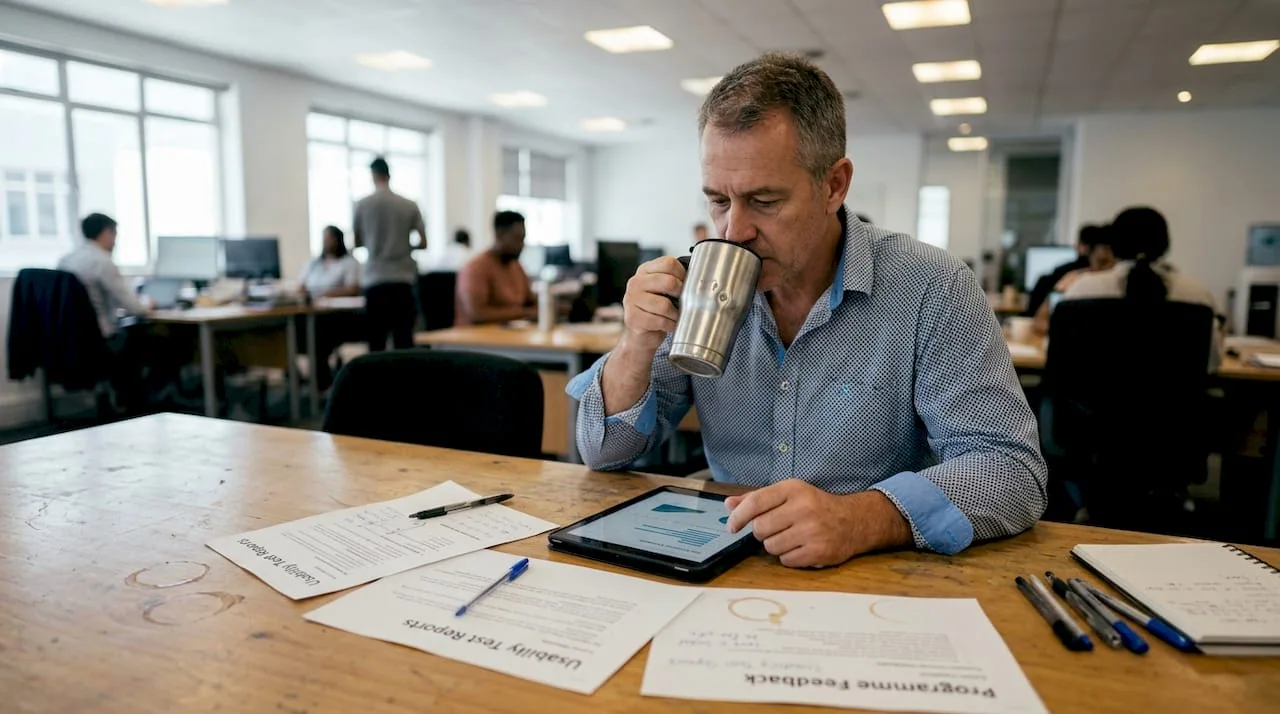
User-centered, data-backed design processes consistently deliver more business value than trend-chasing approaches. This is not a matter of opinion. Businesses that invest in understanding their users through research, testing, and iteration outperform those that design based on aesthetic preference alone. The data is clear, and the competitive implications are significant.
Trust is another principle that deserves direct attention. Research confirms that prototypical layouts create trust and positive attitudes in visitors. When your site behaves the way users expect, they feel confident engaging with it. When it does not, they leave. It is that direct.
Key usability principles every business website should embody:
- Clarity: Every page should have a single, obvious purpose
- Consistency: Navigation, typography, and visual cues should remain uniform throughout
- Accessibility: Design must accommodate users with varying abilities and devices
- Speed: Load times directly affect both user satisfaction and search engine rankings
- Feedback: Users should always know what action they have taken and what happens next
Pro Tip: Run your existing site through Google’s PageSpeed Insights and a basic accessibility checker before investing in a redesign. You may find quick wins that improve web usability without a full overhaul.
Statistic: Professionally designed, user-focused websites generate up to 3.4 times more revenue than those built without a structured design process.
Accessibility is not merely a legal consideration in many jurisdictions. It is a business opportunity. Sites that are accessible to users with disabilities, slow connections, or older devices reach a broader audience and signal that your business is inclusive and professional. When you improve user experience with intention, you remove barriers between your business and its customers. Addressing poor user experience proactively is far less costly than recovering from the reputational damage of a frustrating site.
Modern web design approaches and philosophies
Principles are a foundation, but approaches vary widely. Navigating the major philosophies influencing today’s business websites requires understanding what each approach prioritises and which business contexts it serves best.
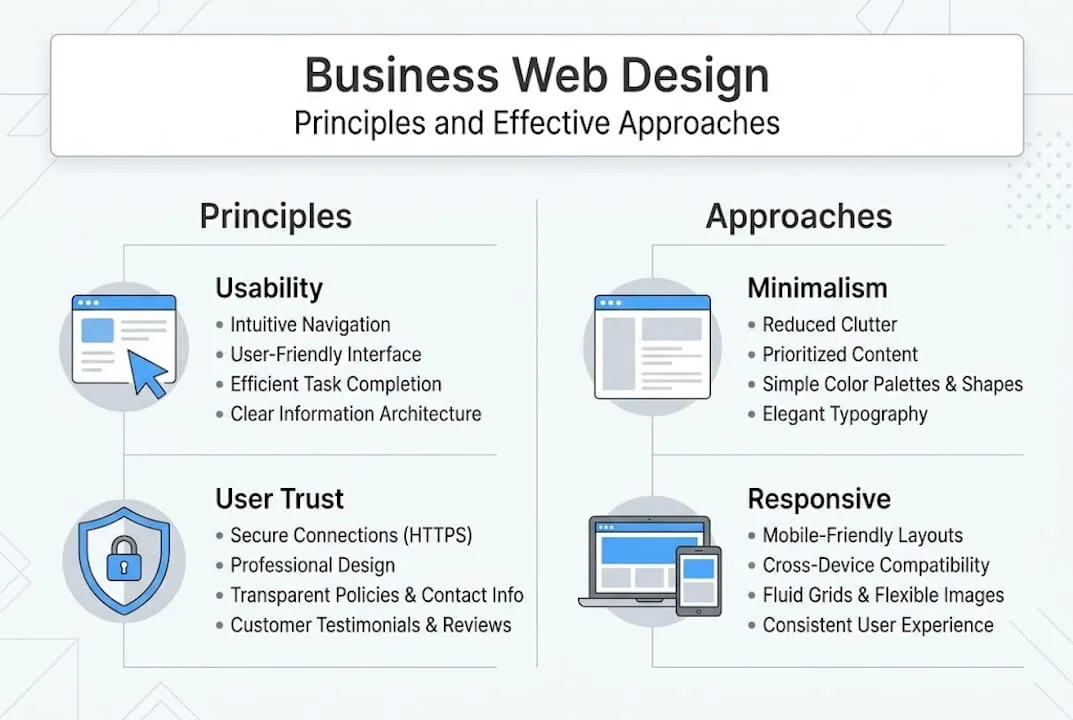
The 2025 web design debate has crystallised around several contrasting philosophies, each with legitimate applications depending on your audience and objectives.
| Approach | Core characteristic | Best suited for |
|---|---|---|
| Minimalism | Clean layouts, fast load times, high clarity | B2B, professional services, SaaS |
| Maximalism/Brutalism | Bold visuals, high contrast, memorable impact | Creative industries, fashion, entertainment |
| Fluid/Responsive | Adapts seamlessly to any screen size | All businesses with mobile audiences |
| Evergreen/Timeless | Classic structures that age well | Long-established brands, legal, finance |
| Trend-driven | Reflects current aesthetic movements | Startups, lifestyle brands, short campaigns |
| AI-assisted | Rapid iteration, data-informed layouts | Businesses scaling content or testing variants |
Minimalism prioritises speed and cognitive clarity. Less visual noise means users reach the information they need faster, which typically improves conversion rates in professional service environments. Maximalism, by contrast, creates memorable brand experiences and works well when emotional impact is the goal, such as in creative agencies or consumer lifestyle brands.
Fluid and responsive design is no longer optional. It is a baseline requirement. Explore custom web design trends to understand how leading businesses are implementing responsive frameworks that serve users across every device without compromise.
The AI-assisted design debate is particularly relevant in 2026. AI tools can accelerate prototyping, generate layout variants, and surface data-driven insights at scale. However, they raise genuine questions about brand authenticity and strategic coherence. AI can produce efficient outputs, but human expertise is still required to ensure those outputs align with your brand values and long-term positioning. Review UI/UX approaches to see how these philosophies translate into practical interface decisions.
Choosing the right design for your business goals
With so many approaches available, selecting what actually drives results for your specific business requires a structured process rather than intuition alone. Here is a practical sequence to follow:
- Define your primary business objective. Is the site designed to generate leads, sell products, build authority, or support existing clients? Every design decision should trace back to this.
- Identify your audience’s expectations and device preferences. A B2B procurement manager behaves very differently online than a retail consumer.
- Audit your existing digital presence. Understand what is working, what is failing, and where users drop off before committing to a direction.
- Select an approach that matches your brand maturity. An established financial services firm and a new consumer app have very different design needs.
- Prioritise scalability. Choose design systems and platforms that can grow with your business rather than requiring a full rebuild in two years.
Pro Tip: Resist the temptation to design for what impresses you personally. Use analytics, heatmaps, and user testing to validate assumptions before committing to a full build.
The table below maps common business types to recommended design priorities:
| Business type | Design priority | Key consideration |
|---|---|---|
| E-commerce | Speed, clarity, trust signals | Checkout friction reduction |
| B2B services | Authority, content depth | Lead capture and qualification |
| Professional services | Credibility, accessibility | Portfolio and testimonial prominence |
| Startups | Differentiation, scalability | Brand story and growth flexibility |
Businesses that invest in professional web design see up to 3.4 times more revenue, which makes the case for treating design as a strategic investment rather than a cost. For deeper context on aligning design with growth, explore web development best practices, the role of AI in website design, and strategies for mastering user experience across your digital presence.
Implementing web design: Steps and pitfalls to avoid
Once you have chosen the right direction, turning your plan into a successful web presence requires disciplined execution. Here is the process we recommend:
- Discovery: Define your business goals, map your customer journeys, and document technical requirements before any design work begins. Skipping this phase is the single most common cause of costly redesigns.
- Wireframing and prototyping: Create low-fidelity layouts that test navigation logic and content hierarchy before investing in visual design. Validate these with real users where possible.
- Visual design and content integration: Apply your brand system to the approved structure, ensuring consistency across all pages and components.
- Development and quality assurance: Build to the approved design, test across browsers and devices, and verify performance benchmarks before launch.
- Launch and iterate: Go live with a monitoring plan in place. Use real user data to identify friction points and improve continuously.
Design systems provide scalable solutions, fostering consistency and efficiency across every page and future update. Rather than treating each new page as a standalone project, a well-structured design system gives your team reusable components that maintain brand coherence at scale.
Common pitfalls to avoid include designing for desktop only, neglecting page speed optimisation, and launching without a content strategy. Another frequent mistake is treating the launch as the finish line. Effective web design is an ongoing process of refinement, not a one-time event. You can learn more about enhancing user experience through iterative design practices that keep your site aligned with evolving user needs.
Pro Tip: Build a post-launch review into your project plan from day one. Schedule a 30-day and 90-day performance review to catch usability issues before they affect your bottom line.
Why true business web design means more than following trends
Here is a perspective that many businesses learn only after an expensive redesign: chasing design trends is a losing strategy. Trends move fast. User needs move slowly. The businesses that build durable digital advantages are those that invest in understanding their customers deeply and designing systems that serve those customers consistently over time.
We have seen organisations spend significant budgets on visually striking sites that fail to convert because the design prioritised aesthetic novelty over functional clarity. The user-centred approach is not a design style. It is a discipline. It requires ongoing research, honest performance measurement, and the willingness to make changes based on data rather than personal preference.
Authentic branding, grounded in a genuine understanding of your audience, creates more durable competitive advantage than any trend cycle can offer. The most effective business websites we have worked on are not the most visually complex. They are the most purposeful.
Take the next step: Professional web design solutions
Applying the principles covered in this article requires more than good intentions. It requires a partner with the technical expertise and strategic experience to translate business objectives into a web presence that performs. At Cloudfusion, we specialise in building custom, scalable websites that are designed around your specific audience, goals, and growth trajectory. Our custom web development portfolio demonstrates the range of solutions we have delivered across industries. If you are ready to invest in a web presence that works as hard as your business does, get a web design quotation and let us build something purposeful together.
Frequently asked questions
What are the main elements of web design?
Web design covers visual layout, content organisation, user experience (UX), branding, and technical usability. Modern practice emphasises intent-driven design systems over rigid, pixel-perfect one-offs to ensure scalability and consistency.
How does web design impact business results?
Well-designed websites build trust and can increase business revenue significantly. Professional design processes deliver up to 3.4 times more revenue compared to sites built without a structured, user-focused approach.
Should my business prioritise minimalism or a bold, trendy website?
The right choice depends on your audience and objectives. Minimalism supports clarity and speed and suits professional service environments, while bold, maximalist designs create stronger emotional impact for creative or consumer-facing brands.
What is the first step to designing a new business website?
Start by clearly defining your business goals, target audience needs, and required functionality before selecting any layouts or visual styles. Discovery before design prevents costly rework later.
Can artificial intelligence help with web design?
Yes, AI tools can accelerate prototyping and surface data-driven layout insights, but AI efficiency vs human authenticity remains a core tension. Human strategy is essential to ensure brand consistency and genuine audience alignment.
Recommended
- Web Design by Cloudfusion
- Web design and development: Unlock your digital potential
- Web Development Basics 2025: Guide for Modern Businesses
- Responsive web design service guide for business 2026
- Web hosting explained: Types, mechanics, and best solutions
- Website Structure and User Trust: What You Need to Know