
What Is Cloud Computing: Powering Scalable Business
Cloud computing explained for IT managers—learn the fundamentals, types, business benefits, key costs, and risks unique to digital transformation.
Start reading
Over 85 percent of American e-commerce businesses now rely on cloud computing for rapid growth and efficient operations. As seasonal spikes and unpredictable demand become the norm, choosing the right solution can mean the difference between seamless customer experiences and costly interruptions. From south-african retailers scaling across continents to local midsize operations, this guide clears up the essentials, highlights major deployment models, and equips IT managers with practical strategies for secure, cost-effective cloud adoption.
Table of Contents
- Cloud Computing Essentials And Core Concepts
- Major Types: Public, Private, And Hybrid Clouds
- How Cloud Services Power Modern E-Commerce
- Security, Compliance, And Regional Considerations
- Cost Factors, Pitfalls, And Common Misconceptions
Key Takeaways
Point | Details |
|---|---|
Understanding Cloud Models | Cloud computing encompasses IaaS, PaaS, and SaaS, enabling businesses to choose necessary services for scalability and flexibility. |
Evaluation of Deployment Models | Selecting between public, private, and hybrid clouds should align with organisational needs for control, cost, and security. |
Importance of Security | Implementing robust security measures is vital for safeguarding data and ensuring regulatory compliance across different jurisdictions. |
Cost Management Strategies | Continuous monitoring and rightsizing of cloud resources are essential to avoid hidden costs and achieve financial efficiency. |
Cloud Computing Essentials And Core Concepts
Cloud computing represents a transformative technological approach where computing services are delivered over the internet, enabling businesses to access scalable and flexible technological resources without substantial upfront infrastructure investments. By leveraging remote servers hosted online, organisations can dynamically manage computational power, storage, and advanced digital services with unprecedented efficiency.
At its core, cloud computing encompasses three primary service models: Infrastructure as a Service (IaaS), Platform as a Service (PaaS), and Software as a Service (SaaS). IaaS provides fundamental computing infrastructure like virtual machines and networks, PaaS offers development platforms for building custom applications, while SaaS delivers complete software applications directly via the internet. These models enable businesses to select precisely the technological capabilities they require, scaling resources up or down according to immediate operational demands.
The infrastructure powering cloud computing relies on critical technological components including virtualisation, which allows multiple virtual systems to operate simultaneously on single physical hardware, and sophisticated networking technologies that ensure secure, rapid data transmission. Deployment models further diversify cloud computing’s applicability: public clouds offer shared resources accessible to everyone, private clouds provide dedicated infrastructure for single organisations, and hybrid clouds combine both approaches, delivering maximum flexibility for complex business requirements.
Pro tip: When evaluating cloud computing solutions, prioritise providers offering transparent scalability options and comprehensive security protocols to protect your organisation’s digital assets.
Major Types: Public, Private, And Hybrid Clouds
Cloud deployment models provide organisations with diverse technological strategies for managing computational resources, each offering unique advantages tailored to specific business requirements. Cloud infrastructure models represent sophisticated approaches to digital resource management, enabling businesses to select the most appropriate technological framework for their operational needs.
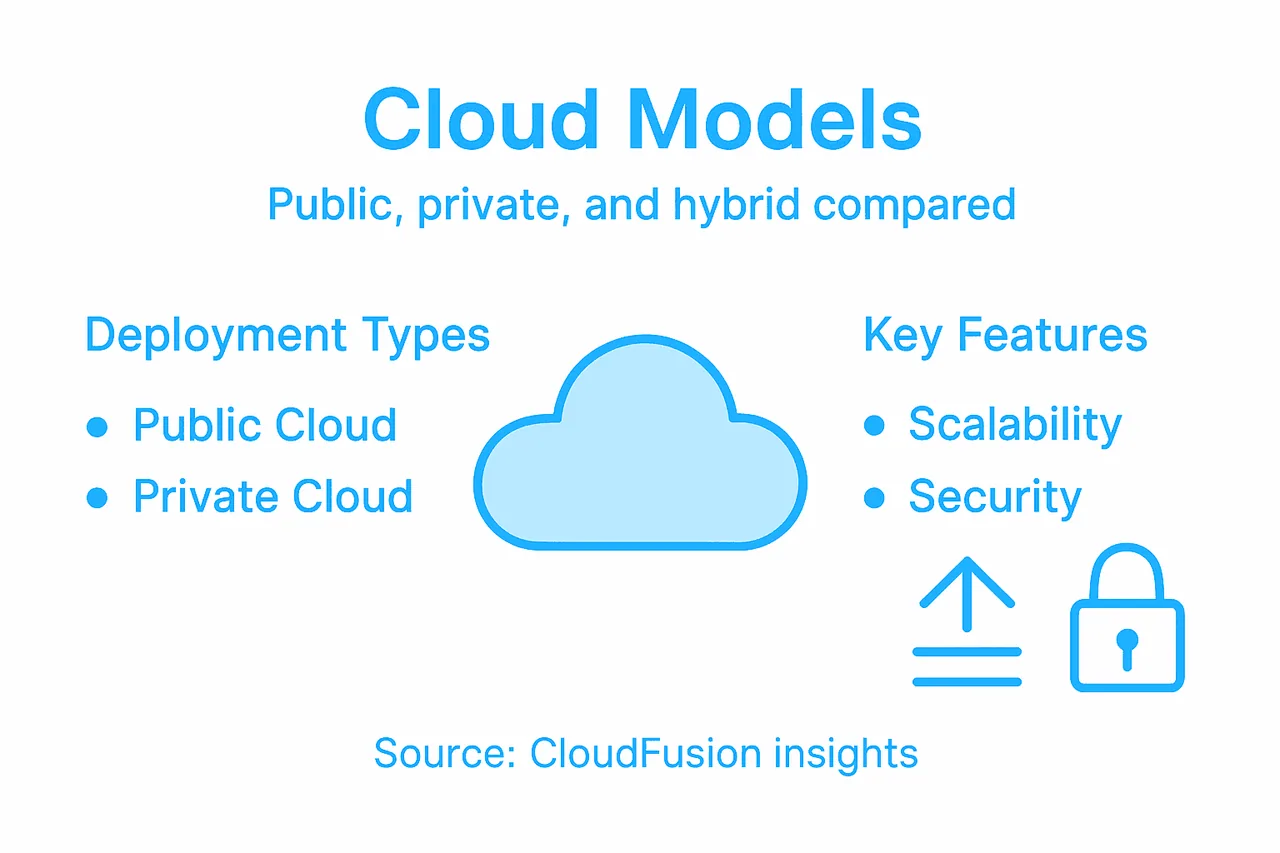
Public clouds represent the most accessible and cost-effective deployment model, where computing resources are owned and operated by third-party service providers and made available to multiple organisations over the internet. These platforms offer remarkable scalability, allowing businesses to rapidly expand or contract their computational capabilities without significant upfront infrastructure investments. Typical characteristics include shared hardware infrastructure, pay-as-you-use pricing models, and minimal maintenance responsibilities for the end-user organisation.
Private clouds, by contrast, provide dedicated infrastructure exclusively for a single organisation, delivering enhanced security, compliance, and precise control over computational resources. These environments are typically hosted either on-premises or through dedicated third-party data centres, offering organisations complete governance of their digital ecosystem. Hybrid cloud models ingeniously combine public and private cloud infrastructures, enabling businesses to distribute workloads strategically across different environments, balancing performance, security, and cost-efficiency.
Pro tip: Conduct a comprehensive assessment of your organisation’s specific computational requirements before selecting a cloud deployment model to ensure optimal alignment between technological infrastructure and business objectives.
Here’s a comparison of major cloud deployment models to help you identify the best fit for your organisation:
Model | Control Level | Scalability | Typical Use Cases |
|---|---|---|---|
Public Cloud | Low (third-party) | Very high | Start-ups, website hosting |
Private Cloud | High (organisation) | Moderate to high | Banking, healthcare, government |
Hybrid Cloud | Mixed (flexible) | Very high | Enterprises with variable needs |
How Cloud Services Power Modern E-Commerce
Cloud computing has fundamentally transformed e-commerce by providing businesses with unprecedented technological flexibility and scalability. Cloud infrastructure enables rapid adaptation to fluctuating market demands, allowing online retailers to efficiently manage computational resources during peak shopping periods and seasonal variations.

E-commerce platforms leverage multiple cloud service models to enhance operational efficiency. Infrastructure as a Service (IaaS) provides flexible server resources, Platform as a Service (PaaS) offers development environments for custom applications, and Software as a Service (SaaS) delivers ready-to-use e-commerce solutions. These models enable businesses to scale computational capabilities dynamically, reducing infrastructure costs while maintaining high performance and reliability. Advanced cloud technologies support critical e-commerce functions like real-time inventory management, secure payment processing, and personalised customer experiences.
Artificial Intelligence integrated with cloud computing represents a transformative approach for modern online businesses. Machine learning algorithms running on scalable cloud infrastructure can analyse customer behaviour, optimise pricing strategies, detect potential fraud, and create personalised shopping recommendations. This technological synergy allows even small e-commerce enterprises to access sophisticated data analytics and intelligent customer engagement tools that were previously available only to large corporations with extensive technological resources.
Pro tip: Regularly audit your cloud service configuration to ensure optimal performance, security, and cost-efficiency for your e-commerce platform.
Security, Compliance, And Regional Considerations
Cloud computing security represents a complex landscape of technological and regulatory challenges that demand sophisticated, nuanced strategies from businesses operating across different geographical regions. Information security frameworks have become increasingly critical in protecting organisational data and maintaining regulatory compliance across diverse technological ecosystems.
Regional compliance requirements significantly impact cloud service implementation, with different jurisdictions maintaining unique data protection standards. In the African context, organisations must navigate complex regulatory environments that balance technological innovation with stringent privacy protections. Key considerations include data localisation requirements, cross-border data transfer regulations, and sector-specific security mandates. Businesses must implement robust encryption protocols, comprehensive access control mechanisms, and continuous security monitoring to ensure alignment with local and international regulatory frameworks.
Cybersecurity strategies for cloud computing extend beyond technical configurations, encompassing organisational governance, risk management, and ongoing compliance assessment. Organisations need to develop holistic approaches that integrate technological safeguards with human-centric security practices. This includes regular security awareness training, implementing multi-factor authentication, conducting periodic vulnerability assessments, and maintaining transparent incident response protocols. The goal is creating a resilient security culture that can adapt to evolving digital threats while maintaining operational efficiency and regulatory compliance.
Pro tip: Develop a comprehensive cloud security strategy that combines technological solutions with regular staff training and proactive compliance monitoring.
Below is a summary of key cloud security strategies and their business impact for African organisations:
Security Strategy | Description | Business Benefit |
|---|---|---|
Data Encryption | Secures information from breaches | Mitigates data theft risk |
Access Control Mechanisms | Limits user rights, enforces policies | Prevents unauthorised access |
Regular Vulnerability Tests | Finds system weaknesses proactively | Reduces exposure to cyber threats |
Staff Awareness Training | Educates employees on security risks | Strengthens organisational defence |
Cost Factors, Pitfalls, And Common Misconceptions
Cloud computing represents a complex financial landscape where organisations must navigate nuanced cost considerations and potential technological challenges. Financial pitfalls in cloud adoption can rapidly erode potential cost savings if businesses fail to implement strategic resource management approaches.
Many organisations mistakenly assume cloud computing offers automatic cost reduction, overlooking critical financial intricacies. Hidden expenses such as data transfer costs, egress fees, storage charges, and resource underutilisation can significantly impact budgetary expectations. Businesses frequently over-provision computational resources, leading to unnecessary expenditure. Smart cloud strategy requires continuous monitoring, rightsizing infrastructure, and implementing dynamic scaling mechanisms that align precisely with actual operational requirements.
Common misconceptions about cloud computing extend beyond financial considerations, encompassing performance, security, and operational effectiveness. Organisations often believe cloud migration guarantees immediate efficiency improvements, yet successful implementation demands comprehensive planning, skills development, and organisational cultural transformation. Technical teams must develop sophisticated understanding of cloud architectures, cost optimization techniques, and performance management strategies to truly leverage cloud computing’s potential. Effective cloud adoption requires a holistic approach that balances technological capabilities, financial constraints, and strategic business objectives.
Pro tip: Implement automated cloud cost monitoring tools and conduct quarterly infrastructure audits to identify and eliminate unnecessary computational expenses.
Unlock Scalable Growth with Custom Cloud Solutions
Understanding the power of cloud computing is one thing but harnessing it effectively to scale your business is another challenge entirely. Many organisations struggle with choosing the right cloud deployment model, managing costs, and ensuring security compliance while trying to boost their online presence. The article highlights key pain points such as selecting between public, private or hybrid clouds and the importance of scalable, secure infrastructure for modern e-commerce success.
At CloudFusion, we specialise in bridging this gap with tailored digital and cloud services designed to grow with your business. Whether you need a bespoke website, a custom mobile application or robust cloud hosting integrated with industry best practices, our solutions combine technological expertise and strategic branding to maximise your investment. Learn how our Web Design and Development services can deliver scalable systems aligned with your unique needs and compliance requirements.
Take control of your digital transformation today by exploring our comprehensive offerings at CloudFusion. Don’t let cloud complexities hold you back. Start with a professional consultation and propel your business into a future of secure, flexible, and cost-effective growth.
Frequently Asked Questions
What are the main service models in cloud computing?
Cloud computing primarily encompasses three service models: Infrastructure as a Service (IaaS), which offers fundamental computing infrastructure; Platform as a Service (PaaS), providing development platforms for custom applications; and Software as a Service (SaaS), which delivers complete software applications via the internet.
How do public, private, and hybrid clouds differ?
Public clouds are shared resources managed by third-party providers, making them cost-effective and highly scalable. Private clouds offer exclusive resources for a single organisation, focusing on enhanced security and control. Hybrid clouds combine elements of both public and private clouds, allowing organisations to balance performance, security, and costs according to their needs.
What impact does cloud computing have on e-commerce?
Cloud computing enhances e-commerce by providing scalable resources for managing peak demands, enabling rapid adaptation to market changes. It supports critical functions like real-time inventory management and secure payment processing, and integrates AI for personalized customer experiences.
What are key security considerations for cloud computing?
Organisations should implement a comprehensive cloud security strategy that includes data encryption, access control mechanisms, regular vulnerability assessments, and staff training. This helps mitigate risks such as data breaches and ensures compliance with regulatory frameworks.