
AI digital marketing strategies to boost SME growth
Unlock growth with AI digital marketing strategies! This guide reveals how SMEs can leverage AI for impactful, cost-effective campaigns.
Start reading
TL;DR:
- AI marketing tools are affordable and accessible to SMEs, improving conversion rates by up to 20%.
- A structured four-stage framework guides SMEs from assessment to ongoing optimization of AI strategies.
- Prioritizing strategy and human oversight is crucial for ethical, effective, and sustainable AI marketing success.
Most SMEs leave measurable revenue on the table simply because they assume AI-powered marketing belongs exclusively to enterprise brands with large budgets and dedicated data science teams. That assumption is demonstrably wrong. AI personalization raises conversion rates by up to 20%, and those gains are just as accessible to a 12-person marketing team as they are to a Fortune 500 organisation. This guide cuts through the noise, demystifies the core technologies, and presents a structured, practical roadmap that marketing managers at small to mid-sized enterprises can act on immediately, without requiring a massive budget or specialist AI department.
Table of Contents
- How AI is transforming digital marketing for SMEs
- The 4-stage framework: From assessment to optimisation
- Personalisation, automation, and hyper-local targeting: High-ROI AI applications
- Navigating ethics, risks, and human creativity with AI
- Why strategy—not technology—drives true AI marketing success
- How Cloudfusion accelerates your AI digital marketing journey
- Frequently asked questions
Key Takeaways
| Point | Details |
|---|---|
| Strategic framework | Using a structured four-stage AI adoption process helps SMEs maximize results and minimize risk. |
| High-ROI applications | Personalization, automation, and hyper-local targeting are the best entry points for measurable marketing gains. |
| Human oversight critical | Blending AI with human strategy and ethics ensures long-term, sustainable success. |
| SMEs can compete | AI enables smaller businesses to target customers more precisely and improve conversion rates by up to 20 percent. |
How AI is transforming digital marketing for SMEs
The misconception that AI transforming digital marketing is exclusively a large-enterprise concern has persisted far too long. In reality, the same technologies that power personalisation engines at global retailers are now available through affordable, modular platforms accessible to SMEs of any size. Understanding which technologies matter most is the first step toward making informed investment decisions.
The core AI technologies reshaping SME marketing are:
- Machine learning (ML): ML algorithms analyse historical customer behaviour patterns to predict future actions, enabling you to present the right offer to the right customer at precisely the right moment. Predictive lead scoring, churn prevention, and product recommendation engines all rely on ML at their core.
- Natural Language Processing (NLP): NLP powers conversational AI chatbots, automated customer service responses, and content generation tools. For a lean marketing team, NLP-driven chatbots can handle first-touch customer inquiries around the clock without adding headcount.
- Big Data analytics: Advanced analytics platforms surface emerging trends, audience segment shifts, and campaign performance anomalies far faster than manual reporting allows. This gives SME marketers the ability to act on real intelligence rather than gut instinct.
- Marketing automation: Repetitive tasks such as email segmentation, A/B test execution, social media scheduling, and ad bid management can all be automated, freeing your team to focus on strategy and creative development.
The compounding effect of combining these technologies is significant. Core AI technologies in digital marketing such as ML-driven personalisation have been shown to raise conversion rates by up to 20%, a figure that translates directly to revenue for SMEs operating on tighter margins.
“AI in digital marketing is not about big budgets. It’s about smart targeting and faster learning. SMEs that embrace this mindset outpace competitors who are still waiting for the perfect moment to start.” — Marketing executive at a mid-sized e-commerce enterprise
The practical implication is clear. You do not need to deploy every AI capability simultaneously. Start by identifying which customer interactions are the most repetitive and which data sources you already hold, then map those to the relevant technology. A focused deployment of even one AI capability, such as a personalised email engine, generates measurable impact quickly and builds the internal confidence needed to scale further.
Exploring the full range of AI marketing strategies available to SMEs today reveals how rapidly this landscape is evolving, and how attainable these tools have become for teams without dedicated AI specialists.
The 4-stage framework: From assessment to optimisation
Understanding the key technologies is valuable, but without a structured adoption path, most SME marketing teams stall at the excitement stage. The AI-driven digital marketing for SMEs framework provides a proven four-stage approach that reduces implementation risk and accelerates time to measurable ROI.
The four stages are:
-
Assessment: Conduct an honest audit of your existing marketing technology stack. Identify which tools you currently use, what data they generate, and whether that data is clean, structured, and accessible. Data quality is the single biggest determinant of AI effectiveness. A CRM full of duplicate records or an email platform with outdated segments will limit any AI tool built on top of it. Evaluate your team’s current skill level and identify specific capability gaps before committing to any platform.
-
Planning: Define clear, measurable business goals that AI will support. Avoid vague objectives like “improve engagement.” Instead, set specific targets such as “increase email click-through rates by 15% within two quarters” or “reduce customer acquisition cost by 10% within six months.” Examining sound digital marketing frameworks at this stage will help you structure goals with strategic precision rather than chasing technology trends.
-
Implementation: Begin with incremental deployment rather than a full platform overhaul. A single AI-driven email personalisation campaign, for example, allows your team to learn the technology, measure results, and build stakeholder confidence before expanding scope. Reference proven growth strategies for digital marketing during this phase to ensure your implementation decisions align with broader business objectives. Many of the marketing tactics for startups that deliver early traction translate effectively to established SMEs.
-
Optimisation: Use AI analytics dashboards to monitor campaign performance continuously. Set review cadences at two-week intervals initially, then monthly once patterns stabilise. The optimisation stage is not a one-time event. It is an ongoing discipline of testing, learning, and refining that compounds returns over time.
Comparison: Traditional vs. AI-assisted marketing workflows
| Workflow element | Traditional approach | AI-assisted approach |
|---|---|---|
| Email segmentation | Manual list filtering | Predictive ML-based segmentation |
| A/B testing | Sequential, slow cycles | Automated multivariate testing |
| Content personalisation | Generic batch messaging | Dynamic, individual-level content |
| Performance reporting | Weekly manual dashboards | Real-time automated analytics |
| Lead scoring | Sales team judgement | ML-driven behavioural scoring |
Pro Tip: Even resource-constrained teams can begin the assessment stage using free tools. Google Analytics 4, your existing CRM’s built-in reporting, and a simple spreadsheet mapping your current touchpoints are entirely sufficient to complete a meaningful initial audit. You do not need to invest in new technology to understand what you already have.
Personalisation, automation, and hyper-local targeting: High-ROI AI applications
With a structured roadmap established, the next question is where to focus first for the fastest, most measurable return. Not all AI applications deliver equal value for SMEs. Prioritising the right use cases in the right sequence is what separates teams that see rapid ROI from those that get stuck in lengthy implementation cycles.
The highest-value AI applications for SME marketing teams include:
- Hyper-local targeting: SMEs competing against larger national or international brands can use AI-powered location data and behavioural signals to reach highly specific local audiences with precision that broad-reach campaigns cannot match. This levels the competitive playing field considerably and allows you to dominate your immediate geographic market before scaling outward.
- Personalisation at scale: Moving beyond first-name email salutations, true AI personalisation adapts content, offers, and timing based on individual browsing history, purchase behaviour, and engagement patterns. Key AI mechanics including hyper-local targeting and personalisation at scale are now accessible through platforms designed specifically for SME budgets.
- AI content generation: Tools powered by large language models can produce first-draft blog posts, social media captions, ad copy variations, and email subject lines at a fraction of the time required for manual creation. The critical caveat is that human editorial review remains essential to maintain brand voice and factual accuracy.
- Conversational AI and chatbots: Deploying a well-configured AI chatbot on your website or social channels captures leads, qualifies prospects, and answers product questions at any hour. The revenue impact of 24/7 availability is particularly significant for SMEs that lack dedicated after-hours support staff.
- Marketing automation: From drip email sequences triggered by specific user behaviours to automated digital marketing automation workflows that move prospects through the funnel, automation reduces manual workload while improving response consistency and speed.
AI application ROI impact for SMEs
| AI application | Typical impact | Implementation complexity |
|---|---|---|
| Email personalisation | Up to 20% conversion rate lift | Low |
| Hyper-local ad targeting | 15-30% improvement in ad spend efficiency | Medium |
| AI chatbots | 30-40% reduction in first-response time | Medium |
| Predictive lead scoring | 25% increase in sales team efficiency | High |
| Automated A/B testing | 2x faster optimisation cycles | Low to medium |
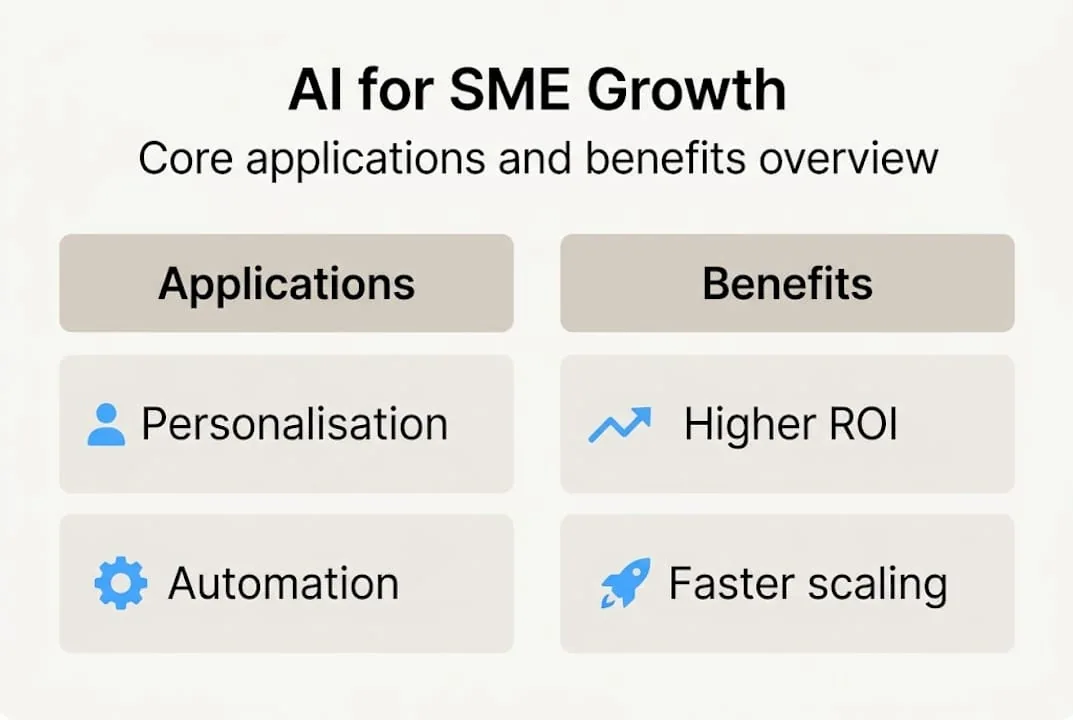
Exploring how AI drives website growth beyond campaigns reveals an even broader picture of where these tools create compounding value over time. Meanwhile, reviewing the full spectrum of AI strategy tips will help you sequence your investments for maximum strategic alignment.

Pro Tip: Start with one high-ROI use case and run it for a full quarter before expanding. AI-driven email personalisation is almost universally the best entry point because the data requirements are low, the feedback loop is fast, and the results are easy to attribute directly to the technology investment.
Navigating ethics, risks, and human creativity with AI
High-ROI execution is essential, but managing the risks and ethical dimensions of AI marketing is equally critical for long-term brand credibility and regulatory compliance. The challenges are real, and ignoring them creates both legal exposure and reputational risk that can undermine the gains you work hard to achieve.
Edge cases and challenges in AI adoption for marketing include data privacy concerns, opaque “black-box” algorithmic decisions, skill gaps within teams, and the strategic risk of over-relying on AI without maintaining clear human oversight and creative direction. Each of these deserves a structured mitigation plan, not an afterthought.
Best practices for ethical and risk-managed AI marketing:
- Prioritise data privacy compliance: Ensure all customer data used to train or power AI tools is collected with explicit consent and managed in accordance with applicable privacy regulations. This is non-negotiable from both a legal and a trust perspective.
- Audit AI outputs regularly: Black-box algorithms can produce biased recommendations or inappropriate content without any visible signal. Establish a regular review cadence for AI-generated outputs, particularly in personalisation and content generation.
- Address skill gaps proactively: Many SME marketing teams lack the technical fluency to evaluate AI tool claims critically. Invest in targeted upskilling through short courses, vendor training, and cross-functional collaboration with IT or development partners.
- Avoid vendor lock-in: Over-dependence on a single AI platform creates significant operational risk if that vendor changes pricing, discontinues features, or exits the market. Maintain a diversified technology approach wherever possible.
- Maintain human creative oversight: AI excels at optimisation and pattern recognition, but strategic messaging, brand storytelling, and nuanced audience empathy still require human judgment. Define clear boundaries between what AI handles autonomously and where human approval is mandatory.
- Establish transparent AI governance: Document how AI tools influence your marketing decisions and create internal accountability structures. This is increasingly important as regulators and consumers pay closer attention to AI-driven marketing practices.
“Rushing AI adoption leads to forgettable content and eroded customer trust. Sustainable success demands that human creativity, strategic oversight, and ethical awareness remain at the centre of every AI-assisted campaign.”
The ethical digital marketing principles that underpin responsible practice are not a constraint on AI adoption. They are the foundation that makes AI-powered marketing trustworthy, scalable, and resilient to the regulatory changes that will inevitably continue to reshape this space.
Why strategy—not technology—drives true AI marketing success
Here is the perspective that most AI marketing guides avoid: the technology is largely commoditised. The tools available to a well-resourced SME today are genuinely powerful, accessible, and affordable. But the gap between SMEs that see transformative results and those that see marginal improvements has almost nothing to do with which platform they chose. It comes down entirely to how clearly they defined their strategy before selecting any tool at all.
Prioritising strategy before AI tools, integrating design thinking, and focusing on high-ROI use cases like content personalisation are the practices that distinguish resilient, growing SMEs from those perpetually chasing the next shiny platform. The evidence is consistent. AI amplifies efficiency when directed by sound human judgment, but rushed adoption without strategic grounding produces mediocre, undifferentiated marketing at scale.
We have observed that the most successful SMEs treat AI as a force multiplier for a well-defined strategy, not as a substitute for one. They invest time upfront in goal clarity, audience understanding, and ethical frameworks. Then, and only then, do they select tools. This sequencing is not cautious. It is the most efficient path to ROI. Explore how digital solutions for SMEs can be structured to reinforce this strategy-first mindset across your entire digital ecosystem.
Pro Tip: Re-assess your AI marketing goals every quarter. If your strategy is not actively driving which AI tools you use and how you measure them, the technology has become the strategy. That inversion is the root cause of most AI marketing failures.
How Cloudfusion accelerates your AI digital marketing journey
With a clear strategy in place, execution capability becomes the critical variable. Cloudfusion delivers the technical foundation that SME marketing managers need to move from strategy to scalable, AI-enhanced implementation. Our custom web development services ensure your digital infrastructure supports the data collection and personalisation requirements that effective AI marketing demands. For brands extending their reach through mobile channels, our mobile app development solutions provide the engagement layers where AI-driven personalisation delivers the most immediate customer impact. Reliable, high-performance web hosting packages ensure your AI-powered campaigns run on infrastructure that scales with your growth, without technical bottlenecks undermining your results.
Frequently asked questions
What are the first steps for SMEs starting with AI digital marketing?
Begin with an honest assessment of your current marketing tech stack, gather available data, and identify key business goals before selecting any AI tools. This structured 4-stage approach ensures your technology choices are grounded in real business requirements rather than vendor marketing.
How much can AI personalisation improve conversion rates for SMEs?
AI-powered personalisation can boost conversion rates by as much as 20%, making it one of the highest-ROI investments available to SME marketing teams operating with limited budgets.
What challenges do SMEs face when adopting AI for digital marketing?
Common challenges include data privacy concerns, skill gaps, and the risk of over-relying on AI without maintaining clear ethical practices and human oversight throughout the implementation process.
What is the most cost-effective AI use case for small marketing teams?
Personalisation and automated email campaigns are high-ROI, entry-level use cases that scale well for small teams, with conversion rate improvements of up to 20% achievable without significant technical complexity or large platform investment.