

Why businesses need SEO: a practical 2026 guide
Discover why businesses need SEO in 2026 to enhance visibility, reduce costs, and drive effective marketing strategies. Capture traffic now!
Start reading
TL;DR:
- SEO improves website visibility by targeting high-intent users actively searching for products or services. It builds sustainable, long-term traffic that reduces customer acquisition costs and accelerates sales cycles through pre-educating prospects. Regular global audits and continuous optimization are essential for maximizing SEO’s strategic growth benefits across markets.
Search engine optimisation (SEO) is defined as the practice of improving a website’s visibility in organic search results to attract users who are actively looking for products or services you offer. Understanding why businesses need SEO comes down to one core truth: Google Search processes billions of queries daily, and the businesses ranking on page one capture the majority of that intent-driven traffic. According to Factors.ai, SEO captures demand during the research phase, lowering customer acquisition costs compared to paid channels that become unsustainable once budgets run out. For South African businesses competing in an increasingly digital economy, SEO is not a marketing experiment. It is a foundational growth strategy.
Why businesses need SEO to capture real buyer demand
Most paid advertising targets users who may or may not be ready to buy. SEO works differently. It positions your business in front of people who are already searching for a solution, which means the traffic arriving at your site carries genuine purchase intent.
This distinction matters enormously for your cost per acquisition. Pay-per-click campaigns on Google Ads or Meta deliver traffic only while you are spending. The moment your budget ends, so does your visibility. SEO, by contrast, builds compounding traffic over time, sustaining growth well beyond the limits of any single campaign.
Here is what makes SEO particularly powerful for demand capture:
- High-intent targeting: Users searching “accounting software for small businesses South Africa” are far closer to a purchase decision than someone who sees a banner ad.
- Multi-surface reach: Buyers research across multiple platforms, including voice assistants, community forums like Reddit, and YouTube, and SEO signals extend across all of these surfaces.
- Compounding returns: A well-optimised blog post or product page continues generating traffic months and years after publication, unlike a paid ad that disappears the moment spend stops.
- Lower acquisition costs: As your organic rankings improve, the cost of each new customer decreases, making SEO one of the most cost-efficient channels available to growing businesses.
Pro Tip: Optimise your content for search intent, not just keywords. A page targeting “how to reduce payroll errors” will convert better than one targeting “payroll software” because it matches what the buyer is actually trying to solve at that moment.
The importance of SEO for businesses becomes especially clear when you compare the long-term cost curves. Paid channels require continuous investment to maintain results. SEO requires upfront effort and ongoing refinement, but the returns accumulate rather than reset.
How does SEO shorten the sales cycle?
Here is something that surprises most business owners: SEO does not just bring traffic. It pre-educates your buyers before they ever speak to your sales team.

When a prospect finds your comparison page, your use case content, or your detailed product documentation through organic search, they arrive at the first sales conversation already informed. Factors.ai describes this effect precisely: good SEO makes the first sales meeting feel like the third, because buyers have already educated themselves through your content.
This has direct commercial implications. Your sales team spends less time explaining fundamentals and more time addressing specific objections and closing deals. The content doing this work includes:
- Comparison pages: “X vs Y” content that helps buyers evaluate options and positions your offering clearly.
- Use case content: Industry-specific pages showing exactly how your product or service solves a particular problem.
- Integration and technical documentation: Detailed content that answers the questions buyers ask before committing.
- FAQ and objection-handling content: Pages that address pricing concerns, implementation timelines, and support structures.
Beyond sales efficiency, this content builds authority. Organic search results are perceived as more credible and trustworthy than paid ads, which drives higher conversion rates. A business that consistently appears in organic results for relevant queries is seen as an established, knowledgeable player in its field. That perception is difficult to buy and easy to build through consistent SEO investment.
What are the broader benefits of SEO across industries?
SEO advantages for companies extend well beyond traffic generation. The benefits of SEO touch brand awareness, customer engagement, competitive positioning, and the overall efficiency of your marketing spend.
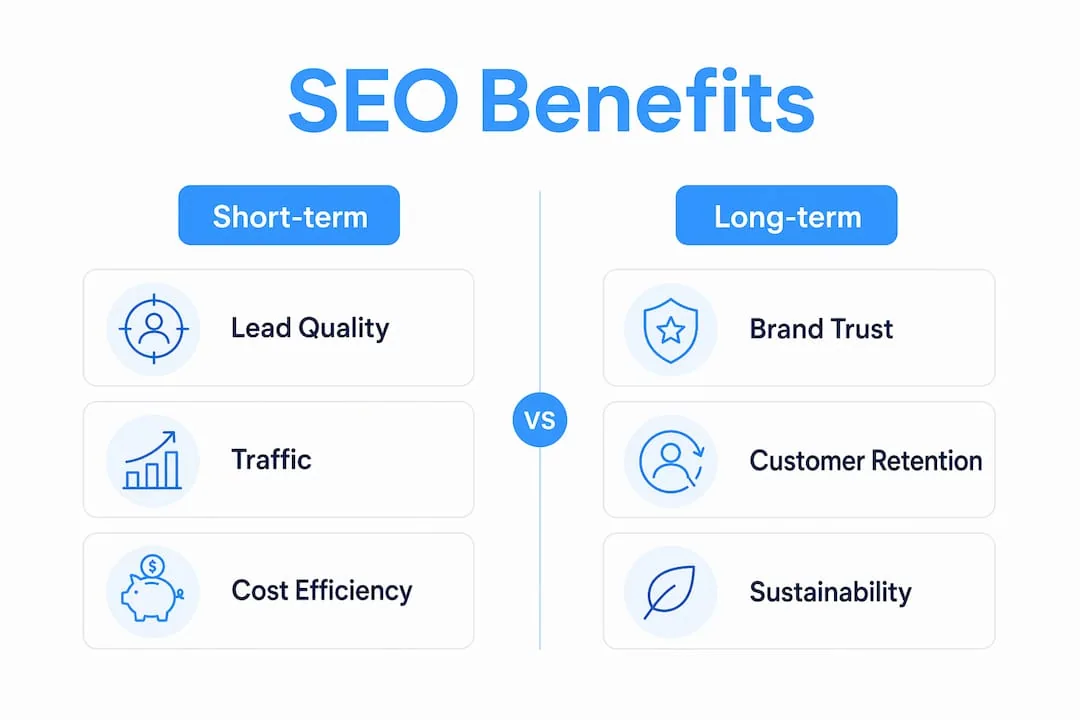
The table below compares SEO against other common digital marketing channels across key performance dimensions:
| Channel | Cost Over Time | Traffic Sustainability | Trust Perception | Lead Quality |
|---|---|---|---|---|
| SEO | Decreases as rankings improve | Compounding, long-term | High (organic credibility) | High (intent-driven) |
| Pay-Per-Click | Constant or increasing | Stops when budget ends | Moderate | Moderate |
| Social Media Ads | Constant | Stops when budget ends | Lower | Variable |
| PR and Content | Moderate | Medium-term | High | Moderate to high |
| Email Marketing | Low | Dependent on list health | High | High (warm audience) |
The table makes one thing clear: SEO is the only channel where your investment actively reduces your cost per lead over time while simultaneously building trust. That combination is why SEO complements paid, PR, and social marketing for a truly comprehensive digital strategy rather than replacing any single channel.
For businesses in competitive South African industries, from financial services to e-commerce to professional services, ranking on the first page of Google for high-value keywords delivers a competitive edge that is genuinely difficult for rivals to replicate quickly. Measuring SEO success should go beyond traffic metrics. Track qualified leads generated, pipeline value influenced, and conversion rates from organic traffic to get an accurate picture of commercial impact.
Why do businesses need a global SEO audit?
For businesses operating across multiple markets or planning international expansion, a global SEO audit is the starting point for any serious growth strategy. The term “global SEO audit” refers to a structured evaluation of your website’s technical health, content relevance, and keyword alignment across different countries and languages.
The critical insight here is that most international SEO audits fail commercially. According to The Marketing Juice, international audits often focus on technical tags like hreflang attributes while neglecting keyword intent and pipeline measurement by market. Fixing a hreflang error is useful. Discovering that your primary keyword has no search volume in a target market is far more valuable.
A properly conducted global SEO audit addresses the following:
- Keyword demand by market: Search intent and terminology vary significantly between countries. “Accounting software” may be the dominant term in South Africa, while a different phrase entirely dominates in the UK or Australia.
- Technical and content gaps: Identifying pages that exist in one language but not another, or that rank well locally but fail internationally.
- Commercial calibration: Mapping keyword opportunities to actual revenue potential, not just traffic volume.
- Pipeline measurement by market: Understanding which markets are generating qualified leads from organic search, not just sessions.
Pro Tip: When prioritising improvements from a global SEO audit, rank issues by commercial impact first and technical severity second. A technically perfect site that targets the wrong keywords in a new market will generate traffic with no pipeline value.
Businesses expanding into new regions should treat a global SEO audit the way they treat a market entry analysis. It tells you where the demand actually exists, which keywords align with buyer intent, and where your current digital presence is leaving revenue on the table.
Key takeaways
SEO is the most cost-efficient digital channel available to businesses because it captures high-intent demand, builds compounding traffic, and lowers acquisition costs over time while simultaneously building brand credibility.
| Point | Details |
|---|---|
| SEO captures buyer intent | Organic search targets users actively researching solutions, delivering higher-quality leads than most paid channels. |
| Compounding traffic value | SEO results grow over time, unlike paid ads that stop generating traffic the moment budget ends. |
| Sales cycle acceleration | SEO content pre-educates prospects, making sales conversations more productive and shortening time to close. |
| Global audits require commercial focus | International SEO audits must prioritise keyword intent and pipeline impact, not just technical fixes. |
| SEO integrates with all channels | Organic search complements paid, PR, social, and email marketing for a complete digital strategy. |
SEO is core growth infrastructure, not a marketing add-on
I have worked with enough South African businesses to know that SEO is often treated as something to consider after the website is built and the paid ads are running. That sequencing is backwards, and it costs businesses real money.
The most telling sign of a mature SEO strategy is what happens in the sales room. When your prospects arrive already knowing your product, having read your comparison content and your use case pages, the conversation shifts from education to evaluation. SEO changes sales dynamics by enabling prospects to self-educate digitally, and that shift makes your entire revenue operation more efficient.
What I have also observed is that businesses which treat SEO as a continuous programme, rather than a once-off project, consistently outperform those that do not. Rankings require maintenance. Search intent evolves. Competitors publish new content. The businesses winning in organic search are the ones measuring performance against commercial outcomes, not just keyword positions, and adjusting their strategy accordingly.
If you are a business owner or marketing manager reading this, the question is not whether SEO matters for your industry. It does. The question is whether your current investment in SEO is calibrated to your actual growth targets. Start with a proper SEO implementation checklist and measure everything against pipeline, not just traffic.
— Anton
How Cloudfusion can build your seo-ready digital presence
Cloudfusion builds websites and digital solutions that are architected for search performance from the ground up. Every custom web development project we deliver is structured with technical SEO best practices built in, from site speed and mobile performance to clean URL structures and schema markup. South African businesses across retail, professional services, and technology have used Cloudfusion’s development expertise to establish strong organic search presence and generate qualified leads consistently. If you are ready to build a digital presence that works as hard as your sales team, give us a shout and let’s chat about your project.
FAQ
What is SEO and why does it matter for businesses?
SEO, or search engine optimisation, is the process of improving your website’s visibility in organic search results. It matters because it connects your business with buyers who are actively searching for what you offer, at a lower long-term cost than paid advertising.
How does SEO lower customer acquisition costs?
SEO captures demand from users already in the research phase, meaning you are not paying per click to reach them. As your rankings improve over time, the cost of each new customer decreases because the traffic compounds without proportional increases in spend.
What is a global SEO audit and when does a business need one?
A global SEO audit is a structured review of your website’s technical health, content relevance, and keyword alignment across multiple countries or languages. Businesses need one before entering new international markets or when organic traffic from a specific region is underperforming relative to its commercial potential.
How does SEO support the sales process?
SEO content, including comparison pages, use case articles, and technical documentation, educates prospects before they contact your sales team. This means initial sales conversations are more advanced and productive, shortening the overall time to close.
How do i measure whether my SEO strategy is working?
Track qualified leads and pipeline value generated from organic traffic, not just sessions or keyword rankings. Conversion rate from organic visitors and cost per acquisition from SEO compared to paid channels are the most commercially meaningful metrics to monitor.