

The role of cultural design in websites explained
Discover the role of cultural design in websites and learn how it enhances trust, engagement, and conversions for diverse audiences.
Start reading
TL;DR:
- Cultural design aligns website elements with users’ cultural expectations, trust signals, and behaviors to improve engagement. It impacts color choices, navigation, imagery, and trust cues, which vary significantly across cultures and influence conversion rates. Implementing culture-aware UX through research, native reviews, and continuous testing can deliver measurable business success in diverse markets.
Cultural design in websites is defined as the practice of aligning visual, structural, and content elements with the cultural expectations, behaviours, and trust signals of a specific user group. It goes far beyond translation. The role of cultural design in websites directly shapes whether users trust your site, engage with your content, and ultimately convert. Research confirms that culture-aware UX treats localisation as an ongoing practice, not a one-time fix, and that differences in user expectations, trust cues, and instincts affect engagement and conversion in measurable ways. For web designers, digital marketers, and business owners targeting diverse audiences, whether locally in South Africa or globally, understanding cultural influences in web design is one of the highest-leverage decisions you can make.
How does cultural design influence website elements?
Cultural influences in web design operate at every layer of the interface. Colour is the most visible example. White signals purity in Western markets but mourning in parts of East Asia. Red communicates danger in Northern Europe but luck and prosperity in China. These are not minor stylistic preferences. They are deeply embedded cultural associations that shape first impressions within milliseconds of a page loading.

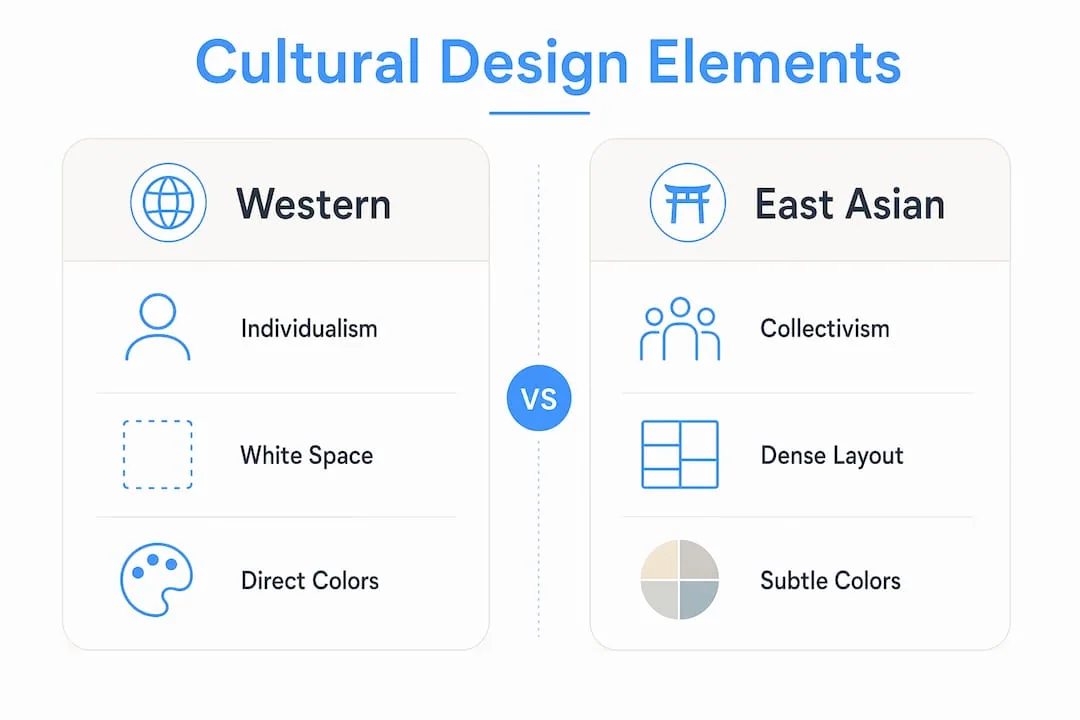
Typography and layout follow similar patterns. Arabic and Hebrew users read right-to-left, which means RTL layouts are not optional for those markets. They are functional requirements. East Asian design traditions often favour higher information density, with more content visible above the fold, while Scandinavian and Northern European conventions lean toward minimalism and white space. Cultural sensitivity in web design confirms that adapting language, imagery, layout, and using A/B testing by market are the core techniques for effective cultural adaptation.
Imagery choices carry significant weight. A photograph of a handshake communicates professionalism in many Western contexts, but in some collectivist cultures, group imagery or community-focused visuals build stronger rapport. Navigation hierarchy also differs. High power-distance cultures, where authority and hierarchy are respected, often respond better to structured, top-down navigation. Low power-distance cultures tend to prefer flat, exploratory navigation structures.
The table below illustrates how key design elements vary across cultural contexts:
| Design element | Western (individualist) | East Asian (collectivist) | Middle East (RTL, high context) |
|---|---|---|---|
| Colour palette | Neutral, minimal, brand-led | Vibrant, red and gold prominent | Rich colours, geometric patterns |
| Layout density | Low density, white space | High density, layered content | Moderate, RTL structure required |
| Navigation style | Flat, exploratory | Hierarchical, structured | Formal, authority-driven |
| Trust signals | Reviews, data, transparency | Community endorsements, brand heritage | Religious or local authority cues |
| Imagery | Individual achievement | Group harmony, family | Modest, culturally appropriate |
Pro Tip: Before launching in a new market, run your design past native users from that region, not just translators. Translation alone misses structural and trust elements that only a native product experience review will catch.
How does cultural design shape user trust and engagement?
Trust is the mechanism that converts visitors into customers, and trust is culturally constructed. Cross-border trust mechanisms vary significantly: collectivist cultures rely more on relational trust, community endorsements, and social proof from known groups, while individualist cultures prioritise technological assurances, privacy policies, and transparent data practices. A site that builds trust effectively in Germany may feel cold and impersonal to users in Brazil or Nigeria.
The practical evidence for this is compelling. Localised checkout flows in Southeast Asian markets increased conversion by 40%, reduced cart abandonment by 52%, and decreased checkout time by 28%, delivering a 12:1 ROI. This was not achieved through translation alone. The localisation included linguistic, functional, visual, and regulatory adaptations. That result illustrates precisely why cultural aesthetics in design are a commercial priority, not a cosmetic one.
It is worth noting that cultural dimensions only weakly moderate the relationship between trust and purchase intention in some contexts. This means you cannot assume a single cultural framework will predict behaviour universally. Market-specific testing and adaptation remain necessary.
Here are the trust cues to adapt by market when building culturally responsive web design:
- Social proof format. Collectivist markets respond to group endorsements and community testimonials. Individualist markets respond to verified reviews and star ratings.
- Security and privacy signals. Northern European and North American users expect visible SSL badges, GDPR notices, and clear data policies. These may be less prominent drivers in other regions.
- Payment method familiarity. Local payment options, such as SnapScan or Ozow in South Africa, signal that a business understands the local market.
- Authority cues. In high power-distance cultures, endorsements from recognised institutions or industry bodies carry more weight than peer reviews.
- Contact and support visibility. Many markets, particularly in Africa and Latin America, require visible local phone numbers and WhatsApp contact options to establish credibility.
Pro Tip: Use analytics by market segment to validate which trust cues are actually driving conversions in each region. Do not assume benefits. Measure them.
What frameworks guide cultural design decisions?
The most widely applied model for understanding cultural differences in UX is Geert Hofstede’s cultural dimensions framework. Hofstede identified six dimensions: power distance, individualism versus collectivism, masculinity versus femininity, uncertainty avoidance, long-term versus short-term orientation, and indulgence versus restraint. Each dimension has direct UX implications.
High uncertainty avoidance cultures, such as Japan and Greece, prefer detailed navigation, comprehensive FAQs, and explicit instructions. They are uncomfortable with ambiguity in interfaces. Low uncertainty avoidance cultures, such as Singapore and Denmark, tolerate open-ended navigation and minimal instruction. Applying Hofstede’s framework to user experience design means structuring information architecture, onboarding flows, and CTA language to match these expectations from the start.
Beyond Hofstede, quantitative evaluation frameworks now exist to assess cultural symbol effectiveness in design. Research shows that an AHP-TOPSIS evaluation framework can quantify how well a cultural symbol translates into a design context, balancing cultural meaning with legibility. Expert panels showed high consistency in assessments, and user surveys validated reliability and content relevance. This matters because it gives design teams a reproducible, evidence-based method for making cultural symbol decisions rather than relying on intuition.
The table below maps Hofstede’s dimensions to practical UX decisions:
| Hofstede dimension | High score implication | Low score implication |
|---|---|---|
| Power distance | Formal hierarchy in navigation, authority endorsements | Flat navigation, peer-driven content |
| Uncertainty avoidance | Detailed instructions, comprehensive FAQs, explicit CTAs | Minimal guidance, exploratory UX |
| Individualism | Personal achievement messaging, individual reviews | Community focus, group testimonials |
| Long-term orientation | Emphasis on reliability, heritage, and longevity | Focus on immediate benefits and offers |
Users from different cultures navigate and interpret web interfaces differently based on these dimensions, which is why locale-specific landing pages and onboarding variants are recommended when behaviour differs significantly between markets.
How to implement cultural design in website projects
The starting point is understanding the difference between translation, localisation, and culture-aware design. Translation converts words. Localisation adapts language, date formats, currency, and basic imagery. Culture-aware design goes further, aligning the entire user experience with the mental models, trust expectations, and interaction preferences of the target culture. Culture-aware UX should be integrated early in the design process to align with users’ mental models, not applied as a post-launch correction.
A practical implementation workflow looks like this. Start with cultural research using Hofstede’s dimensions and regional UX studies to map the target audience’s expectations. Then conduct native market reviews, where actual users from the target culture evaluate the full product experience, not just the translated copy. Follow this with cultural experience testing using A/B tests on localised variants, tracking engagement, bounce rates, and conversion by segment. Iterate based on data, not assumptions.
Common pitfalls to avoid in culturally responsive web development:
- Assuming colour neutrality. No colour is universally neutral. Always validate palette choices with native market input.
- Copying Western UX patterns globally. Navigation structures, form designs, and CTA placements that perform well in one market may create friction in another.
- Treating localisation as a launch task. Cultural design requires continuous iteration as markets evolve and user expectations shift.
- Ignoring mobile-first cultural norms. In many African and Asian markets, mobile is the primary access point, and mobile UX design must reflect local usage patterns.
- Overlooking regulatory and cultural compliance. Some markets have specific requirements around imagery, data handling, or content that affect design decisions directly.
The concept of glocalisation captures the balance well: maintain global brand consistency in core identity and structure, but adapt content, trust signals, imagery, and interaction patterns to local cultural expectations. This is not a compromise. It is the most commercially effective approach to custom web design for diverse markets.
Pro Tip: Build a cultural design checklist into your project kickoff process. Include colour validation, RTL readiness, trust signal mapping, and native user review as standard deliverables for any international or multicultural project.
Key takeaways
Cultural design is the single most underinvested lever in web development for businesses targeting diverse markets, and the data on conversion uplift makes the commercial case impossible to ignore.
| Point | Details |
|---|---|
| Cultural design goes beyond translation | Adapting trust cues, imagery, and navigation structure drives measurable engagement gains. |
| Trust is culturally constructed | Collectivist markets need relational signals; individualist markets need transparency and data. |
| Frameworks guide decisions | Hofstede’s dimensions and AHP-TOPSIS provide structured, evidence-based cultural design methods. |
| Localisation delivers ROI | Culturally adapted checkout flows in Southeast Asia achieved a 40% conversion increase and 12:1 ROI. |
| Continuous testing is non-negotiable | Analytics and A/B testing by market segment validate cultural design impact rather than assuming it. |
Why cultural design deserves more than an afterthought
Here is what I have observed working across web projects for South African businesses and clients targeting international markets: the teams that treat cultural design as a strategic input from day one consistently outperform those that bolt it on at the end. The difference is not subtle. It shows up in bounce rates, in checkout abandonment, and in the quality of user feedback.
What surprises most clients is how much of the friction in their sites has nothing to do with performance or functionality. It comes from misaligned trust signals, imagery that does not resonate, or navigation patterns that feel foreign to the user. A South African e-commerce site expanding into Nigeria or Kenya cannot simply translate its existing copy and expect the same results. The payment methods, the community trust signals, the mobile-first interaction patterns, all of these need deliberate attention.
The most overlooked aspect of cultural design is the mental model gap. Users arrive at your site with a set of expectations shaped by every digital experience they have had in their cultural context. When your design matches those expectations, the experience feels effortless. When it does not, users leave without being able to articulate why. That invisible friction is what culture-aware UX is designed to eliminate.
My recommendation is to treat cultural design as you would treat website UX strategy: as an ongoing practice with measurable outcomes, not a one-time deliverable. Build it into your design system, your testing cadence, and your client briefing process. The businesses that do this consistently will build digital products that genuinely connect with diverse audiences, and that connection is what drives long-term commercial performance.
— Anton
How Cloudfusion builds culturally aligned websites
Cloudfusion designs and develops websites that account for the cultural expectations of your specific audience, whether you are targeting local South African markets or expanding across borders. The team integrates cultural research, native market review, and iterative testing into every custom web development project, so your site does not just look good. It performs for the people it is built for. If you are building or redesigning a website for a diverse or international audience, give us a shout. Let’s chat about how cultural design can make your digital presence more effective from day one.
FAQ
What is the role of cultural design in websites?
Cultural design in websites aligns visual, structural, and content elements with the cultural expectations and trust signals of a specific user group. It directly affects engagement, trust, and conversion rates across diverse markets.
How does culture impact user experience on websites?
Culture shapes how users interpret colour, navigate interfaces, and evaluate trust signals. Users from different cultural backgrounds navigate and interpret web interfaces differently based on dimensions like individualism, power distance, and uncertainty avoidance.
Why is translation not enough for international websites?
Translation converts words but does not adapt trust cues, form designs, CTAs, or credibility signals to cultural expectations. Major design gains come from adapting these structural and trust elements, which translators typically miss.
How do you measure the impact of cultural design?
Use A/B testing on localised design variants and segment analytics by market to track engagement, bounce rates, and conversion. Testing and analytics validate cultural design impact rather than assuming benefits.
What is the difference between localisation and culture-aware design?
Localisation adapts language, currency, and basic imagery. Culture-aware design goes further by aligning the entire user experience, including navigation, trust signals, and interaction patterns, with the mental models of the target culture.