

Custom built software: a practical guide for businesses
Discover how custom built software can transform your business operations. Learn practical tips and strategies for effective implementation!
Start reading
TL;DR:
- Custom built software is developed exclusively to address a company’s unique operational needs, offering tailored solutions that differ from standard products. It emphasizes defining quality attributes upfront, following a structured agile process, and leveraging local expertise to ensure compliance and strategic alignment. Partnering with experienced local developers like Cloudfusion enables businesses to create scalable, secure, and efficient systems that provide competitive advantage and long-term value.
Custom built software is software designed and developed exclusively for a specific organisation to solve its particular operational challenges, workflows, and strategic requirements. Unlike packaged products such as SAP Business One or Microsoft Dynamics, which serve broad markets, bespoke software solutions are architected from the ground up around your processes. The industry standard term for this discipline is custom software development, and it encompasses everything from internal enterprise tools and customer-facing web applications to mobile platforms and system integrations. Cloudfusion builds these solutions for South African businesses across retail, finance, and manufacturing, applying quality frameworks like ISO/IEC 25010 to deliver software that performs reliably in production, not just in a demo.
What quality attributes define excellent custom built software?
ISO/IEC 25010 defines nine product quality characteristics including Reliability, Security, Maintainability, and Safety, which form the foundation for evaluating any custom software application. This matters because most disputes between clients and developers arise not from missing features, but from unmet quality expectations that were never written down.
The nine characteristics in the ISO/IEC 25010 model cover the full spectrum of what makes software fit for purpose:
- Functional suitability: Does the software do what the business actually needs?
- Reliability: Does it perform consistently under expected conditions without failure?
- Security: Does it protect data and resist unauthorised access?
- Maintainability: Can developers update and extend it without breaking existing functionality?
- Performance efficiency: Does it respond within acceptable timeframes under load?
- Usability: Can your staff use it without extensive retraining?
- Portability: Can it run across different environments or be migrated when infrastructure changes?
- Compatibility: Does it integrate cleanly with your existing systems?
- Safety: Does it prevent states that could cause harm to people or operations?
Specifying quality attributes upfront, rather than focusing solely on feature lists, aligns development priorities with business outcomes and reduces post-launch disputes. A retailer in Johannesburg, for example, might prioritise Reliability and Performance efficiency above all else during peak trading periods like Black Friday. A financial services firm in Cape Town, by contrast, would weight Security and Safety far more heavily given POPIA compliance obligations.
Acceptance criteria mapped to quality metrics prevent the classic “it works on my machine” dispute and give your QA team measurable testing targets. Without this, testing becomes subjective and delivery timelines stretch.

Pro Tip: Before signing any development contract, ask your vendor to map each acceptance criterion to a specific ISO/IEC 25010 characteristic. If they cannot do this, treat it as a red flag.
How does custom built software compare to off-the-shelf solutions and low-code platforms?
Off-the-shelf software refers to packaged products sold to multiple organisations with minimal configuration, such as QuickBooks for accounting or Shopify for e-commerce. Low-code platforms like Microsoft Power Apps or OutSystems sit in the middle ground, allowing some customisation through visual tools without full development effort. Custom made software occupies a different position entirely: it is built to your specification, owned by your organisation, and shaped around your competitive differentiators.
The comparison below clarifies where each option excels and where it falls short.
| Factor | Off-the-shelf | Low-code platform | Custom built software |
|---|---|---|---|
| Upfront investment | Low (subscription) | Low to medium | High (R1.5M to R6M+) |
| Customisation depth | Limited to vendor features | Moderate | Unlimited |
| Scalability | Vendor-dependent | Moderate | Fully controlled |
| Competitive advantage | None (competitors use same tool) | Limited | High |
| Maintenance control | Vendor-managed | Shared | Fully owned |
| Integration flexibility | API-dependent | Moderate | Fully tailored |
| Long-term cost | Recurring licence fees | Recurring fees | Lower over time |
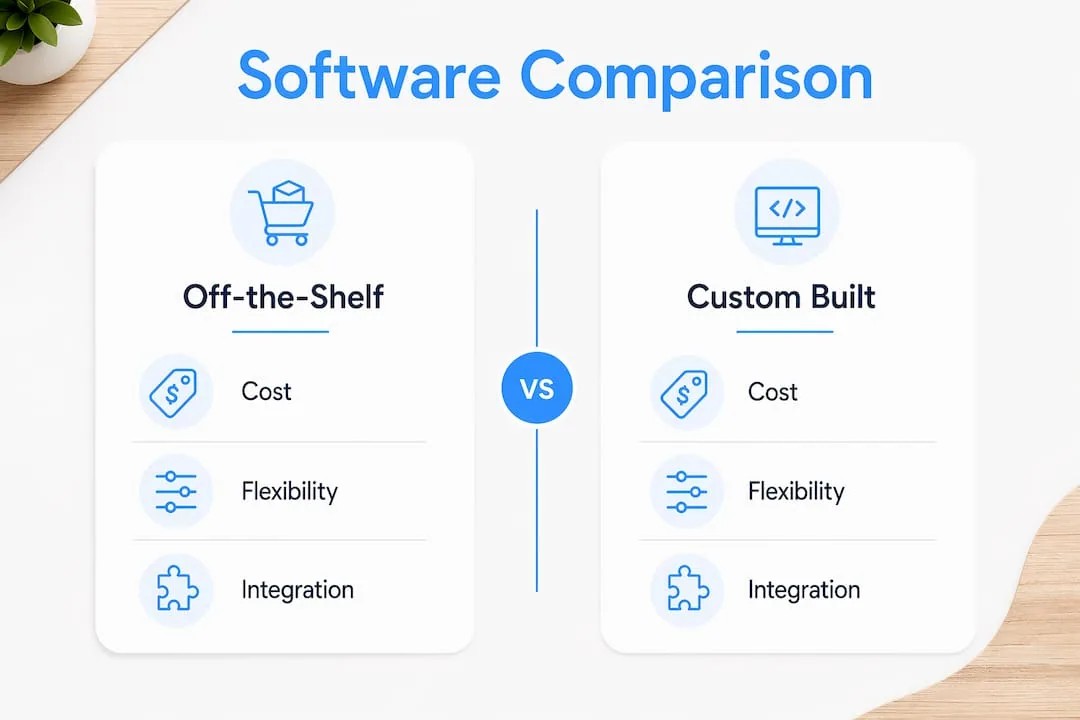
Custom software development costs typically range from R1.5 million to over R6 million depending on complexity, scope, and quality requirements. That figure sounds significant until you calculate the cumulative cost of annual licence fees, per-user charges, and the productivity losses from forcing your team to work around software that was never designed for your processes.
The advantages of custom software become clearest in three scenarios. First, when your business processes are genuinely differentiated and off-the-shelf tools would require you to change how you operate to fit the software. Second, when you need deep integration with proprietary systems, legacy databases, or local payment gateways. Third, when you are building a product or platform that is itself a revenue-generating asset, not just an internal tool.
Low-code platforms are a reasonable choice for rapid prototyping or departmental tools with limited complexity. They become a liability when you need to scale, when security requirements are stringent, or when the vendor’s roadmap diverges from your business direction.
What are the key steps in developing custom built software?
Structured development phases covering requirements, planning, design, architecture, coding, integration, and testing are the foundation of successful tailored software development. Skipping or compressing any phase is the single most common cause of cost overruns and failed projects.
Here is how a well-managed custom software development process unfolds:
- Requirements gathering: Document both functional requirements (what the software must do) and quality requirements (how well it must do it, using ISO/IEC 25010 as your framework). Involve end users, not just management.
- Project planning: Define scope, milestones, budget, and risk mitigation. Agree on a change management process before development starts, not after.
- UX/UI design: Prototype the user interface and validate it with actual users before a single line of code is written. Changes at this stage cost a fraction of what they cost post-development.
- Architecture design: Define the technical structure, data models, and integration points. Decisions made here determine how maintainable and scalable the system will be for the next decade.
- Development and coding: Build iteratively in sprints, with working software delivered at the end of each sprint for stakeholder review.
- Integration: Connect the new system to existing platforms, payment gateways, ERP systems, or third-party APIs. This phase is consistently underestimated in time and complexity.
- Testing: Execute functional, performance, security, and user acceptance testing. Each test case should trace back to a specific quality attribute.
- Deployment and handover: Release to production with a documented support and maintenance plan in place from day one.
Agile iterative development with continuous stakeholder feedback is the most effective way to keep a custom software project aligned with evolving business needs. Fixed-scope waterfall projects frequently deliver software that was accurate to the brief written twelve months earlier but no longer matches the business reality at launch.
Pro Tip: Allocate at least 15% of your total project budget to post-launch support and iteration. The first three months after go-live will surface requirements that no discovery process could have anticipated.
How can South African businesses leverage local custom software development?
South African businesses gain measurable advantages by working with local development partners who understand the regulatory environment, market nuances, and operational realities that offshore teams often miss. This is not a matter of sentiment. It is a practical consideration that affects project outcomes.
The local advantage manifests in several concrete ways:
- POPIA compliance by design: Local developers build data protection requirements into the architecture from the start, rather than retrofitting compliance after the fact.
- Local payment gateway integration: Solutions can be built to work natively with PayFast, Peach Payments, Ozow, and other South African payment infrastructure without the workarounds that offshore teams require.
- Language support: Custom software can support multiple languages including English and Afrikaans, which matters for customer-facing applications in the Western Cape and other bilingual markets.
- Time zone alignment: Real-time communication during business hours eliminates the delays that compound when your development team is in Eastern Europe or Southeast Asia.
- Sector-specific knowledge: South African retail, mining, agriculture, and financial services each operate under specific regulatory and operational conditions that local developers understand from direct experience.
Cloudfusion works across these sectors, delivering custom web and mobile solutions that are built for the South African market from the ground up. The firm’s portfolio includes bespoke web applications, mobile platforms, and integrated digital solutions for businesses that need software shaped around their specific competitive context, not around a generic product template.
The South African tech ecosystem has matured significantly, with skilled development teams capable of delivering enterprise-grade solutions at competitive rates relative to Western markets. For businesses searching for custom software development near them, the combination of local expertise, cultural alignment, and direct accountability makes a compelling case for keeping development onshore.
Key takeaways
Custom built software delivers its highest value when quality attributes are defined upfront, development follows a structured agile process, and the chosen partner understands your local market and regulatory context.
| Point | Details |
|---|---|
| Define quality attributes early | Use ISO/IEC 25010 to specify Reliability, Security, and Maintainability before development begins. |
| Custom vs. off-the-shelf | Custom software costs more upfront but delivers lower long-term costs and genuine competitive differentiation. |
| Structured development process | Follow all eight phases from requirements to deployment; skipping phases is the primary cause of project failure. |
| Local development advantage | South African partners provide POPIA compliance, local payment integration, and real-time communication. |
| Budget for post-launch iteration | Allocate at least 15% of project budget to support and refinement after go-live. |
Why I think most businesses approach custom software backwards
Most organisations I have worked with arrive at the custom software conversation after they have already exhausted off-the-shelf options. By that point, they have accumulated years of workarounds, manual processes, and data silos that the new software must also untangle. The project scope balloons, the budget doubles, and the timeline slips.
The businesses that get the best outcomes from bespoke software solutions start the conversation earlier, before the pain becomes acute. They approach it as a strategic investment with a defined quality framework, not as a rescue operation. Defining your ISO/IEC 25010 quality attributes before you write a brief is not bureaucratic overhead. It is the single most effective way to protect your investment and hold your development partner accountable.
My advice to any decision-maker evaluating this path: do not let cost be the first filter. Let fit be the first filter. If your processes are genuinely differentiated and your competitive advantage depends on how your systems work, then custom built software is not an expense. It is infrastructure. Partner with a firm like Cloudfusion that has a track record in your sector, asks hard questions during scoping, and can show you live examples of what they have delivered. The conversation you have before the contract is signed tells you everything you need to know about the partnership you are entering.
— Anton
Build your custom software solution with Cloudfusion
Cloudfusion specialises in custom web development and mobile application development for South African businesses that need software built around their specific operations, not around a vendor’s product roadmap. From initial scoping and requirements gathering through to deployment and ongoing support, the team applies structured development practices and quality frameworks to deliver solutions that perform in production. If you are ready to explore what a tailored software solution could do for your business, give us a shout and let’s chat about your project.
FAQ
What is custom built software?
Custom built software is software developed specifically for a single organisation’s unique operational needs, as opposed to off-the-shelf products designed for broad markets. It gives businesses full control over features, integrations, and quality standards.
How much does custom software development cost in South Africa?
Custom software development typically ranges from R1.5 million to over R6 million depending on complexity, scope, and quality requirements. Accurate scoping at the outset is the most effective way to control costs.
When should a business choose custom software over off-the-shelf tools?
Choose custom software when your processes are genuinely differentiated, when deep integration with local systems is required, or when the software itself is a revenue-generating asset. Off-the-shelf tools are more appropriate for generic functions like basic accounting or email.
What is ISO/IEC 25010 and why does it matter for custom software?
ISO/IEC 25010 is an international standard that defines nine product quality characteristics including Reliability, Security, and Maintainability. Using it to define acceptance criteria upfront prevents disputes and gives your QA team measurable testing targets.
How do I find reliable custom software development near me in South Africa?
Look for a local development partner with a verifiable portfolio in your sector, demonstrated knowledge of POPIA compliance, and a structured development process that includes quality attribute specification. Cloudfusion is one such partner, with experience across web, mobile, and enterprise software for South African businesses.