

Custom software services: Unlock efficiency and growth
Discover how custom software services drive efficiency and digital transformation. Compare custom vs. off-the-shelf, measure ROI, and apply proven best practices.
Start reading
TL;DR:
- Custom software caters precisely to unique business processes, offering long-term efficiency and competitive advantages.
- Proper edge case management during requirements reduces bugs and minimizes costly rework in development.
- Investing in thorough discovery and requirements definition significantly improves project success and ROI.
Most software failures don’t happen because of the obvious requirements everyone writes down on day one. Edge cases cause 80% of bugs despite representing only 20% of all development scenarios, and generic off-the-shelf platforms are simply not built to handle the unique operational complexity your business generates. When your workflows don’t map cleanly to a packaged solution, you’re not just dealing with inconvenience. You’re absorbing hidden costs, compounding inefficiencies, and ceding competitive ground. This guide covers what custom software services actually are, how they compare to off-the-shelf alternatives, how to execute a project successfully, and how to evaluate the real financial return.
Table of Contents
- What are custom software services?
- Custom vs. off-the-shelf software: What’s best for your business?
- Best practices for success: From requirements to launch
- Measuring ROI and total cost of ownership
- Our unexpected lesson from a decade of custom software projects
- Explore custom software solutions for your business
- Frequently asked questions
Key Takeaways
| Point | Details |
|---|---|
| Edge cases matter | Addressing edge cases early prevents most software bugs and improves reliability. |
| Custom software ROI | Custom solutions deliver greater total value over time compared to off-the-shelf options. |
| Best practices win | Following clear requirements and layered testing ensures successful project delivery. |
| Clear frameworks | Using ROI and TCO frameworks helps leaders make confident investment decisions. |
| Expert guidance | Partnering with experienced providers speeds up transformation and reduces risk. |
What are custom software services?
Custom software services refer to the design, development, deployment, and ongoing maintenance of software solutions built specifically to meet a defined set of business requirements. Unlike packaged products that serve a broad market, custom solutions are architected around your processes, your data structures, and your integration landscape. Understanding custom software development as a strategic investment rather than a procurement decision is the first shift that separates high-performing enterprises from those perpetually patching generic tools.
The scope of custom software services typically spans several delivery types:
- Custom web applications: Browser-based platforms built for internal operations, customer portals, or industry-specific workflows
- Mobile applications: Native or cross-platform apps that extend enterprise capability to field teams, customers, or partners
- System integrations: Middleware and API layers that connect disparate platforms, eliminating data silos and manual reconciliation
- Process automation: Workflow engines that replace repetitive human tasks with reliable, auditable logic
- Data and reporting platforms: Custom dashboards and analytics tools aligned to your specific KPIs
Businesses pursue custom software for several converging reasons. Operational efficiency is the most immediate driver. When software mirrors your actual process rather than forcing your team to adapt to someone else’s assumptions, throughput increases and error rates drop. Competitive differentiation is equally compelling. A proprietary tool your competitors cannot replicate becomes a structural advantage.
“The global custom software development market was valued at $43 billion in 2024 and is projected to reach $146 billion by 2030, growing at a 22.6% CAGR. This trajectory reflects how broadly enterprises are recognising that bespoke solutions deliver what packaged software cannot.”
Proper edge case management is one area where custom development holds a decisive advantage. Because the solution is built around your specific data and logic, developers can anticipate the boundary conditions that generic platforms routinely ignore, reducing production failures before they reach your users.
Custom vs. off-the-shelf software: What’s best for your business?
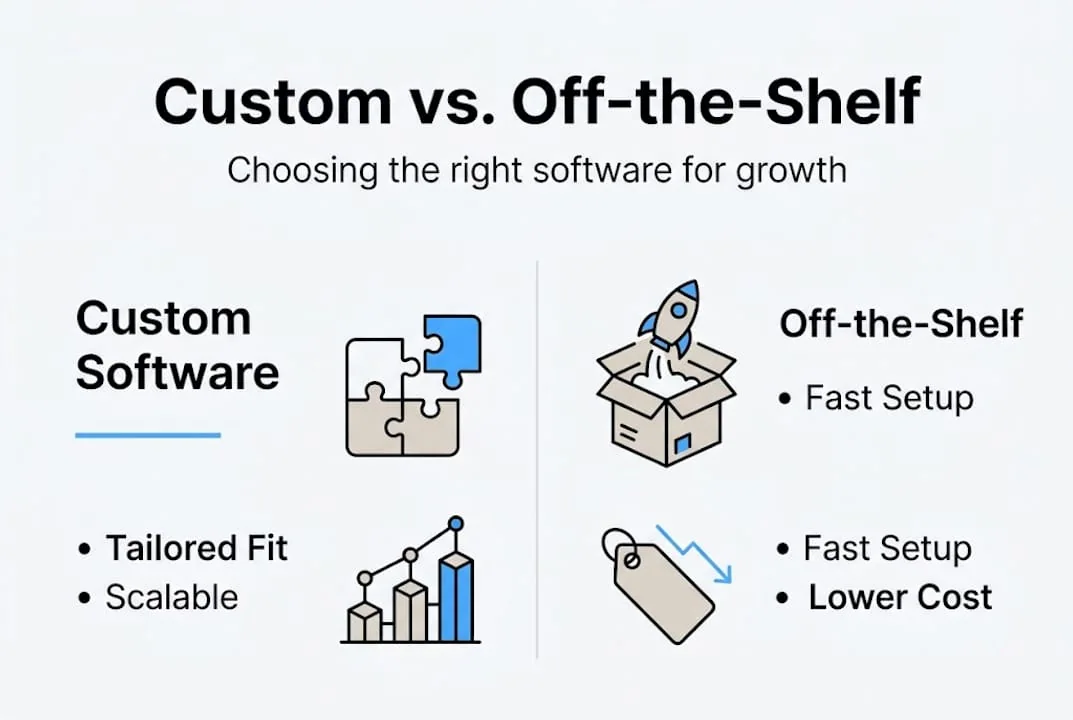
With a clear understanding of custom software’s scope, it’s essential to weigh its advantages against off-the-shelf alternatives to identify the most suitable option for your business. The decision is rarely binary, but the tradeoffs are significant and quantifiable.
| Criteria | Custom software | Off-the-shelf software |
|---|---|---|
| Initial cost | Higher upfront investment | Lower initial outlay |
| Time to value | Longer build cycle (3–12 months) | Faster deployment |
| Fit to process | Exact match to your workflows | Requires process adaptation |
| Integration | Designed for your ecosystem | Limited or costly connectors |
| Scalability | Built to your growth trajectory | Vendor-dependent roadmap |
| Total cost of ownership (2–4 years) | Favourable at scale | Licensing costs compound |
Off-the-shelf solutions are justified when your requirements are genuinely generic, your team’s processes align closely with the platform’s assumptions, and speed of deployment outweighs long-term fit. Accounting software for a standard SME or a basic CRM for a small sales team are reasonable examples.
However, custom software delivers greater long-term value and superior integration for businesses with unique processes, complex data relationships, or aggressive scaling plans. The benefits of custom software become most visible when off-the-shelf workarounds start consuming engineering time and operational bandwidth.
When building custom software, consider the following criteria before committing to either path:
- Does your process have significant exceptions or unique logic that packaged tools cannot accommodate?
- Will you require deep integration with proprietary or legacy systems?
- Is your competitive advantage tied to how you execute a specific workflow?
- Do you anticipate rapid scaling that will outgrow a vendor’s standard tier?
Pro Tip: Apply the CRUD+E framework when evaluating your requirements. Map every core function as Create, Read, Update, Delete, or Execute. If your Execute logic is complex and proprietary, custom development is almost always the stronger strategic choice. You can also use this framework to test edge cases systematically during the evaluation phase.
Best practices for success: From requirements to launch
Once you’ve chosen a custom solution, it’s vital to understand how to execute successfully from concept to final deployment while avoiding costly mistakes. The most expensive errors in custom software projects are not technical. They are organisational, rooted in vague requirements, shifting scope, and underestimated complexity.
A well-structured project follows these core phases:
- Discovery and scoping: Engage stakeholders across all affected departments. Document current-state processes, pain points, and desired outcomes with precision before any design work begins.
- Requirements definition: Translate business needs into functional and non-functional specifications. Define edge cases explicitly at this stage, not during QA.
- Architecture and design: Establish the technical foundation, including data models, integration points, and security requirements. UI/UX design should reflect actual user workflows.
- Iterative development: Build in sprints with regular stakeholder reviews. Catching misalignment early costs a fraction of what late-stage rework demands.
- Testing and quality assurance: Apply layered testing from unit to system level, including boundary value analysis and input sanitisation to address edge conditions systematically.
- Deployment and launch: Plan for phased rollout where possible. A controlled launch reduces risk and allows real-world feedback before full-scale adoption.
- Ongoing maintenance: Budget for post-launch support, performance monitoring, and iterative improvement. Software is not a once-off asset.
“The most effective teams handle edge cases through guard clauses and early returns in code logic, combined with software testing best practices that address boundary conditions before they reach production.”
Scope creep is the single most common project failure mode. Custom company solutions that succeed consistently are those where the requirements process is treated with the same rigour as the development process itself. Solving business problems with software requires that those problems be precisely defined before a single line of code is written.

Pro Tip: Establish a formal change control process from day one. Every scope addition must be evaluated for time, cost, and risk impact before approval. This single discipline prevents the majority of budget overruns in custom development projects.
Measuring ROI and total cost of ownership
With processes and best practices established, it’s time to evaluate how custom software truly delivers value and savings over the long run. Many businesses underestimate the return because they compare upfront development costs against a packaged licence fee without accounting for the full cost picture.
| Cost category | Custom software | Off-the-shelf software |
|---|---|---|
| Upfront investment | High (development + design) | Low (licence or subscription) |
| Year 1 ongoing cost | Moderate (support + hosting) | Moderate to high (per-user fees) |
| Year 2 to 4 cumulative cost | Stable, predictable | Escalates with users and features |
| Integration cost | Included in build | Often significant add-on cost |
| Customisation cost | Minimal (already tailored) | High (vendor-dependent) |
| TCO at scale (2–4 years) | Favourable at scale | Increasingly costly |
The primary ROI drivers for custom software are measurable and strategic:
- Operational efficiency: Automating manual processes and eliminating redundant steps directly reduces labour cost and error rates
- Integration value: Connecting previously siloed systems removes reconciliation overhead and improves data accuracy across the organisation
- Competitive capability: Proprietary tools that encode your best processes create barriers that competitors using generic platforms cannot easily replicate
- Reduced downtime: Systems built to your infrastructure and load profile experience fewer performance failures than over-stretched packaged tools
- Scalability without penalty: Growth does not trigger punitive per-seat licensing or forced tier upgrades
To accurately measure ROI, track business efficiency with custom software by baselining current process times, error rates, and integration costs before deployment, then measuring the delta at 6, 12, and 24 months post-launch. Many organisations also find that saving time with custom software compounds across departments in ways that were not anticipated during initial scoping, making the actual return significantly higher than projected.
Our unexpected lesson from a decade of custom software projects
Here is the insight most guides miss: the businesses that extract the greatest long-term value from custom software are not necessarily those with the largest budgets or the most sophisticated technology teams. They are the ones that invest disproportionately in requirements rigour before development begins.
We have consistently observed that projects with thorough discovery phases, where edge cases are identified and documented as first-class requirements, experience dramatically fewer production failures. Edge cases cause 80% of bugs despite representing only 20% of scenarios, and yet most project timelines allocate almost no structured time to mapping them before build. The CRUD+E framework addresses this directly, but only if it is applied during requirements, not retrospectively during testing.
The second lesson is that custom software’s value is chronically underestimated until something breaks in a packaged alternative. Organisations that address business needs proactively with bespoke solutions avoid the compounding cost of workarounds, data inconsistencies, and vendor lock-in that accumulate silently over years. The strategic case for custom software is strongest precisely when it is hardest to see.
Explore custom software solutions for your business
If the frameworks and data in this article have clarified your thinking, the logical next step is to evaluate what a purpose-built solution could achieve for your specific operational context. At CloudFusion, we design and deliver custom web development solutions and mobile app development services that are architected around your business requirements, not adapted from generic templates. From initial discovery through to deployment and ongoing support, our approach prioritises requirements precision, edge case coverage, and measurable ROI. Reach out to our team to discuss your project scope and explore how a tailored digital solution can drive the operational efficiency and competitive advantage your business needs.
Frequently asked questions
What types of businesses benefit most from custom software services?
Companies with unique processes, integration needs, or significant scaling plans consistently extract the greatest value from custom solutions, as these are the scenarios where off-the-shelf platforms create the most operational friction.
How long does custom software development typically take?
Most projects require 3 to 12 months depending on requirements complexity, the number of integrations involved, and the depth of testing required. Greater long-term value is typically realised when adequate time is allocated to discovery and requirements definition upfront.
Is custom software more expensive than off-the-shelf?
Upfront development costs are higher, but TCO favours custom after 2 to 4 years at scale, particularly when integration, customisation, and per-user licensing costs are factored into the comparison.
How are edge cases managed in custom software?
Edge cases are addressed through structured requirements mapping, boundary value analysis, input sanitisation, and layered testing from unit through to full system validation, ensuring boundary conditions are resolved before reaching production.