TL;DR:
- Industry-specific software, known as vertical SaaS, focuses on solving workflows unique to a single industry. Selecting a niche and a highly painful, frequent workflow ensures better adoption and project success. Building a clear, verifiable SRS and designing APIs before data models help ensure proper integration and reduce future refactors.
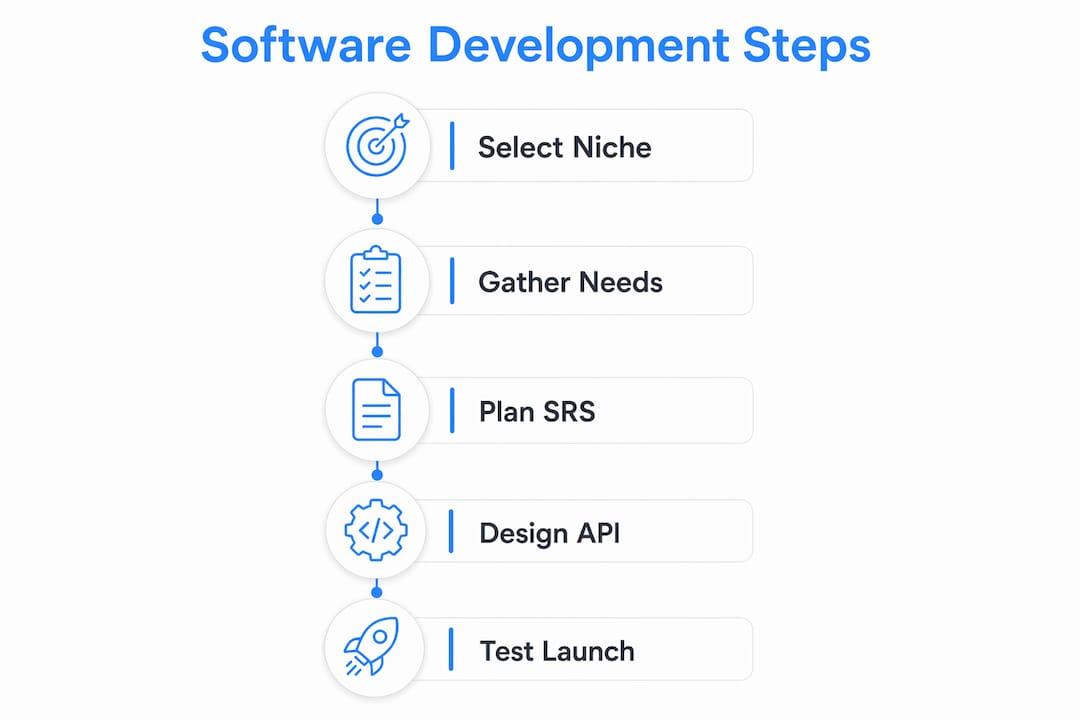
Industry-specific software is defined as a custom-built application that solves one or more workflows unique to a single vertical, such as healthcare, logistics, or legal services, rather than attempting to serve every business type. The recognised industry term for this category is vertical software or vertical SaaS, and understanding that distinction matters before you write a single line of code. This guide walks you through how to create industry-specific software from niche selection through to launch, with a focus on South African businesses building tailored software solutions that fit real operational needs.
How do you select the right industry and workflow to focus on first?
Vertical SaaS success depends on deep domain knowledge and focusing on one workflow completely rather than partially covering many. That single insight separates products that get adopted from products that gather dust.
The first decision is not which technology to use. It is which industry segment and which specific workflow to target. A broad market segment, such as “healthcare,” is not a niche. A niche is “private physiotherapy practices managing patient appointment scheduling and medical aid claims.” The narrower your definition, the more precisely your software can mirror the language, rules, and daily habits of its users.
How to identify the right workflow:
- Map the most painful and most frequent tasks in the target industry. Frequency matters as much as pain. A workflow that causes frustration once a year is a poor MVP candidate.
- Confirm that potential clients are already paying for a solution, even a clunky one. Choosing a reachable market that already pays for a painful workflow significantly improves your chances of commercial success.
- Assess your own domain access. Can you get five industry practitioners to spend an hour with you each week? If not, your feedback loop will be too slow.
- Consider South African industry context. Sectors such as construction project management, fleet logistics, and property rental administration carry compliance and workflow requirements that generic platforms like Xero or Salesforce do not fully address.
Pro Tip: Before committing to an industry, spend two weeks shadowing a practitioner in that sector. You will learn more about workflow pain in those two weeks than in three months of desk research.
Selecting a high-impact task for your MVP is the single decision with the highest return on investment in the entire development process. Get this right, and every subsequent phase becomes more focused and less expensive.
What are the essential requirements and planning steps?
Requirements are the foundation of any industry-focused application design. Without precise, verifiable requirements, your development team builds assumptions rather than solutions.

The standard document for capturing these requirements is a Software Requirements Specification, or SRS. An SRS defines what the software must do, for whom, and under what conditions. Requirements documents should explain “why and for whom” alongside “what done looks like” to align business and engineering teams effectively. That dual purpose reduces rework and prevents the common failure where developers build exactly what was written but not what was meant.
Steps to build a solid SRS for industry-specific development:
- Write user stories with acceptance criteria. Each story follows the format: “As a role], I need [capability] so that [outcome].” Acceptance criteria define the conditions under which the story is complete. [Pairing user stories with acceptance criteria reduces ambiguity between business and engineering teams.
- Make every requirement verifiable. A requirement like “the system must be fast” cannot be tested. “The system must return search results within 1.5 seconds for datasets up to 10,000 records” can be tested and verified.
- Build a traceability matrix. This links each requirement to a design decision and a test case. Traceability connects requirements to design and test artefacts, forming a verification chain that auditors and stakeholders can follow.
- Run a stakeholder review before development begins. Present the SRS to at least three industry practitioners and one technical lead. Capture their sign-off in writing.
- Flag regulated requirements separately. If your software touches medical devices, financial transactions, or safety-critical systems, standards like IEC 62304 apply. Requirements in regulated settings must be verifiable, traceable, and verified before the next lifecycle phase begins.
Pro Tip: Create a simple one-page requirements summary for non-technical stakeholders. Use plain language, no acronyms, and include a visual workflow diagram. Stakeholders who understand the requirements are far more likely to give useful feedback.
A well-constructed SRS is not bureaucracy. It is the single document that prevents your project from drifting into scope creep and budget overruns. For custom software development projects, this planning phase typically saves more time than it costs.
How to design and develop industry-specific software with an API-first mindset
The most common technical mistake in building niche software is designing the database first and the API second. This approach produces software that works internally but integrates poorly with the external systems your clients already use.
API-first architecture inverts that sequence. You design the API contract before writing any implementation code. API-first architecture designs the API contract before implementation, enabling better integration and future system scalability. For industry software, this matters because your clients will always need your system to talk to their accounting platform, their ERP, or their government reporting portal.
Core principles for API-first, industry-focused design:
- Model your data around industry entities, not generic tables. A logistics platform should have entities like “Consignment,” “Proof of Delivery,” and “Driver Manifest,” not generic “Item” and “Record” tables. Generic data models used first lead to awkward workflows and expensive refactors later.
- Treat data contracts as first-class APIs. Integration data contracts should carry explicit semantics, versioning, lifecycle management, and ownership. This prevents semantic drift when your software connects to third-party systems.
- Use semantic versioning from day one. Version your API as v1, v2, and so on. Clients who integrate with v1 should never be broken by a v2 release.
- Document your API before you build it. Tools like Swagger (OpenAPI) let you publish a contract that both your front-end team and your clients can review before a single endpoint exists.
| Design approach | Outcome |
|---|---|
| Database-first | Fast to start, expensive to integrate later |
| API-first | Slower to start, integrates cleanly from launch |
| Industry entity modelling | Mirrors client workflows, reduces training time |
| Generic CRUD modelling | Requires client adaptation, increases support load |
The table above shows why the API-first approach, though it requires more upfront planning, produces software that fits naturally into existing industry workflows. For South African businesses building niche software in sectors like property management or healthcare administration, this integration readiness is often the deciding factor in client adoption.
What are best practices for testing, compliance, and launching industry software?
Testing industry-specific software is not the same as testing a general consumer app. Your clients operate within workflows that carry legal, financial, or safety consequences. A bug in a payroll module or a medical records system is not a minor inconvenience. It is a compliance failure.
A structured approach to quality and launch:
- Verify requirements before writing code. Verification of requirements before design ensures they are complete, consistent, verifiable, and traceable. This is a lifecycle gate, not an optional step.
- Separate verification from testing. Verification asks: “Are we building the right thing?” Testing asks: “Are we building it correctly?” Both questions need answers before you ship.
- Run user acceptance testing with real industry practitioners. Synthetic test cases miss the edge cases that practitioners encounter daily. Invite three to five clients to run their actual workflows through the software before launch.
- Integrate with existing systems in a staging environment first. Never test integrations in production. South African businesses often connect to systems like Sage Pastel or SARS eFiling, and integration failures in live environments carry real financial risk.
- Plan a phased rollout. Launch with one client, one workflow, and one integration. Stabilise that before expanding. This approach reduces the blast radius of any post-launch issues.
“Failing idea selection is a major risk rather than engineering execution.” This observation from vertical SaaS practitioners confirms that most industry software failures happen before development begins, not during it.
Compliance checkpoints are not the end of the process. They are gates throughout it. For regulated South African industries, including medical devices, financial services, and construction safety, build your compliance review into each sprint rather than treating it as a final sign-off.
Key takeaways
Creating industry-specific software requires a focused niche, precise requirements, API-first design, and phased testing before any launch can succeed.
| Point | Details |
|---|---|
| Choose a specific niche | Target one industry segment and one painful, frequent workflow before writing any code. |
| Build a verifiable SRS | Every requirement must be testable and traceable to a design decision and a test case. |
| Design APIs before data models | API-first architecture prevents costly integration refactors after launch. |
| Test with real practitioners | User acceptance testing with actual industry clients surfaces edge cases synthetic tests miss. |
| Launch in phases | Start with one client and one workflow to contain risk and gather focused feedback. |
Why most industry software fails before the first line of code
I have seen this pattern more times than I care to count. A business leader has a genuinely good idea for a niche application. The domain knowledge is there. The market need is real. But the project stalls or ships something that nobody actually uses, and the reason is almost always the same: the team tried to solve too much at once.
The instinct to build a complete platform from day one is understandable. You want to justify the investment. You want to impress early clients. But vertical software built for a specific industry succeeds precisely because it does one thing exceptionally well, not because it does everything adequately.
The other failure I see consistently is poor stakeholder involvement during requirements. Developers get a brief, disappear for three months, and return with something technically correct but operationally wrong. The fix is not more documentation. It is more conversation. Weekly check-ins with one or two industry practitioners during the build phase catch misalignments before they become expensive.
My honest advice: resist the urge to build features your clients have not asked for. Build the one workflow they cannot live without, build it to a high standard, and ship it. Everything else follows from there.
— Anton
How Cloudfusion helps businesses build tailored industry software
Cloudfusion works with South African businesses to design and build custom web applications that fit specific industry workflows rather than forcing businesses to adapt to generic platforms. The team brings both technical depth and local market knowledge to each project, from requirements specification through to API integration and launch.
Whether you are building a niche property management tool, a logistics tracking application, or a compliance-driven healthcare platform, Cloudfusion’s development process is built around your industry’s actual workflows. The team also supports mobile app development for businesses that need field-based or client-facing solutions alongside their core platform. Give us a shout to discuss your project needs and find out how we can help you build software your industry will actually use.
FAQ
What is industry-specific software?
Industry-specific software, also called vertical software or vertical SaaS, is a custom application built to solve workflows unique to one industry sector rather than serving a broad general market.
How do I choose which industry workflow to build first?
Focus on the workflow that is both the most painful and the most frequent for your target clients. Workflows that clients are already paying to solve, even with imperfect tools, are the strongest MVP candidates.
What is an SRS and why does it matter for niche software?
An SRS (Software Requirements Specification) is a document that defines what the software must do, for whom, and under what conditions. It ensures every requirement is verifiable and traceable, which reduces rework and supports compliance in regulated industries.
Why is API-first design important for industry-focused applications?
API-first design means the integration contract is defined before any code is written. This ensures your software connects cleanly to the external systems your clients already use, without requiring expensive refactors after launch.
How long does it take to build industry-specific software?
Timeline depends on workflow complexity and integration requirements, and is not publicly fixed. A focused MVP covering one end-to-end workflow typically takes three to six months from requirements sign-off to launch, assuming regular stakeholder involvement throughout.
Recommended