

Product design services: your 2026 business guide
Unlock the future with expert product design services. Our 2026 guide helps you navigate every phase from conception to launch!
Start reading
TL;DR:
- Product design services follow a structured, multi-phase process to develop validated, user-centered products ready for market. They encompass discovery, research, iteration, prototyping, and handoff, with costs and timelines differing for physical and digital products. Effective collaboration and clear deliverables reduce costly rework and ensure successful product launches.
Product design services are defined as a structured, multi-phase process that transforms a business concept into a validated, user-centred product ready for market launch. Whether you are developing a physical hardware device or a digital application, the process spans discovery, user research, design iteration, prototyping, and engineering handoff. A full design process typically runs 8 to 16 weeks, covering every phase from stakeholder alignment to production-ready documentation. In 2026, physical product design budgets range from R15,000 to R75,000 and beyond, while digital MVP design cycles commonly sit between R50,000 and R120,000. Understanding this scope upfront helps you plan realistically and choose the right partner.
What are the key phases of product design services?
Product design services follow a defined sequence of phases, each producing specific deliverables that feed the next stage. Skipping or compressing phases is the most common cause of expensive rework. Fast-turnaround quotes often omit research or validation steps entirely, which creates downstream problems that cost far more to fix than the time saved upfront.
The standard phases work as follows:
- Discovery and strategy. The team conducts stakeholder interviews, maps user needs, and defines the core problem. Deliverables include a project brief, user personas, and a validated problem statement.
- Research and validation. User interviews, competitive analysis, and early concept testing happen here. The goal is to confirm assumptions before committing design resources.
- Design iteration. This phase produces wireframes, high-fidelity UI designs, interaction specifications, and design systems. For physical products, it includes concept sketches and 3D modelling.
- Prototyping and testing. Typical deliverables include concept prototypes, functional prototypes, and production-intent models. Digital products produce clickable prototypes tested with real users.
- Handoff and implementation. Developer specifications, annotated designs, CAD files, manufacturing documentation, and UX flow diagrams are packaged for the engineering or development team.
Each phase builds on the last. Discovery without research produces assumptions. Research without iteration produces reports that gather dust. The full sequence is what converts an idea into a product that actually works in the hands of a real user.
Pro Tip: Request a phase-by-phase deliverables list before signing any contract. If a provider cannot specify what you will receive at the end of each phase, that is a red flag worth taking seriously.

How do physical and digital product design services differ?
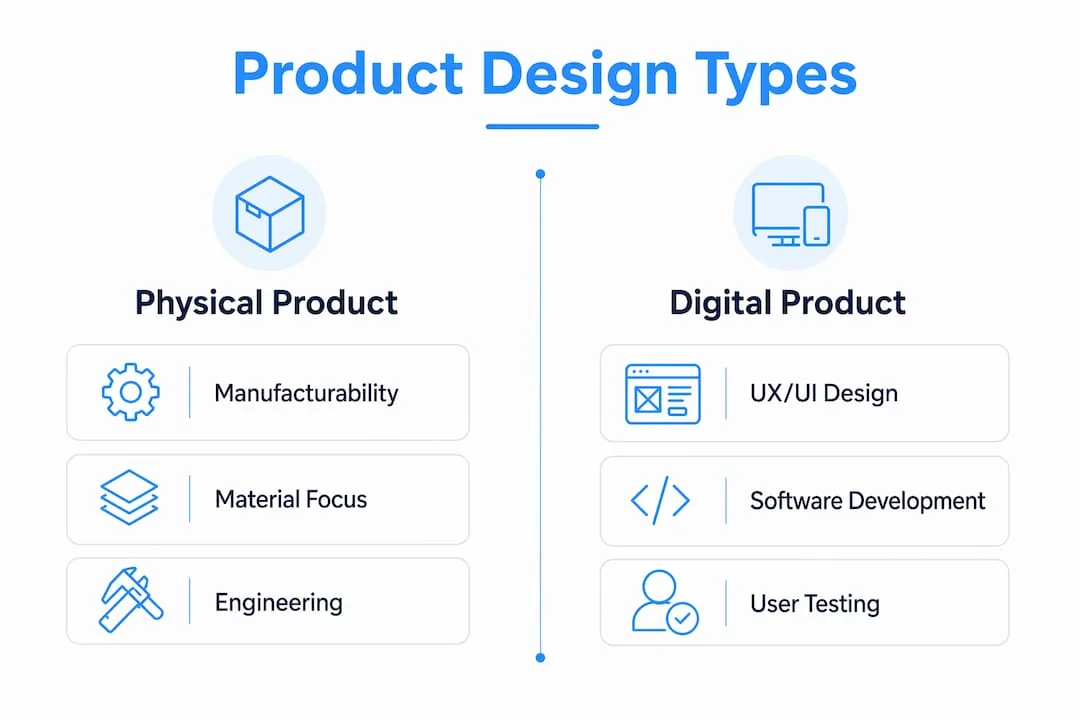
The distinction between physical and digital product design services is more significant than most businesses expect. Both disciplines share user research and iterative design principles, but the technical requirements, cost structures, and timelines diverge considerably.
| Dimension | Physical product design | Digital product design |
|---|---|---|
| Core disciplines | Industrial design, mechanical engineering, DFM | UX design, UI design, usability testing |
| Key deliverables | CAD models, 3D prototypes, manufacturing specs | Wireframes, clickable prototypes, design systems |
| Prototype cost range | R1,000 to R180,000+ depending on method | R5,000 to R30,000 for interactive prototypes |
| Typical timeline | 12 to 24 weeks for production-ready design | 8 to 16 weeks for MVP design cycle |
| Regulatory considerations | ISO 13485, FDA QMSR for medical devices | WCAG accessibility, POPIA compliance |
Physical product design demands manufacturability thinking from day one. Design for Manufacturability checks run iteratively at multiple gates rather than as a single final review, which significantly reduces late-stage tooling errors and production delays. For regulated products such as medical devices, strict documentation per ISO 13485 applies at every design phase, including formal design reviews and documented inputs and outputs.
Digital product design, by contrast, focuses on user interface logic, interaction flows, and developer handoff quality. Effective mobile app design can drive significantly higher user engagement, which makes the investment in thorough UX research and iteration directly measurable in product performance. The key difference is that digital products can be iterated post-launch at relatively low cost, while physical products carry tooling and manufacturing costs that make late changes extremely expensive.
Key considerations when choosing between the two service types:
- Physical product design requires vendors with engineering and manufacturing network access.
- Digital product design requires vendors with strong UX research and developer handoff capabilities.
- Hybrid products, such as IoT devices, require both disciplines working in parallel.
- Product design blends aesthetics, strategy, user experience, engineering precision, and market insights to ensure commercial success across both categories.
What budget should you plan for product design services in 2026?
Budget planning for product design services requires understanding both the phase-based cost structure and the variables that shift prices significantly. The ranges below reflect 2026 market rates and apply to both physical and digital product development services.
Physical product design cost breakdown:
| Phase | Typical cost range |
|---|---|
| Discovery and strategy | R55,000 to R185,000 |
| Detailed design | R185,000 to R740,000 |
| Prototyping | R90,000 to R460,000 |
| Testing and validation | R90,000 to R555,000 |
These figures align with stage-based cost breakdowns for physical products, where discovery runs $3,000 to $10,000 and detailed design reaches $10,000 to $40,000 at current exchange rates.
Prototype costs vary most dramatically based on manufacturing method. 3D printed prototypes cost approximately $20 to $200 per unit, while injection-moulded prototypes with tooling run $1,000 to $10,000 and beyond. This means multiple prototype iterations at varying fidelity levels, from concept to functional to production-intent, must be budgeted as separate line items rather than a single cost.
For digital products, MVP design cycles typically cost between $50,000 and $120,000, with fully engineered physical prototypes reaching $150,000 and above. South African businesses working with local agencies will find rates more competitive, though international-standard quality requires investment in the discovery and research phases that cheaper quotes routinely exclude.
Hidden costs that businesses consistently underestimate include user testing incentive payments, regulatory compliance documentation, travel for on-site manufacturing reviews, and design system maintenance post-handoff. Building a 15% contingency into your design budget is standard practice for any product development project.
Pro Tip: When comparing proposals, ask each provider to itemise costs per phase. A quote that bundles everything into a single figure almost always means the research and validation phases are either minimal or absent.
What are best practices for working with product design providers?
Getting the most from a product design engagement depends as much on how you manage the relationship as on which provider you choose. The following practices separate successful product launches from expensive redesigns.
- Define deliverables in writing before work begins. A Statement of Work should specify exactly what you receive at each phase gate, including file formats, documentation standards, and review cycles.
- Map design deliverables to engineering and manufacturing gates. Aligning design outputs to downstream production steps, including locking tolerances and material decisions at the right time, prevents tooling delays and vendor coordination failures.
- Run DFM checks iteratively, not once at the end. Iterative DFM reviews at multiple project gates catch problems when they are still inexpensive to fix, rather than after tooling has been commissioned.
- Protect the research and prototyping phases. These are the phases most often cut when budgets tighten, and they are the phases that prevent the most expensive mistakes. User testing with five to eight representative users typically surfaces 85% of critical usability issues.
- Establish a single point of contact on both sides. Fragmented communication between multiple stakeholders and multiple designers produces inconsistent decisions and scope creep.
- Watch for red flags. Unrealistic timelines under four weeks for a full design cycle, vague deliverable descriptions, and missing documentation standards are reliable indicators of a provider who will create problems rather than solve them.
For digital products, applying UX design strategies that are grounded in user behaviour data produces measurably better outcomes than designing from assumptions. The same principle applies to physical products: decisions made without validated user research are guesses, regardless of how experienced the designer is.
Pro Tip: Schedule a mid-project design review with your engineering or development team before the handoff phase begins. Catching misalignments between design intent and technical feasibility at this point costs a fraction of what it costs to fix after handoff.
Key takeaways
Effective product design services require a structured, phase-based process with clearly defined deliverables, validated user research, and iterative prototyping to reduce costly rework and deliver market-ready products.
| Point | Details |
|---|---|
| Full process takes 8 to 16 weeks | Shorter timelines risk skipping research and validation, leading to expensive rework. |
| Physical and digital design differ significantly | Hardware requires DFM and engineering alignment; digital requires UX research and developer handoff quality. |
| Budget by phase, not total project | Discovery, design, prototyping, and testing each carry distinct costs that must be planned separately. |
| Deliverables must be contractually defined | A Statement of Work specifying phase outputs protects both parties and keeps projects on track. |
| Iterative DFM checks reduce production risk | Running manufacturability reviews at multiple gates prevents late-stage tooling errors and delays. |
Why I think most businesses underinvest in the design process
Most businesses treat product design services as a cost to minimise rather than a risk management tool. I have seen this pattern repeatedly: a business compresses the discovery phase to save two weeks and three weeks of budget, then spends six months and ten times the money fixing a product that missed the user need entirely.
The South African market adds a specific layer of complexity here. Local manufacturing networks are smaller, tooling lead times are longer, and the cost of a late-stage design change is proportionally higher than in markets with dense supplier ecosystems. This makes the upfront investment in thorough research and iterative prototyping even more critical, not less.
The businesses that get the best results from custom product design are the ones that treat their design partner as a strategic collaborator rather than a vendor executing a brief. They share business context, they participate in user research sessions, and they make decisions based on validated data rather than internal opinion. That collaborative posture is what separates products that gain market traction from products that get shelved after launch.
If you are evaluating a product development agency, ask them to walk you through a project where the research phase changed the direction of the design. If they cannot give you a specific example, their process is probably not as research-driven as their proposal suggests.
— Anton
How Cloudfusion can support your product design goals
Cloudfusion works with South African businesses and entrepreneurs to design and build digital products that are grounded in user research and built for real-world performance. From initial discovery through to custom web development and mobile application development, the team applies a structured design process that aligns every deliverable to your business objectives and technical requirements. Whether you are launching a new digital product or redesigning an existing platform, Cloudfusion brings the strategic depth and technical capability to take your concept from validated idea to production-ready solution. Give us a shout to discuss your project and get a clear picture of what the design process looks like for your specific product.
FAQ
What does a product design service typically include?
Product design services cover discovery, user research, design iteration, prototyping, testing, and engineering handoff. Deliverables range from user personas and wireframes to CAD models, annotated designs, and manufacturing documentation depending on whether the product is physical or digital.
How long does the product design process take?
A complete design process takes 8 to 16 weeks for most products. Timelines under four weeks typically skip critical research and validation phases, which increases the risk of costly rework after launch.
How do I hire a product designer or agency?
When learning how to hire a product designer, request a phase-by-phase deliverables list, ask for case studies where research changed the design direction, and confirm that the contract specifies outputs at each project gate rather than a single final deliverable.
What is the difference between industrial design and UX design?
Industrial design services focus on physical product form, materials, manufacturability, and engineering integration. UX design focuses on digital product usability, interaction flows, and interface logic. Hybrid products such as IoT devices require both disciplines working in parallel.
Why do product design costs vary so much between providers?
Cost differences reflect whether research, validation, and prototyping phases are included in the scope. Providers quoting significantly lower than market rates typically exclude these phases, which shifts the risk of design failure onto the client rather than resolving it during the design process.