TL;DR:
- Effective online retail branding creates a consistent identity that builds trust and encourages customer loyalty. It relies on visual identity, messaging, and customer experience working together across all digital channels. Maintaining strict style guides and regular audits ensures brand consistency and enhances sales performance.
Branding in online retail is defined as the deliberate creation of a consistent, recognizable identity across every digital touchpoint your store occupies. The role of branding in online retail goes far beyond a logo or colour palette. It shapes how customers perceive your store before they read a single product description, and it determines whether they return after their first purchase. Strong branding builds trust, reduces your dependence on paid advertising, and directly increases customer lifetime value. For e-commerce entrepreneurs and retail managers competing in a crowded digital market, branding is not a creative luxury. It is an operational necessity.
What are the core components of effective online retail branding?
Effective online retail branding rests on three interconnected pillars: visual identity, messaging, and customer experience. Each pillar must work in concert with the others to create a coherent impression across every channel your customers encounter.

Visual identity
Visual identity is the most immediate signal your brand sends. Ecommerce branding extends beyond logos to include consistent product photography style, packaging, typography, and web layout. Each of these elements contributes to how quickly shoppers recognise your store and decide to trust it. Consistent product photography is often the strongest immediate branding signal shoppers perceive before reading product copy. Inconsistent imagery reduces trust, while consistent visuals create a polished and memorable shopping experience.
Messaging
Messaging reflects your brand’s mission, values, and personality. It answers the question every potential customer asks: why should I buy from you instead of someone else? Your tone of voice in product descriptions, email campaigns, and social media posts must align with the values your visual identity projects. A brand that looks premium but writes casually creates cognitive dissonance. That dissonance costs you conversions.
Customer experience
Digital branding involves shaping brand perception across all digital channels, including websites, emails, social media, and ads, for a coherent customer experience. Consistency across these touchpoints strengthens brand identity and customer trust. A shopper who clicks a Facebook ad and lands on a product page that looks completely different from the ad will hesitate. That hesitation is a direct result of poor brand alignment, and it shows up in your bounce rate.
- Logo and colour palette: Use the same hex codes, fonts, and logo variations across your website, email templates, and marketplace listings.
- Typography: Choose two typefaces maximum and apply them consistently across all digital assets.
- Product photography style: Standardise backgrounds, lighting, and angles so every product image feels like it belongs to the same family.
- Tone of voice: Document your brand’s personality traits and apply them to every piece of copy your team produces.
- Brand style guide: Create a single reference document that governs all of the above and share it with every team member and supplier.
Pro Tip: Create a one-page brand quick-reference card from your full style guide. Pin it to your team’s shared workspace so every designer, copywriter, and ad manager has instant access to your core visual and messaging rules.
How does branding impact sales performance and customer engagement?
Branding builds the trust that converts browsers into buyers. 90% of customers cite brand loyalty as a key reason for buying, which means the brands that win repeat purchases are the ones that have invested in a recognizable and trustworthy identity. That loyalty translates directly into higher customer lifetime value and lower customer acquisition costs over time.
Online retail accounts for over 20% of worldwide retail sales in 2026. That scale means the competition for customer attention has never been more intense. In that environment, a strong brand identity is what separates stores that grow organically from those that remain permanently dependent on paid traffic to survive.
The financial logic is straightforward:
- Lower acquisition costs: Customers who recognise and trust your brand convert at higher rates from organic search, email, and social media. You spend less per sale.
- Higher lifetime value: Loyal customers buy more frequently and spend more per order. Brand trust is the primary driver of that loyalty.
- Reduced price sensitivity: Customers with a strong emotional connection to a brand are less likely to abandon a purchase because of a competitor’s discount.
- Improved conversion rates: Visual branding enhances clarity, credibility, and expectation alignment, supporting wider merchandising and conversion rate optimisation efforts.
Branding does not work in isolation. Pricing, user experience, offer strength, and traffic quality all contribute to sales performance. Branding amplifies the effect of every other element when it is done well. It is the foundation on which all other marketing activity builds.
How do you maintain branding consistency across digital channels?
Maintaining branding consistency requires operational discipline, not just creative intent. Successful branding requires strict brand style guides that link paid ads directly to product detail pages, ensuring customers feel they have landed in the right place instantly. This is not a one-time design exercise. It is an ongoing management process.
- Create a detailed brand style guide. Document your visual rules, tone of voice, and messaging hierarchy in a single source of truth. Include specific rules for how your brand appears on paid ads versus product pages versus email campaigns.
- Audit every digital touchpoint quarterly. Check your website, marketplace listings, email templates, and social media profiles against your style guide. Inconsistencies accumulate over time and erode trust.
- Apply bridge image rules to paid advertising. Brand style guides include strict bridge image rules beyond hex codes to connect paid advertising to product pages visibly. The image a customer sees in an ad should match the imagery on the landing page they arrive at.
- Use technology to manage brand assets centrally. Tools like cloud file storage allow your marketing, design, and development teams to access approved assets from a single location, preventing outdated logos or off-brand images from appearing in customer-facing materials.
Pro Tip: Assign one person in your team as the brand guardian. Their job is to review every new piece of customer-facing content against the style guide before it goes live. This single step prevents most brand consistency failures.
What branding strategies work best for e-commerce entrepreneurs?
Building a strong online brand requires a clear plan and consistent execution. The following strategies apply whether you are launching a new store or auditing an existing one.
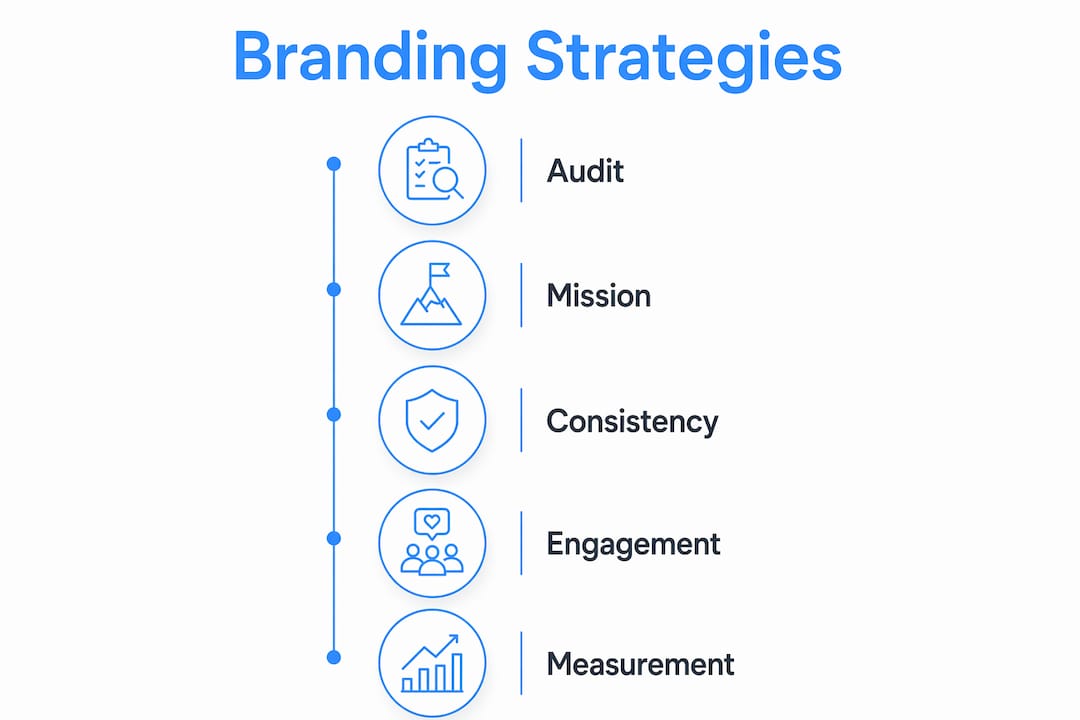
Developing a brand with a clear mission, core values, and a bridge strategy ensures a cohesive experience across ads, email marketing, and your website. That cohesion reduces your reliance on paid marketing over time, which is one of the most significant financial benefits of investing in branding early.
| Strategy | What it involves | Primary benefit |
|---|---|---|
| Brand audit | Assess current visual and messaging consistency across all channels | Identifies gaps before they cost you customers |
| Customer-centric storytelling | Use customer language, reviews, and stories in your brand narrative | Builds emotional connection and trust |
| Data-driven audience targeting | Use analytics to understand who your customers are and what they value | Aligns branding with actual buyer behaviour |
| High-quality product photography | Invest in professional, consistent imagery across all product listings | Increases perceived quality and conversion rates |
| Cross-channel coordination | Align branding across social media, email, marketplaces, and your website | Strengthens recognition and reduces confusion |
Understanding what digital branding means for your business is the starting point for any of these strategies. Without a clear definition of what your brand stands for, execution across channels becomes inconsistent by default.
Knowing how to measure brand awareness is equally important. You cannot improve what you do not measure. Track metrics like direct traffic volume, branded search queries, email open rates, and repeat purchase rates to gauge whether your branding investment is paying off.
Brand consistency across marketing, your website, and every customer touchpoint is not just a design preference. It is a measurable business driver that affects revenue directly.
Key takeaways
Branding in online retail is an operational discipline that builds trust, reduces acquisition costs, and drives customer loyalty across every digital channel.
| Point | Details |
|---|---|
| Visual identity drives first impressions | Consistent photography, typography, and colour across all channels build trust before customers read a word. |
| Brand loyalty influences purchasing decisions | 90% of customers cite brand loyalty as a key reason for buying, making it a direct sales driver. |
| Branding lowers acquisition costs | A recognizable brand converts more customers from organic channels, reducing dependence on paid advertising. |
| Style guides operationalize consistency | A detailed brand style guide with bridge image rules prevents trust erosion across ads and product pages. |
| Measure to improve | Track branded search, direct traffic, and repeat purchase rates to assess whether your branding is working. |
Branding in South African e-commerce: what I’ve actually seen work
The South African online retail market has its own character, and that shapes how branding needs to work here. Consumers are increasingly sophisticated, but they are also acutely aware of value. A brand that looks polished but prices itself out of the local market will struggle regardless of how good its visual identity is. The brands I see succeeding locally are the ones that align their visual and messaging identity with genuine local relevance, not just global design trends.
The biggest mistake I observe is treating branding as a once-off project. A business invests in a logo and a website, then lets both drift as the team grows and new people start producing content without referencing any style guide. Within 18 months, the brand looks fragmented. Customers notice, even if they cannot articulate why. They simply feel less confident buying.
What actually works is treating branding like a system, not a campaign. That means documented rules, regular audits, and someone accountable for enforcement. It also means integrating your brand identity directly into your website architecture and your marketing technology stack, so consistency is built into the process rather than policed after the fact. For South African retailers competing against both local players and international platforms, that operational discipline is the real differentiator.
— Anton
How Cloudfusion can build your online brand
Cloudfusion works with e-commerce entrepreneurs and retail managers who need more than a good-looking website. The team integrates brand strategy directly into custom web development so your visual identity, messaging, and customer experience are built into the architecture of your store from day one. Cloudfusion’s branding services cover everything from visual identity creation to style guide development, ensuring your brand remains consistent as your business grows. For teams managing content across multiple locations, cloud file storage keeps brand assets centralised and accessible. Give us a shout if you are ready to build a brand that works as hard as your products do.
FAQ
What is the role of branding in online retail?
Branding in online retail creates a consistent, recognizable identity across all digital touchpoints that builds customer trust and drives repeat purchases. It reduces reliance on paid advertising by strengthening organic recognition and customer loyalty.
How does branding affect e-commerce sales?
Strong branding increases conversion rates by building credibility and aligning customer expectations before purchase. It also raises customer lifetime value by fostering loyalty that drives repeat buying behaviour.
What should a brand style guide include for an online store?
A brand style guide for an online store should document your logo usage rules, colour palette, typography, tone of voice, and product photography standards. It should also include bridge image rules that connect your paid advertising visuals directly to your product pages.
How do you measure branding effectiveness in e-commerce?
Track branded search query volume, direct website traffic, repeat purchase rates, and email open rates to assess branding impact. Rising numbers in these metrics indicate that customers are actively seeking out your brand rather than discovering it through paid channels.
Why is brand consistency important across digital channels?
Inconsistency across channels creates doubt in the customer’s mind and increases the likelihood of abandonment. Consistent branding across your website, ads, email, and marketplace listings reinforces trust at every stage of the buying journey.
Recommended