TL;DR:
- Mobile apps serve as essential tools for startups to access markets, improve customer engagement, and operate efficiently. They provide a direct channel to users, enabling better retention, personalized experiences, and operational automation that websites cannot match.
Mobile apps are the primary channel through which startups access markets, engage customers, and build lasting brand presence in 2026. The role of mobile apps in startups has shifted from optional investment to foundational business infrastructure. Mobile apps give startups direct access to billions of smartphone users worldwide, a reach that no website or social media profile alone can match. Startups that treat app development as a core part of their go-to-market strategy gain measurable advantages in customer acquisition, retention, and operational efficiency. This guide breaks down exactly how mobile apps drive growth, what best practices actually work, and why South African founders cannot afford to ignore the mobile opportunity.
How do mobile apps drive growth and market access for startups?
Mobile apps give startups a direct channel to customers that websites and social media cannot replicate. A website requires a user to open a browser, search, and navigate. An app sits on the home screen, ready to engage the moment a customer picks up their phone. That difference in friction is the difference between a one-time visitor and a loyal user.
Continuous brand presence on devices builds stronger customer engagement and loyalty than websites alone. Every time a user scrolls past your app icon, your brand registers. That passive exposure compounds over time into recognition and trust, which are the two things a new startup needs most.
The growth mechanics of mobile apps work across three distinct areas:
- Customer acquisition: App store listings on Google Play and the Apple App Store function as additional discovery channels. Users searching for solutions in your category find your product without paid advertising.
- Customer retention: Push notifications and personalised in-app content keep users returning. Direct communication through apps maintains ongoing user relationships far more effectively than email campaigns.
- Scalability: App platforms handle user growth without proportional increases in infrastructure cost. A startup can go from 500 to 50,000 users without rebuilding its core system.
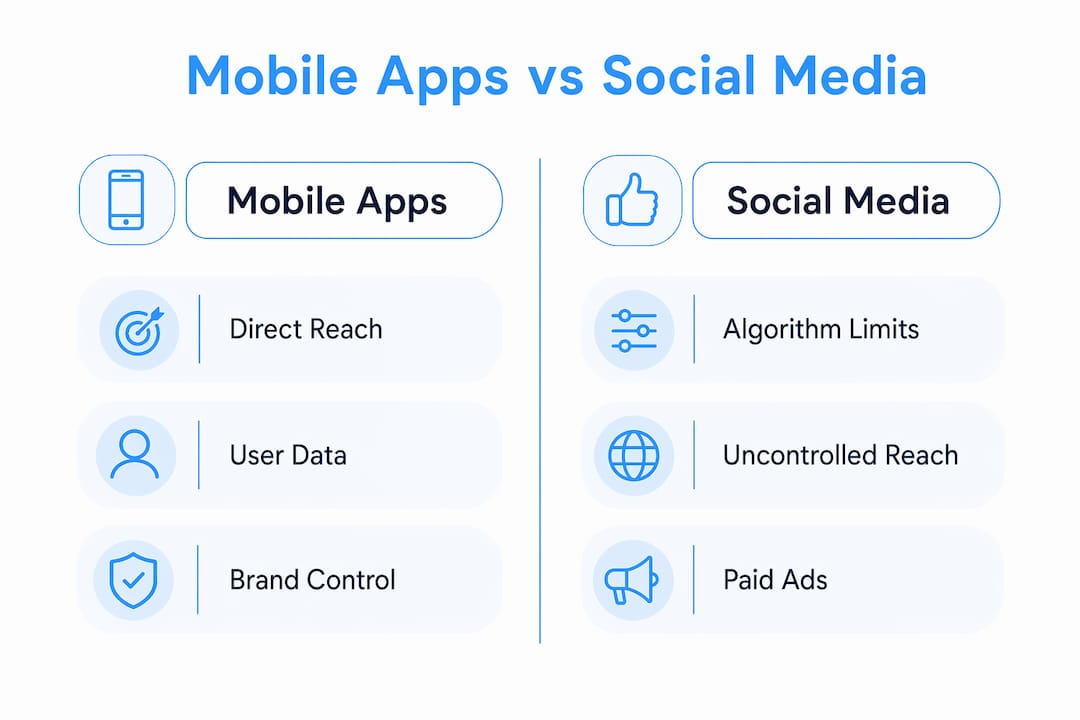
Contrast this with a social media-only strategy. Social platforms control your reach, change their algorithms, and charge for visibility. An app gives you a direct, owned relationship with every user who installs it.
Pro Tip: Build your app’s onboarding flow before you build any other feature. The first three minutes a new user spends in your app determine whether they stay or delete it.
In what ways do mobile apps enhance customer engagement and brand visibility?
Mobile apps create a level of brand engagement that no other digital channel matches. The app icon on a user’s device is a daily brand impression that costs nothing after installation. That persistent visibility is one of the most underrated mobile application benefits for startups operating on tight marketing budgets.

Push notifications and real-time updates increase user re-engagement in ways that email simply cannot. Email open rates are notoriously low. A well-timed push notification, by contrast, appears directly on the lock screen and demands attention. The key is relevance: notifications tied to user behaviour or preferences convert far better than broadcast messages.
Four mechanisms drive deeper engagement through mobile apps:
- Personalised user experiences: Apps collect behavioural data and use it to tailor content, recommendations, and offers to each individual user. This personalisation increases satisfaction and time spent in the app.
- Loyalty programmes: In-app reward systems, points tracking, and exclusive offers give users a reason to return. Startups like Yoco and SnapScan in South Africa have used app-based loyalty mechanics to build sticky user bases.
- AI-powered chatbots and support: AI integration via mobile apps reduces operational costs while improving response times. An AI Receptionist System embedded in an app handles routine queries around the clock without adding headcount.
- Direct marketing channel: Apps reduce dependence on paid advertising by giving startups a free channel to communicate promotions, product updates, and content directly to opted-in users.
“Mobile apps have shifted from luxury investments to mandatory strategic assets that continuously engage users directly on their devices.” — BlogsGod.com
The cost implication is significant. A startup that builds a strong app-based engagement loop spends less on paid acquisition over time because retention replaces the need for constant top-of-funnel spend.
How do mobile apps improve operational efficiency in startups?
Operational efficiency is where mobile apps deliver value that founders often overlook during the planning phase. Most startup founders think of apps as customer-facing tools. The internal operational benefits are equally powerful.
Automation through apps reduces manual work and human error. Booking systems, payment processing, inventory updates, and customer communication can all run through a single app interface. That consolidation cuts the time your team spends on repetitive tasks and redirects it toward growth activities.
Data insights from mobile apps reveal user behaviour, preferences, and engagement patterns in real time. These insights inform product decisions, marketing strategies, and feature prioritisation. A startup that knows exactly which features users engage with most can allocate development resources with precision rather than guesswork.
Key operational advantages mobile apps deliver:
- Integrated communication: Systems like AI Receptionist tools embedded in apps handle inbound queries, appointment scheduling, and follow-ups automatically.
- Real-time analytics: App dashboards give founders live data on user activity, conversion rates, and drop-off points. This replaces the lag of monthly reports with daily decision-making capability.
- Reduced support costs: Self-service features within apps, such as FAQ sections, order tracking, and account management, reduce the volume of support tickets your team handles.
- Mobility for internal teams: Field teams, sales staff, and remote workers access business systems through mobile apps, removing the dependency on desktop infrastructure.
Pro Tip: Connect your app’s analytics to a tool like Google Analytics for Firebase from day one. The data you collect in the first 90 days will shape every product decision you make in year one.
What are best practices for developing a successful startup app?
The single most important principle in startup app development is the Minimum Viable Product, or MVP. An MVP is the version of your app with only the core features needed to solve the user’s primary problem. You launch it early, collect real feedback, and improve from there. Lean MVP development reduces time and cost while validating product-market fit before full-scale investment.
The failure mode most startup founders fall into is building too much before launching. They spend six months adding features, then discover that users wanted something different. An MVP approach compresses that feedback loop from months to weeks.
The table below compares the two dominant development approaches for startups:
| Approach | Time to launch | Cost | Risk level | Best for |
|---|---|---|---|---|
| MVP (lean build) | 6–12 weeks | Low to medium | Low | Early-stage startups validating ideas |
| Full-feature build | 6–18 months | High | High | Funded startups with proven demand |
Align every feature decision with a specific business goal or user need. If a feature does not directly support acquisition, retention, or revenue, cut it from the first version. You can always add it later once the core product proves itself.
Iterating based on user feedback is not a sign of poor planning. It is the method. Successful startup app development prioritises lean, usable MVPs with disciplined build-launch cycles rather than feature-heavy slow builds. The startups that win are the ones that ship, learn, and improve faster than their competitors.
For founders exploring lean app development strategies, the build-measure-learn cycle is the framework that separates sustainable growth from expensive guesswork.
How do mobile apps position South African startups in the digital market?
South Africa presents a specific and compelling case for mobile-first startup strategy. Smartphone penetration continues to grow across the country, and a large portion of South Africans access the internet primarily through their phones rather than desktop computers. This makes mobile apps not just useful but the primary interface between startups and their customers.
Local consumer behaviour strongly favours mobile-first solutions. South African users expect to pay, book, communicate, and shop through their phones. Startups that meet users on mobile convert at higher rates than those relying on desktop web experiences.
| Market factor | Impact on South African startups |
|---|---|
| High mobile internet usage | Apps reach users who rarely use desktop browsers |
| Growing middle-class smartphone adoption | Expanding addressable market for consumer apps |
| Underserved rural and peri-urban markets | Mobile apps bridge geographic gaps in service delivery |
| Competitive fintech and e-commerce sectors | App quality directly determines market share |
Startups without mobile apps risk losing customers to competitors who offer better mobile experiences. This is not a future risk. It is the current reality in sectors like fintech, retail, healthcare, and logistics across South Africa.
South African startups also have the advantage of building for a mobile-first market from the start, rather than retrofitting desktop products for mobile. That greenfield position is a genuine competitive edge when executed well. Founders who want to understand mobile app development in South Africa will find that local context shapes both the technical requirements and the user experience decisions.
Key takeaways
Mobile apps are the most direct and cost-effective channel startups have to acquire customers, retain them, and run leaner operations at scale.
| Point | Details |
|---|---|
| Apps outperform websites for retention | Continuous device presence and push notifications keep users engaged far better than browser-based channels. |
| MVP approach reduces launch risk | Launching with core features first validates demand before significant investment is committed. |
| Operational automation cuts costs | Integrating AI tools and self-service features within apps reduces support and admin overhead. |
| Data insights drive better decisions | Real-time app analytics replace lagging monthly reports with daily, actionable business intelligence. |
| South Africa is a mobile-first market | High smartphone usage and mobile internet dependency make apps the primary customer touchpoint locally. |
Why I think most startups still get mobile apps wrong
Having worked with startup founders across various industries, the pattern I see most often is this: founders treat the app as the product rather than the channel. They invest months building a feature-rich application, then launch to silence because they never validated whether users actually wanted those features.
The startups that succeed with mobile apps treat the app as a living system. They launch something small, watch how users behave, and build what the data tells them to build next. That discipline is harder than it sounds, especially when you have a clear vision of what the finished product should look like. But the vision has to earn its place through user validation, not the other way around.
The other mistake I see regularly is ignoring the operational side of apps entirely. Founders focus on the customer-facing experience and miss the internal efficiency gains. An app that automates your booking confirmations, handles routine customer queries through an AI assistant, and gives your team live performance data is worth more than a beautifully designed app that only looks good.
My honest recommendation: if you are a South African startup founder deciding whether to build an app, the question is not whether to build one. The question is how to build the right one, at the right size, for the right stage of your business. Start lean. Ship early. Let your users tell you what to build next. That approach consistently outperforms the big-bang launch strategy, and it protects your capital while you find your footing.
For founders thinking about how mobile app design drives engagement, the design decisions you make in the first version set the tone for everything that follows. Get the fundamentals right before you add complexity.
— Anton
Cloudfusion’s mobile app development services for startups
Cloudfusion works with startup founders who need to move fast without burning through their budget on the wrong features. The team builds lean, well-structured mobile applications designed for rapid launch and iterative growth, with a focus on South African market requirements and user behaviour. Whether you are validating an MVP or scaling an existing app, Cloudfusion brings the technical depth and local market knowledge to get it right. Give us a shout to discuss your project, and explore our mobile app development services to see how we support startups from concept through to launch and beyond. You can also browse our custom development portfolio to see the kind of work we deliver.
FAQ
What is the role of mobile apps in startups?
Mobile apps give startups a direct, owned channel to reach customers, build brand presence, and collect user data. They support growth by improving acquisition, retention, and operational efficiency simultaneously.
How do mobile apps help startups grow faster?
Apps reduce customer friction, enable push notification re-engagement, and provide real-time analytics that inform faster product decisions. Direct market access through apps expands a startup’s reach beyond what websites or social media alone can achieve.
What is an MVP and why does it matter for startup apps?
An MVP, or Minimum Viable Product, is the simplest version of an app that solves the user’s core problem. It allows startups to launch quickly, gather real feedback, and avoid over-investing in features users may not want.
Should South African startups prioritise mobile apps over websites?
South African consumers access the internet primarily through smartphones, making mobile apps the more effective customer touchpoint for most consumer-facing startups. A mobile app and a website serve different purposes and ideally work together, but the app should come first in mobile-heavy markets.
How do mobile apps reduce startup operating costs?
Apps automate routine tasks like booking confirmations, customer queries, and payment processing. AI-powered tools embedded in apps handle support functions around the clock, reducing the need for large customer service teams at early growth stages.
Recommended