

Unlock results with a website content development plan
Learn how a structured website content development plan drives 3:1 ROI. Explore the four phases—Foundation, Blueprint, Production, and Governance—to grow results.
Start reading
TL;DR:
- Documented content strategies are three times more likely to succeed and yield higher ROI.
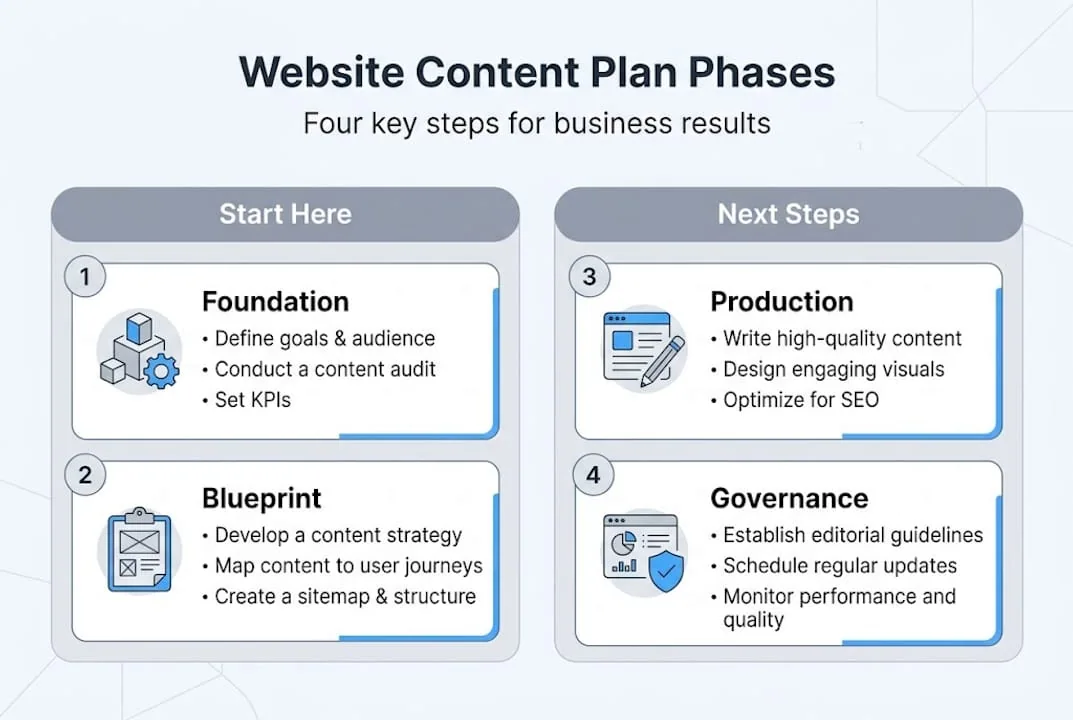
- A strong plan follows four phases: Foundation, Blueprint, Production, and Governance.
- Continuous measurement and leadership alignment are crucial for sustained content performance.
Most businesses invest in website content without a documented plan, and the performance gap is striking. B2B strategies with documentation are three times more likely to succeed, delivering an average ROI of 3:1 and up to 5:1 when paired with effective SEO. Yet the majority of organisations treat content as a series of disconnected tasks rather than a structured system. This guide walks you through the four core phases of a website content development plan, from setting strategic foundations to governing ongoing performance, so your business can move from reactive publishing to deliberate, measurable digital growth.
Table of Contents
- Core phases of an effective website content development plan
- Building your foundation: goals, personas, and alignment
- Blueprinting: auditing content, mapping architecture, and modeling
- Production: guidelines, workflow, and integrating AI with human expertise
- Governance: measuring, optimising, and continuously improving content
- What most website content plans miss—and how to future-proof yours
- See results faster with expert web development support
- Frequently asked questions
Key Takeaways
| Point | Details |
|---|---|
| Documented strategy wins | Companies with a clear, documented content plan are three times more likely to succeed and achieve strong ROI. |
| Human-AI collaboration matters | Blending AI with human oversight is key for content quality and search performance in 2026. |
| Governance enables growth | Ongoing measurement and optimization transform content from an expense into a growth asset. |
| Tailor to audience and goals | Effective plans align tightly to business objectives and audience personas for maximum impact. |
Core phases of an effective website content development plan
With the importance established, it is essential to understand what makes a strong website content plan work at every level. A well-structured plan is not a single document—it is a living system built across four distinct phases, each producing specific outputs that feed the next.
The phased approach to content development includes Foundation, Blueprint, Production, and Governance. Each phase has a clear purpose:
| Phase | Primary purpose | Key deliverable |
|---|---|---|
| Foundation | Align content to business goals | Audience personas, SMART goals |
| Blueprint | Structure and model content | IA map, content audit, content model |
| Production | Create and publish at scale | Editorial guidelines, workflow, content calendar |
| Governance | Measure and optimise | Analytics dashboard, review cadence |
Documenting every phase matters because it forces alignment across marketing, development, and leadership teams. Without written records, strategy drifts. Teams default to producing content based on opinion rather than evidence, and content ROI benchmarks remain out of reach.
Key benefits of a phased, documented approach:
- Reduces duplicated effort across teams
- Creates a shared reference point for decision-making
- Enables faster onboarding for new contributors
- Makes performance measurement consistent and repeatable
- Supports scalable content planning for business growth
Strong web design and development depends on content that is planned before a single page is built, not retrofitted after launch.
Pro Tip: Before you begin any phase, define two to three audience personas and at least one measurable business goal per persona. This single step prevents the most common cause of content failure: creating material nobody needs.
Building your foundation: goals, personas, and alignment
Once you see the complete structure, it is time to focus step-by-step, beginning with the foundation. This phase is where most plans either gain traction or quietly collapse. The reason is almost always the same: teams jump to tactics before strategy is clear.
Prioritising documented strategy aligned to business goals—and auditing existing content rigorously—is what separates high-performing content programmes from those that generate activity without results.
Here is a practical sequence for building your foundation:
- Define SMART goals. Each goal must be Specific, Measurable, Achievable, Relevant, and Time-bound. For example: increase qualified leads from organic search by 25% within six months.
- Build audience personas. Go beyond demographics. Capture decision-making triggers, objections, preferred content formats, and the questions your audience asks before buying.
- Map content to business objectives. Every content type—blog post, case study, landing page—should trace back to a specific business outcome.
- Audit existing content. Identify what is performing, what is outdated, and what gaps exist relative to your goals.
- Resolve strategy-versus-tactics misalignment. If your team is debating which social platform to use before agreeing on core messaging, you have a sequencing problem.
Understanding web development basics will also help you align content goals with the technical capabilities of your platform, so you are not planning content your site cannot effectively deliver.
The most expensive mistake in content strategy is investing in production before the foundation is solid. A well-written article targeting the wrong audience, or the wrong stage of the buyer journey, delivers zero business value regardless of its quality.
When writing for business audiences, clarity of purpose at the foundation stage directly determines the relevance and persuasiveness of every piece produced downstream.
Blueprinting: auditing content, mapping architecture, and modeling
Having clarified foundational goals and audiences, the blueprinting phase brings your strategy to life. This is where abstract goals become concrete structures your team can actually build and navigate.

A content audit is the starting point. You are cataloguing every existing page, post, and asset, then evaluating each against traffic, engagement, conversion, and strategic relevance. The output tells you what to keep, what to update, what to consolidate, and what to remove. Only 40% of B2B marketers have documented content plans, and top performers measure ROI at 84% versus 15% for those without structured approaches—a gap that often originates in skipped or shallow blueprinting.
Legacy versus modern information architecture:
| Dimension | Legacy IA | Modern flexible IA |
|---|---|---|
| Structure | Rigid, siloed by department | Modular, topic-cluster based |
| Navigation | Static menus | Dynamic, user-intent driven |
| Scalability | Breaks under volume | Designed to scale with content growth |
| SEO alignment | Page-by-page optimisation | Pillar and cluster model |
Content models define the fields, formats, and relationships for each content type on your site. They keep writers, designers, and developers aligned as you scale. Think of a content model as a blueprint that prevents your site from becoming an inconsistent patchwork of styles and structures.
Key blueprinting activities:
- Map your full site architecture using a visual tool before building or rebuilding
- Define content types (article, case study, product page, FAQ) with required fields for each
- Identify internal linking opportunities to strengthen topical authority
- Review strategy versus marketing roles to ensure the right people own each deliverable
For businesses managing large volumes of content, scalable content frameworks are essential to prevent architectural debt from accumulating as your site grows.
Production: guidelines, workflow, and integrating AI with human expertise
With a clear plan and blueprint, the focus shifts to consistent content creation and quality control. Production is where strategy becomes visible to your audience, and where discipline separates high-output teams from those that struggle to maintain momentum.
Production guidelines are the operational backbone of your content programme. Without them, quality is inconsistent and onboarding new contributors takes far too long. Your guidelines should include:
- Brand voice and tone standards. Define how your business sounds across different content types and channels.
- SEO requirements. Specify keyword integration, meta description formats, heading structure, and internal linking rules.
- Formatting conventions. Establish rules for paragraph length, use of lists, tables, and visual assets.
- Review and approval workflow. Map who reviews what, in which order, and what the sign-off criteria are.
- Publishing checklist. A final quality gate before any content goes live.
Structuring your workflow around these guidelines creates predictability. Teams know what is expected at each stage, which reduces revision cycles and accelerates output.
AI tools can significantly increase production velocity. However, AI content without human oversight risks search visibility penalties and erodes audience trust. AI scales production; human editors provide the differentiation, accuracy, and contextual judgement that builds credibility. Explore how AI for content development can accelerate your workflow, and review practical guidance on AI-powered web content to understand where automation adds value and where it requires guardrails.
Pro Tip: Treat AI as a first-draft accelerator and research assistant, not a replacement for subject-matter expertise. Every AI-generated piece should pass through a human editor who can verify facts, add original insight, and ensure the content reflects your brand’s genuine experience.
Governance: measuring, optimising, and continuously improving content
Even with strong production, only governance ensures ongoing relevance and impact. Many businesses build a solid content plan, execute it well for several months, and then watch performance plateau because no one is systematically reviewing what is working.
Top-performing content teams measure ROI at 84% versus 15% for lower performers, and 93% report positive ROI from video content specifically. These numbers reflect disciplined governance, not just better content.
Your governance framework should track metrics across three layers:
| Metric layer | Examples | Business relevance |
|---|---|---|
| Traffic and reach | Sessions, impressions, new users | Audience growth and brand visibility |
| Engagement | Time on page, scroll depth, shares | Content quality and relevance |
| Revenue impact | Leads, conversions, pipeline influenced | Direct business value |
Set up your analytics by content type and channel so you can isolate what is driving results. A blog post and a case study serve different functions in the buyer journey and should be evaluated against different benchmarks.
Ongoing optimisation activities include:
- Refreshing high-traffic pages with updated data and improved internal links
- Consolidating thin or overlapping content into stronger, more authoritative pieces
- Sunsetting content that no longer aligns with business goals or audience needs
- Running structured A/B tests on headlines, CTAs, and content formats
Review web development best practices to ensure your technical environment supports fast load times and crawlability, both of which directly affect content performance. For a deeper framework, the content governance guidelines from Harvard Business School Online offer a structured reference point.
What most website content plans miss—and how to future-proof yours
With the complete plan outlined, here is a perspective you will not find on most checklists. The most common reason content plans underperform is not a lack of tools or budget. It is the absence of strategic alignment at the leadership level. Teams chase trending formats, invest in AI platforms, and publish at volume—without ever asking whether the content is moving the business toward a specific outcome.
The concept of E-E-A-T (Experience, Expertise, Authoritativeness, Trustworthiness) is increasingly central to how search engines evaluate content quality. But more importantly, it reflects what sophisticated buyers actually respond to. Content that demonstrates genuine experience and expert judgement builds trust in ways that algorithmically generated material cannot replicate.
Businesses that will lead in 2026 and beyond are those that treat human oversight not as a cost, but as a strategic differentiator. Automation handles volume; people provide the insight and accountability that create lasting audience relationships. Explore custom web development insights to understand how strategic content planning integrates with your broader digital architecture for sustained competitive advantage.
See results faster with expert web development support
Ready to move from a fragmented content approach to a structured, results-driven plan? At CloudFusion, we work with businesses across industries to design and implement content strategies that are fully integrated with custom web development and supported by professional branding services. Whether you are building a new digital presence or optimising an existing one, our team brings the technical depth and strategic perspective to accelerate your outcomes. If you are ready to apply what you have learned here with expert support behind you, get a web development quote and let us map out your next steps together.
Frequently asked questions
What are the core components of a website content development plan?
The four key components are Foundation (goals, personas), Blueprint (audits, IA, content models), Production (guidelines, workflow), and Governance (analytics, optimisation). Each phase builds on the previous one, following the phased content development approach that consistently drives measurable business results.
How often should a business update its website content development plan?
Review and update your plan every 6 to 12 months, or whenever your business goals, competitive landscape, or market conditions shift significantly. More frequent reviews are advisable during periods of rapid growth or digital transformation.
Does using AI for content creation guarantee better website performance?
AI can scale production efficiently but requires human oversight for quality, differentiation, and brand credibility. Without editorial review, AI-generated content risks search visibility penalties and fails to build the audience trust that drives long-term performance.
Is there a standard ROI I should expect from a strong content plan?
A documented content strategy typically delivers a 3:1 ROI, rising to 5:1 with effective SEO integration. Results vary by industry and execution quality, but businesses with structured plans consistently outperform those operating without documentation.
Recommended
- Website Development by Cloudfusion
- Web design and development: Unlock your digital potential
- Custom Website Development: What You Need to Know
- Master effective website navigation design in 2026
- How to Use AI to Optimize Your Website Copy: A Complete Guide - Gleef
- Nectar | Case Study -Online Catalog to Engaging Website: A Brand Store Transformation