

What Is Omnichannel Marketing? Powering Modern E‑Commerce
Omnichannel marketing enhances e-commerce by unifying in-store, digital, and mobile touchpoints. Learn key strategies, challenges, and integration essentials.
Start reading
For many retail marketing managers, juggling disconnected digital and physical channels can leave both customers and teams frustrated. As consumer expectations continue to shift, there is growing pressure to deliver seamless, unified experiences across all touchpoints. Omnichannel marketing directly addresses this challenge by integrating every communication and sales channel, keeping journeys connected and personal whether a customer shops online or visits a physical store.
Table of Contents
- Omnichannel Marketing Explained For Retailers
- Omnichannel Vs Multichannel: Key Differences
- Core Elements Of Effective Omnichannel Marketing
- Real-World Omnichannel Campaign Scenarios
- Common Pitfalls And How To Avoid Them
Key Takeaways
Point | Details |
|---|---|
Omnichannel Marketing Provides a Unified Experience | Integrating multiple channels ensures a seamless customer journey, enhancing satisfaction and loyalty. |
Data Integration is Crucial | Robust CRM systems must be established to aggregate data across platforms for personalised marketing. |
Identifying and Eliminating Friction Points is Essential | Retailers should continuously audit customer journeys to enhance integration and remove potential disconnects. |
Cross-Department Collaboration is Key | Breaking down organisational silos fosters a more cohesive approach to omnichannel strategies, improving overall execution. |
Omnichannel Marketing Explained for Retailers
Omnichannel marketing represents a strategic approach that integrates multiple communication and sales channels to create a unified, seamless customer experience. Unlike traditional multichannel strategies, omnichannel marketing focuses on delivering synchronized customer interactions across digital and physical touchpoints.
At its core, omnichannel marketing recognises that modern consumers expect consistent and personalised experiences regardless of how they interact with a brand. Whether a customer browses products online, visits a physical store, or engages through mobile platforms, the brand experience should feel continuous and interconnected. This approach requires sophisticated data integration, allowing businesses to track customer journeys comprehensively and provide tailored interactions.
Successful omnichannel strategies involve several key components. Retailers must invest in robust customer relationship management (CRM) systems that aggregate data from multiple channels. This enables businesses to understand customer preferences, purchase history, and behaviour patterns. Advanced analytics help create personalised marketing campaigns, recommend products, and deliver targeted communications that resonate with individual customer needs.
Pro tip: Start by mapping your customer’s current journey across all platforms and identify potential friction points where experiences might feel disconnected.
Omnichannel vs Multichannel: Key Differences
Retail strategies have evolved significantly, with multichannel and omnichannel approaches representing distinct methods of customer engagement. Multichannel retailing creates parallel channels that operate independently, allowing customers to interact through various touchpoints like physical stores, websites, mobile apps, and social media platforms.
The critical distinction lies in channel coordination and customer experience. Multichannel strategies focus on maximising individual channel performance, treating each platform as a separate entity with its own goals and metrics. In contrast, omnichannel marketing prioritises a seamless, integrated experience where channels communicate and share data, enabling customers to transition smoothly between platforms without losing context or experiencing inconsistencies.
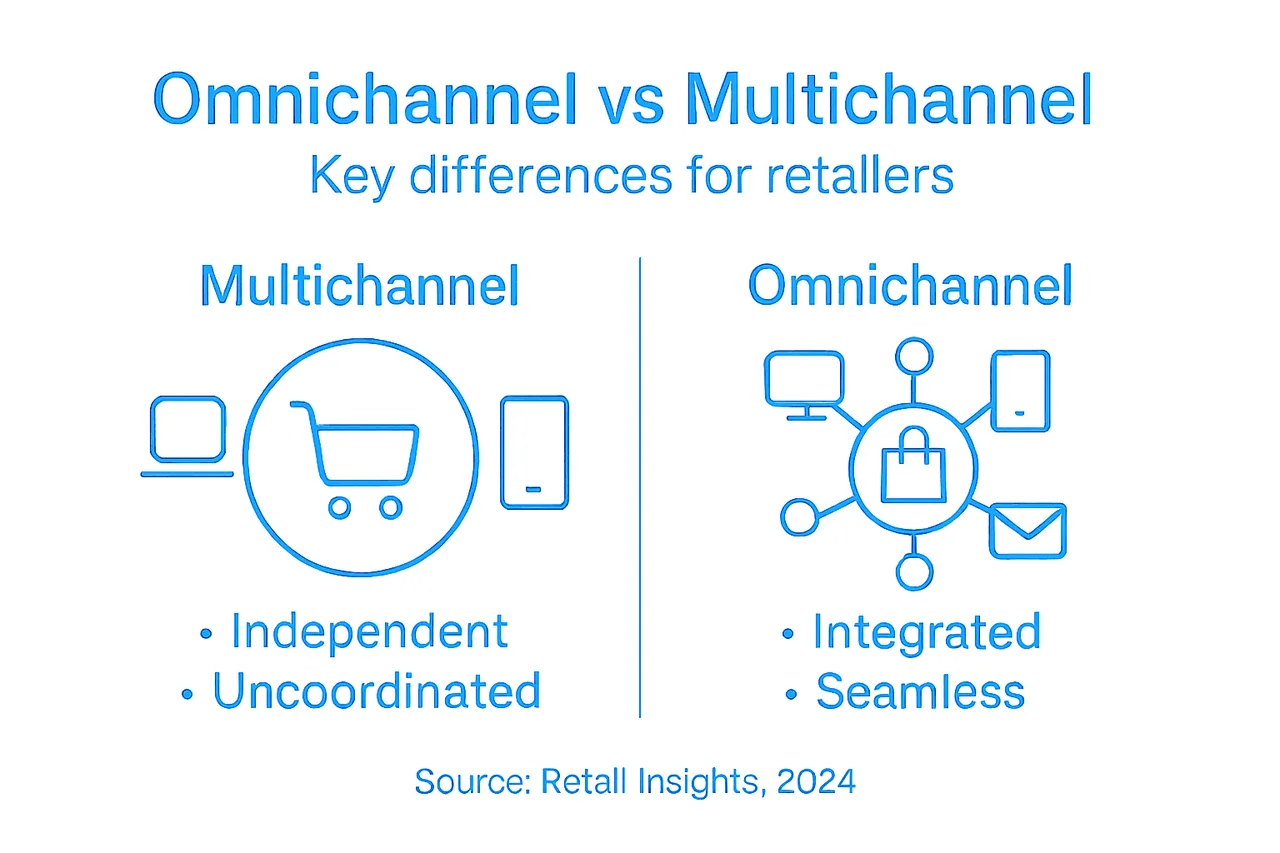
To illustrate the difference, imagine a customer browsing products on a mobile app, adding items to their cart, and later completing the purchase in-store. A multichannel approach might struggle with this transition, potentially losing cart information or requiring the customer to restart the process. An omnichannel strategy ensures that the customer’s journey remains continuous, with cart details, preferences, and purchase history accessible across all platforms, creating a unified and friction-free experience.
Pro tip: Conduct a comprehensive audit of your current channel strategies to identify disconnections and opportunities for creating a more integrated customer experience.
Here’s a concise comparison of multichannel and omnichannel retail strategies:
Aspect | Multichannel Approach | Omnichannel Approach |
|---|---|---|
Channel Coordination | Channels operate independently | Channels are fully integrated |
Customer Experience | Fragmented and inconsistent | Seamless and unified |
Data Sharing | Limited or siloed across channels | Shared in real time across platforms |
Shopping Journey | Disjointed transitions | Continuous across all touchpoints |
Performance Focus | Individual channel optimisation | Overall customer journey optimisation |
Core Elements of Effective Omnichannel Marketing
Effective omnichannel marketing requires a sophisticated approach that goes beyond simply maintaining multiple communication channels. Unified data systems are fundamental to creating a seamless customer experience, enabling businesses to track and respond to customer interactions across different platforms.

The core elements of a successful omnichannel strategy involve several key technological and strategic components. First, advanced customer relationship management (CRM) systems must integrate data from all touchpoints, including physical stores, websites, mobile apps, social media, and customer service channels. This integration allows businesses to develop a comprehensive understanding of individual customer preferences, purchase histories, and interaction patterns.
Personalisation stands as a critical component of omnichannel marketing. Retailers must leverage collected data to create tailored experiences that feel intuitive and responsive to each customer’s unique needs. This might involve strategies like recommending products based on previous purchases, sending targeted communications, or providing personalised pricing and promotions that adapt to the customer’s specific journey across different platforms.
Pro tip: Invest in robust data integration technologies that can consolidate customer information from multiple sources, creating a single, comprehensive view of each customer’s interactions and preferences.
Real-World Omnichannel Campaign Scenarios
Retail brands are increasingly implementing innovative omnichannel strategies that blur the lines between digital and physical shopping experiences. Retailers combine online and offline channels to create seamless customer journeys that adapt to modern consumer preferences.
One prominent example is the buy-online-pickup-in-store (BOPIS) strategy, where customers purchase items digitally and collect them from a physical store location. This approach provides customers with the convenience of online shopping and the immediacy of in-store pickup. Some retailers have expanded this concept by offering curbside pickup, allowing customers to receive their purchases without entering the store, which became particularly popular during pandemic-related restrictions.
Another sophisticated omnichannel scenario involves integrated inventory visibility. Modern retailers now provide real-time stock information across multiple platforms, enabling customers to check product availability online before visiting a physical store. This transparency reduces customer frustration and creates a more predictable shopping experience. Advanced systems even allow customers to reserve items online and try them in-store, or vice versa, giving shoppers unprecedented flexibility in their purchasing journey.
Pro tip: Map your customer’s potential interaction points across digital and physical channels to identify and eliminate potential friction in their shopping experience.
Common Pitfalls and How to Avoid Them
Implementing an effective omnichannel strategy is complex, with numerous potential obstacles that can derail even the most well-intentioned efforts. Operational inefficiencies often undermine omnichannel success, requiring businesses to develop a comprehensive and integrated approach to channel management.
One significant challenge is the persistent problem of organisational silos. Different departments frequently operate with separate goals and technologies, creating fragmented customer experiences. Marketing teams might use different data systems from sales teams, while customer service operates on yet another platform. This disjointed approach prevents the seamless data flow essential for true omnichannel marketing. Successful organisations must break down these internal barriers, creating cross-functional teams and shared performance metrics that incentivise collaboration.
Technological integration presents another critical hurdle. Retailers must invest in robust, flexible technologies that can communicate across various platforms and capture comprehensive customer data. This requires sophisticated customer relationship management (CRM) systems, advanced analytics tools, and integration architectures that allow real-time information sharing. Without proper technological infrastructure, businesses cannot deliver the personalised, consistent experiences that modern consumers expect.
Pro tip: Conduct a comprehensive audit of your current technological ecosystem, identifying gaps and opportunities for creating more integrated, customer-centric systems.
Below is a summary of common pitfalls in omnichannel marketing and recommended solutions:
Challenge | Impact on Business | Recommended Solution |
|---|---|---|
Organisational silos | Fragmented customer experience | Foster cross-department collaboration |
Outdated technology | Inability to unify data | Invest in scalable, integrated systems |
Inconsistent data flows | Missed personalisation | Centralise customer information |
Lack of staff alignment | Ineffective strategy execution | Share goals and success metrics |
Unlock Seamless Omnichannel Experiences with Expert Web Solutions
Navigating the complexities of omnichannel marketing demands more than just intent it requires cutting-edge technology that integrates your digital and physical customer touchpoints flawlessly. If you are struggling with disjointed customer journeys, organisational silos, or inconsistent data flows this article highlights how crucial it is to invest in unified systems that deliver a personalised and seamless shopping experience at every point.
If customer or order information must move between channels, identify which system owns each record and how updates should be handled. Discuss those system connections with Cloudfusion before choosing an integration approach.
Explore how our advanced CRM integrations and cloud-based tools simplify managing complex omnichannel strategies by visiting CloudFusion today. Your seamless customer journey starts here.
Frequently Asked Questions
What is omnichannel marketing?
Omnichannel marketing is a strategic approach that integrates multiple communication and sales channels to provide a unified, seamless customer experience across all touchpoints.
How does omnichannel marketing differ from multichannel marketing?
Omnichannel marketing focuses on creating an integrated customer experience where channels are interconnected, while multichannel marketing operates separate channels independently to optimise their performance.
What key components are essential for an effective omnichannel strategy?
Successful omnichannel strategies require robust customer relationship management (CRM) systems, data integration technologies, and advanced analytics to personalise marketing campaigns and enhance the overall customer journey.
What are some common pitfalls in implementing omnichannel marketing?
Common pitfalls include organisational silos among departments, outdated technology that limits data unification, inconsistent data flows that hinder personalisation, and lack of alignment among staff, which affects strategy execution.