TL;DR:
- Custom e-commerce development creates tailored online platforms that overcome the limitations of standard solutions like Shopify or Magento. It enhances flexibility, data ownership, and integration capabilities, enabling businesses to grow efficiently and protect revenue. Investing in custom development results in better user experience, improved data accuracy, and scalable systems aligned with specific operational needs.
Custom e-commerce development is defined as building a tailored online retail platform designed specifically to meet the unique operational needs and growth demands of your business. Unlike off-the-shelf solutions such as Shopify or Magento, custom development gives you full control over architecture, user experience, data infrastructure, and third-party integrations. This is why e-commerce needs custom development: generic platforms impose hard ceilings on growth, flexibility, and competitive differentiation. More than half of fast-growing e-commerce companies face integration and performance issues within 2–3 years on ready-made platforms. That statistic reflects a structural problem, not a configuration one.
Why do standard e-commerce platforms fall short?
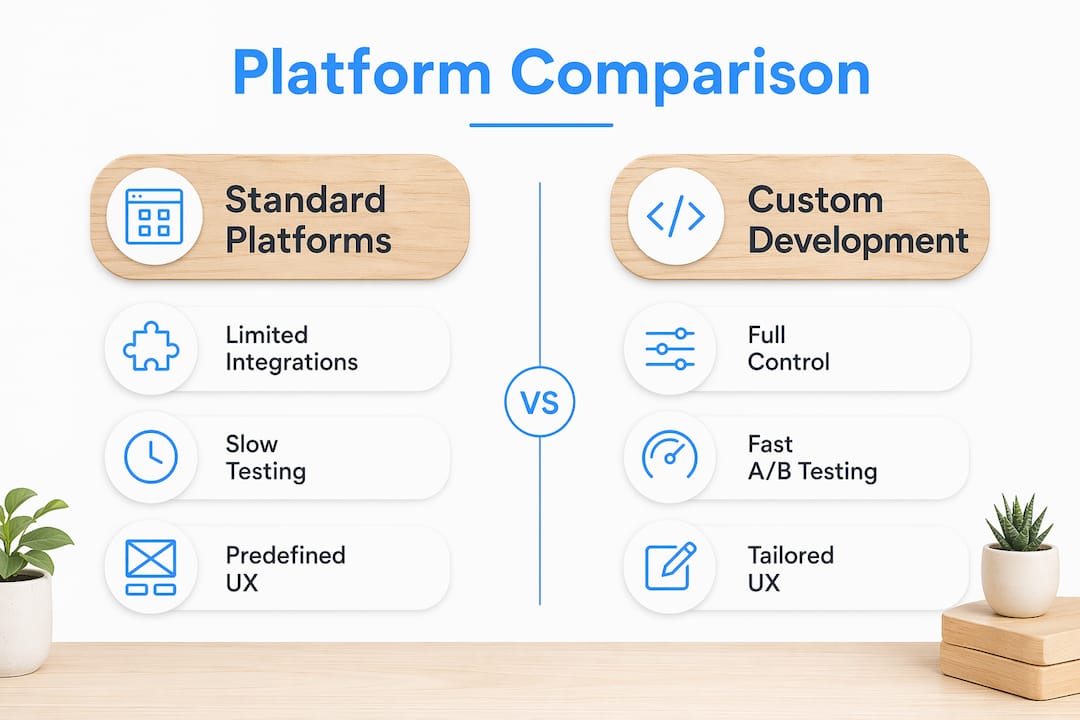
Standard platforms like Shopify and Magento are built for the average merchant. They work well at the start. But as your business grows in complexity, their architectural constraints become real operational costs.
The most common limitations businesses encounter include:
- Vendor lock-in: Your data, workflows, and integrations are tied to a platform’s ecosystem. Migrating away becomes expensive and disruptive.
- Limited custom logic: Pricing rules, product configurations, and checkout flows that deviate from the platform’s defaults require workarounds or costly third-party apps.
- Scalability ceilings: Traffic spikes and order volume growth can expose performance bottlenecks that platform infrastructure cannot resolve without significant additional cost.
- Slow feature delivery: Critical changes depend on the platform’s release cycle or app marketplace. You wait. Your competitors do not.
- Integration friction: Connecting ERP systems, custom CRMs, or logistics platforms often requires middleware that adds cost, latency, and failure points.
Major brands switch from standard platforms to custom development specifically to remove these constraints. This is not a trend driven by preference. It is driven by measurable operational impact.
Pro Tip: Before committing to custom development, audit your current platform’s limitations by listing every workaround or third-party app you are paying for. If that list exceeds five items, you are already paying the custom development tax without the benefits.
How does custom development protect revenue through better UX?
Owning your full technology stack means you control every element of the customer experience, from navigation structure to checkout flow. That control translates directly into revenue protection and growth.

The most compelling evidence of this comes from Next, the UK fashion retailer. Their A/B testing revealed that switching navigation away from the existing “Snail Trail” design would have caused a 9.1% drop in sales, representing a £135m revenue loss over 10 months. The insight here is not just that the test was run. It is that Next had the technical freedom to run it, measure it accurately, and act on the result without waiting for a platform update.
Custom development enables this kind of decision-making through:
- Tight analytics integration: Every user interaction is tracked against your specific business logic, not a generic platform event model.
- Rapid iteration cycles: Design and development teams can test hypotheses and deploy changes in days, not weeks.
- Accurate attribution: You measure what actually drives conversion, not what the platform’s default reporting shows.
| Capability | Standard Platform | Custom Development |
|---|---|---|
| A/B test deployment speed | Days to weeks via apps | Hours via internal pipeline |
| Analytics customisation | Limited to platform events | Full event schema control |
| UX change implementation | Dependent on theme or app | Direct code deployment |
| Revenue attribution accuracy | Platform-defined metrics | Business-specific models |
High-autonomy design teams with custom development synthesise data from multiple sources, including analytics, support tickets, and user research, for faster and higher quality product decisions. That feedback loop is simply not available on a locked platform.
Pro Tip: Treat your checkout flow as a product, not a configuration. Custom development lets you version-control, test, and iterate on checkout the same way you would any other product feature.
Why is first-party data ownership a strategic advantage?
First-party data ownership is the single most undervalued benefit of custom e-commerce solutions in 2026. Browser-based tracking pixels miss up to 30% of conversions due to ad blockers and privacy restrictions. That gap directly distorts your ad targeting, attribution, and personalisation.
Custom development solves this by enabling server-side data pipelines. Instead of relying on a browser pixel that a user’s device can block, your server sends conversion events directly to advertising platforms like Google Ads or Meta. The signal quality improves. Your targeting improves. Your cost per acquisition drops.
The commercial impact is significant. Brands using first-party data infrastructure see up to 2.9x revenue uplift and 1.5x cost reductions through effective data activation and privacy compliance. These are not marginal gains. They represent a structural competitive advantage for businesses that invest in owning their data.
Custom e-commerce solutions must treat first-party data as a critical infrastructure component, integrating it fully into marketing and product pipelines. Without this, you are making decisions on incomplete information.
Privacy compliance is equally important. Automated consent management built into custom platforms propagates consent states across your entire data infrastructure continuously. This keeps you audit-ready and protects you from regulatory exposure under frameworks like POPIA in South Africa and GDPR in markets you may sell into.
What are the security and compliance responsibilities in custom checkout?
Custom e-commerce development introduces specific security responsibilities that standard platforms partially abstract away. Understanding the shared responsibility model is not optional. It is a prerequisite for running a compliant payment operation.
Here is how responsibility is typically distributed:
- Cloud infrastructure providers such as AWS or Google Cloud cover physical security, network controls, and infrastructure-level compliance. They hold their own PCI certifications for the infrastructure layer.
- Merchants are responsible for application-level controls. This includes the payment scripts running on your pages, the APIs connecting to payment gateways, and the data your application stores or transmits.
- Payment gateway providers like PayFast or Peach Payments in South Africa handle card data tokenisation and processing. Their scope covers the transaction flow after handoff.
- Your development team owns the integration points. Any custom checkout logic, form handling, or session management that touches payment data falls within your PCI scope.
PCI compliance responsibility depends directly on your integration approach. Custom checkout flows require early planning of shared responsibilities, not a post-launch audit. The risk of discovering scope gaps after go-live is both expensive and operationally disruptive.
Early PCI scope planning with a clear responsibility matrix and evidence trail is the single most important compliance step in any custom e-commerce build. Build this into your project specification from day one.
How does custom development support deep integrations and scale?
Growing e-commerce businesses operate across multiple systems. Your ERP manages inventory and finance. Your CRM holds customer history. Your PIM controls product data. Your logistics platform handles fulfilment. On a standard platform, connecting these systems requires middleware, third-party connectors, and ongoing maintenance of brittle integrations.
Custom development removes that constraint. You build the integration layer once, to your exact specification, and own it entirely.
| Integration Type | Standard Platform Approach | Custom Development Approach |
|---|---|---|
| ERP (e.g., SAP, Sage) | Third-party connector or middleware | Direct API integration, custom sync logic |
| CRM (e.g., Salesforce, HubSpot) | App marketplace plugin | Native bidirectional data flow |
| PIM systems | Manual export or limited connector | Real-time product data synchronisation |
| Logistics and fulfilment | Platform-approved carrier apps | Custom webhook and fulfilment logic |
| Analytics (e.g., GA4, Mixpanel) | Standard event tracking | Full custom event schema |
Custom solutions simplify and accelerate integrations needed for complex e-commerce businesses, avoiding the constraints of platform ecosystems. This matters most when your business logic is non-standard. Complex pricing rules, tiered customer segments, or multi-warehouse fulfilment are all areas where standard platforms force compromises. Custom development does not.
Performance at scale is the other dimension. A custom architecture designed for your specific traffic patterns and data volumes will outperform a generic platform under load. You are not sharing infrastructure with thousands of other merchants. You are running a system built for your business.
For South African businesses exploring complex integration needs across niche industries, the flexibility of custom development is particularly relevant given the diversity of local ERP and logistics systems in use.
Key takeaways
Custom e-commerce development is the most direct path to removing platform constraints, owning your data, and building a system that scales with your business rather than against it.
| Point | Details |
|---|---|
| Platform limitations are structural | More than half of fast-growing e-commerce businesses hit integration and performance walls within 2–3 years on standard platforms. |
| UX control protects revenue | Next’s A/B testing showed a single navigation change would have cost £135m. Owning your stack prevents those mistakes. |
| First-party data is a revenue asset | Brands with custom data infrastructure see up to 2.9x revenue uplift and 1.5x cost savings through better data activation. |
| PCI scope must be planned early | Custom checkout flows shift compliance responsibility to your team. Define the responsibility matrix before development begins. |
| Deep integrations require custom architecture | ERP, CRM, PIM, and logistics systems connect cleanly only when the integration layer is built to your exact specification. |
The case for custom development is stronger than most businesses realise
I have worked with enough e-commerce businesses to see the same pattern repeat. A business launches on Shopify or Magento, grows quickly, and then hits a wall. Not a small wall. A wall made of third-party apps, workarounds, and platform limitations that collectively cost more in time and money than a custom build would have.
The common objection is cost. Custom development feels expensive upfront. But when you add up the monthly cost of five or six third-party apps, the developer time spent maintaining brittle integrations, and the revenue lost to UX constraints you cannot fix, the maths shifts. Custom development is not a cost. It is a capital investment in infrastructure that compounds over time.
What I find most underappreciated is the data ownership angle. South African businesses are increasingly subject to POPIA compliance requirements, and the shift away from third-party cookies is already affecting ad performance for businesses relying on browser pixels. A custom data infrastructure is not a luxury for enterprise brands. It is a practical necessity for any business serious about accurate measurement and compliant marketing.
My advice is straightforward. If your current platform requires more than a handful of workarounds to do what your business actually needs, the conversation about custom development should happen now, not after the next growth ceiling. Partner with a development team that understands both the technical architecture and your local market context. The analytics integration and iteration speed you gain will pay for the investment faster than you expect.
— Anton
Build your e-commerce platform the right way with Cloudfusion
Cloudfusion builds custom e-commerce solutions for South African businesses that need more than a standard platform can offer. From complex ERP and CRM integrations to server-side data pipelines and fully custom checkout flows, the team brings deep technical expertise and a practical understanding of the local market. Every project is approached as a long-term partnership, not a once-off build. If you are ready to move beyond platform limitations and build something that genuinely fits your business, explore Cloudfusion’s custom web development work or visit the custom development services page to get the conversation started. Give us a shout and let’s talk about what your platform actually needs.
FAQ
What is custom e-commerce development?
Custom e-commerce development is the process of building an online retail platform from the ground up, tailored to your specific business logic, integrations, and growth requirements, rather than using a pre-built solution like Shopify or Magento.
When should a business switch to custom development?
A business should consider custom development when standard platform limitations, such as integration constraints, performance issues, or inflexible checkout flows, are creating measurable operational costs or blocking growth.
How does custom development improve data accuracy?
Custom development enables server-side event tracking, which bypasses ad blockers and browser privacy restrictions. Browser-based pixels miss up to 30% of conversions, making server-side tracking critical for accurate attribution.
What are the PCI compliance implications of a custom checkout?
Custom checkout flows place application-level PCI compliance responsibility on the merchant. Cloud providers cover infrastructure security, but your team owns the payment scripts, API integrations, and data handling at the application layer.
Is custom e-commerce development affordable for mid-sized businesses?
Custom development has a higher upfront cost than standard platforms, but the total cost of ownership often favours custom builds when you account for third-party app fees, integration maintenance, and revenue lost to platform constraints.
Recommended