

Why invest in digital marketing: a 2026 guide for businesses
Discover why invest in digital marketing is essential for business growth. Learn effective strategies and tools for measurable success in 2026.
Start reading
TL;DR:
- Investing in digital marketing provides measurable returns through data-driven campaigns and optimized resource allocation. It enhances brand visibility and trust, especially locally, by leveraging SEO, reviews, and content to attract and retain customers. Combining organic and paid strategies over time ensures sustainable growth, with proper measurement infrastructure essential from the start.
Investing in digital marketing means allocating budget and resources to online channels, including SEO, email, paid search, social media, and content, to generate measurable business growth. For South African business owners and marketing decision-makers, the question is no longer whether to invest but how to do it wisely. Marketing is a business necessity, not an optional line item. Tools like Google Ads, HubSpot, and Elementor have made it possible to track every rand spent against every lead generated, giving you a level of accountability that traditional advertising simply cannot match.
Why invest in digital marketing for measurable ROI
Digital marketing investment is defined by its ability to produce quantifiable returns across every channel you use. Unlike a billboard or a radio spot, every digital campaign produces real-time data covering impressions, clicks, calls, and form completions. That data is not just a report. It is the mechanism that allows you to reallocate budget away from underperforming campaigns and towards what actually works.
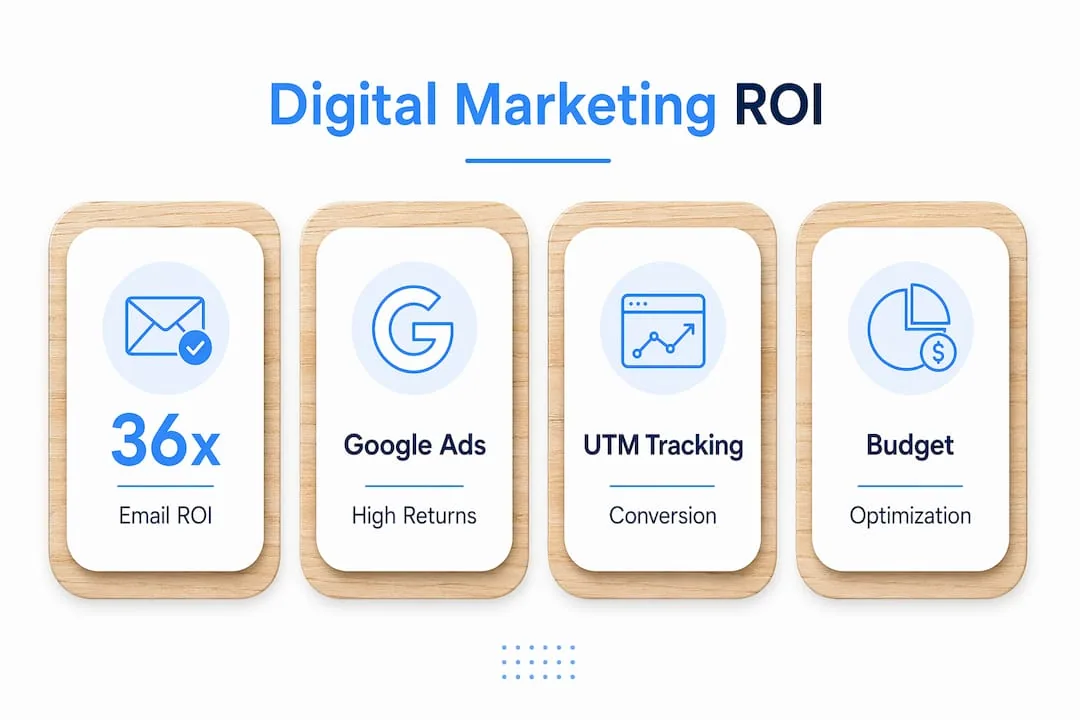
The numbers are compelling. Email marketing delivers an average return of R36 for every R1 spent, making it one of the highest-yield channels available to any business. Google Ads, when well-managed, can deliver an average ROI of 200%. These figures matter because they give you a benchmark against which to evaluate your own campaigns and set realistic expectations.
Marketing analytics enables budget reallocation towards the highest-return channels based on live performance data. This means you are not guessing. You are making decisions grounded in cost per acquisition (CAC), lifetime value (LTV), and conversion rates that update continuously.
| Channel | Typical ROI indicator | Cost efficiency |
|---|---|---|
| Email marketing | ~R36 return per R1 spent | Very high, low marginal cost |
| SEO | Long-term compounding traffic | High over time, low per-lead cost |
| Google Ads (PPC) | Average 200% ROI when managed | Moderate, scales with budget |
| Social media ads | Cost-effective retargeting | High for warm audiences |
Pro Tip: Set up UTM parameters in Google Analytics from day one. Without them, you cannot attribute conversions accurately to specific campaigns, and your ROI calculations will always be incomplete.
How digital marketing builds brand visibility and trust
Brand visibility in digital marketing is built through consistent, multi-channel presence that compounds over time. Digital marketing allows precise targeting by age, city, interests, job title, and income bracket, which means your message reaches the people most likely to buy from you rather than a broad, unqualified audience.

For South African businesses, local SEO and Google My Business optimisation are particularly high-value tactics. Local SEO and Google My Business optimisation are cost-effective strategies to generate leads and build trust within local communities. A plumbing company in Sandton or a law firm in Cape Town can outrank national competitors in local search results purely through consistent content and review management, without a massive advertising budget.
Building brand trust through digital channels requires a deliberate approach across several fronts:
- Reviews and testimonials: Actively request Google reviews after every successful transaction. Social proof is the single most persuasive signal for new customers evaluating your business.
- Content marketing: Publish articles, guides, and videos that answer your customers’ real questions. This positions your brand as an authority before a prospect has even spoken to your team.
- Social engagement: Respond to comments and messages promptly. Brands that engage publicly demonstrate accountability and care, which builds long-term loyalty.
- Consistent visual identity: Your website, social profiles, and email templates should reflect a unified brand identity. Inconsistency erodes trust faster than most businesses realise.
A strong online presence is the foundation on which all of these trust signals rest. Without a well-structured website and active digital profiles, even the best marketing spend will underperform.
Pro Tip: Ask satisfied clients to leave a Google review within 48 hours of project completion. Response rates drop significantly after that window closes.
Organic vs paid digital marketing: which delivers better results?
The most effective digital marketing strategy combines organic and paid channels rather than treating them as competing options. Each serves a distinct purpose, and understanding that distinction is what separates businesses that grow sustainably from those that burn through budget without building lasting assets.
Organic marketing, which includes SEO, content marketing, and social media presence, builds authority and generates traffic at a low marginal cost over time. SEO-generated leads cost 61% less than outbound marketing leads, which is a significant cost advantage for any business managing a finite marketing budget. A website combined with strong SEO and content consistently attracts high-intent visitors over time, meaning people who are already looking for what you sell.
Paid advertising through platforms like Google Ads and Meta delivers immediate visibility and faster lead capture. It is the right tool when you need results quickly, when you are testing a new offer, or when you want to retarget visitors who have already shown interest. Social media retargeting reaches warm audiences at a much lower cost than cold outreach, making it a high-efficiency channel for businesses with an existing customer base.
Here is how to combine both channels effectively over a 12-month period:
- Months 1 to 3: Launch paid search and social campaigns to generate immediate leads while your SEO foundation is being built.
- Months 3 to 6: Publish consistent content targeting high-intent keywords. Begin building your email list as an owned asset.
- Months 6 to 9: Organic traffic begins to grow. Reduce paid spend on keywords where you now rank organically.
- Months 9 to 12: Your email list and organic traffic compound. Paid campaigns focus on new audience acquisition and seasonal promotions.
The critical risk to avoid is cutting organic efforts too early. Sustained commitment is essential to avoid the marketing J-curve trap, where businesses abandon SEO and content just before the compounding effects begin to materialise. Businesses that own their customer data through email lists progressively lower their CAC over time, reducing dependence on paid channels.
Pro Tip: Never let your email list sit idle. Even a monthly newsletter to existing customers generates repeat business at near-zero acquisition cost.
How to maximise your digital marketing investment from the start
The most common reason digital marketing fails is not poor execution. It is poor measurement. The real question is not whether to market but how to measure the value of marketing against cost and acceptable lag time before ROI. Getting this right from the beginning determines whether your investment compounds or evaporates.
Before scaling any spend, validate your offer. Run a small paid campaign to confirm that your landing page converts and that your cost per acquisition is within a range your business can sustain. Scaling a campaign that does not convert is simply spending more money to confirm a problem.
Key metrics every business owner should track:
- Customer acquisition cost (CAC): Total marketing spend divided by new customers acquired in the same period.
- Lifetime value (LTV): Average revenue generated per customer over the full relationship. Your LTV must exceed your CAC for the business to be viable.
- Conversion rate: The percentage of visitors or leads who take the desired action. Small improvements here have an outsized impact on overall ROI.
- Payback period: How many months of revenue from a new customer it takes to recover the cost of acquiring them.
Set up Google Analytics, connect it to your CRM, and use UTM parameters on every campaign link. Without this infrastructure, you are making budget decisions based on incomplete information. Reviewing performance monthly and reallocating budget based on data, rather than intuition, is what separates high-performing marketing programmes from those that stagnate.
Common pitfalls to avoid:
- Spending on paid ads before your website is optimised to convert visitors
- Ignoring mobile performance when a significant portion of South African internet traffic is mobile-first
- Choosing an agency that cannot provide transparent, channel-level reporting
- Treating social media follower counts as a meaningful performance metric
For a detailed framework on tracking returns, Cloudfusion’s guide to measuring digital marketing ROI covers the specific tools and attribution models that work for South African businesses.
Pro Tip: If an agency cannot show you channel-level cost per acquisition in their monthly report, that is a signal to ask harder questions about where your budget is actually going.
Key takeaways
Investing in digital marketing delivers measurable, compounding returns when businesses combine owned assets like email lists with paid channels, track the right metrics, and commit to sustained organic strategies.
| Point | Details |
|---|---|
| ROI is measurable from day one | Track CAC, LTV, and conversion rates using Google Analytics and UTM parameters from the start. |
| Email marketing leads on ROI | At an average R36 return per R1 spent, email is the highest-yield channel for most businesses. |
| Organic and paid channels complement each other | Use paid ads for immediate leads while building SEO and content assets for long-term compounding growth. |
| Avoid the J-curve trap | Cutting organic marketing too early is the most common and costly mistake in digital investment. |
| Local SEO is high-value for South African SMBs | Google My Business optimisation and local content allow smaller businesses to compete with larger brands. |
What I have learned about digital marketing investment in South Africa
Having worked with South African businesses across retail, professional services, and technology, the pattern I see most often is not a lack of willingness to invest. It is a lack of patience combined with a lack of measurement infrastructure. A business will spend R15,000 on Google Ads for three months, see no clear attribution, and conclude that digital marketing does not work. The real problem is almost always that the tracking was never set up correctly in the first place.
Here is something that surprises most clients: the businesses I have seen grow most consistently through digital marketing are not the ones with the largest budgets. They are the ones that treat their website as a conversion asset, build their email list deliberately, and review their numbers every month without fail. A focused content strategy and a well-maintained Google Business Profile have generated more qualified leads for some of our clients than paid campaigns costing three times as much.
The South African market also presents a specific opportunity that many businesses underestimate. South African SMBs can compete with larger brands by focusing on content quality, reviews, and local SEO rather than budget size alone. The digital playing field here is less saturated than in markets like the UK or the US, which means consistent, quality-focused effort yields results faster than most business owners expect.
My honest advice: commit to a 12-month horizon, set up your measurement tools before you spend a single rand on advertising, and choose channels based on where your specific customers actually spend their time online. Digital marketing is not a shortcut. It is a compounding asset that rewards discipline.
— Anton
How Cloudfusion helps you invest in digital marketing wisely
A successful digital marketing strategy starts with a website that is built to perform. Cloudfusion’s custom web development services are designed to give South African businesses a digital foundation that converts visitors into customers, loads fast on mobile, and integrates with your marketing tools from day one. Beyond the website, our mobile app development solutions extend your customer engagement across every touchpoint. Whether you are starting your digital marketing investment or looking to get more from your current spend, give us a shout and let’s chat about what the right strategy looks like for your business.
FAQ
What is the average ROI of digital marketing?
Email marketing delivers an average return of R36 for every R1 spent, while well-managed Google Ads campaigns can achieve a 200% ROI. Returns vary by channel, industry, and how well campaigns are tracked and optimised.
How long does it take to see results from digital marketing?
Paid advertising can generate leads within days, while SEO and content marketing typically take three to six months before compounding effects become visible. Committing to a 12-month strategy gives both channels enough time to deliver meaningful returns.
Why is digital marketing better than traditional advertising?
Digital marketing allows precise targeting by demographics, location, and behaviour, and every campaign produces real-time performance data. Traditional advertising cannot match this level of attribution or cost efficiency, particularly for businesses with limited budgets.
What digital marketing channels should South African businesses prioritise?
Local SEO, Google My Business optimisation, email marketing, and Google Ads are the highest-priority channels for most South African SMBs. Social media retargeting adds significant value once a customer base and website traffic are established.
How do I know if my digital marketing investment is working?
Track customer acquisition cost, lifetime value, and conversion rates using Google Analytics and a CRM. If your LTV consistently exceeds your CAC and your conversion rates are improving month on month, your investment is working.