TL;DR:
- Effective web hosting directly influences e-commerce speed, security, and uptime, which are crucial for sales growth. Upgrading to managed or cloud hosting can significantly improve conversion rates and protect revenue during peak periods. Choosing the right hosting environment based on your growth stage ensures long-term success and better customer experience.
Web hosting is defined as the infrastructure that stores your online store’s data and makes it accessible to customers around the clock. Understanding why e-commerce needs web hosting goes far beyond simply “putting your site online.” Your hosting environment directly controls page load speed, uptime, payment security, and search rankings. Enterprise-grade hosting providers guarantee uptime between 99.9% and 99.99%, and that standard exists because even minutes of downtime during a peak sales period can cost a store thousands of rands. PCI DSS compliance, SSL/TLS encryption, and Content Delivery Network (CDN) integration are not optional extras. They are baseline requirements for any store that takes revenue seriously.
How does web hosting affect e-commerce performance and sales?
Hosting is the single biggest technical lever you have over your store’s speed and reliability. Most e-commerce entrepreneurs focus on product photography and ad spend, yet the server responding to every click is what determines whether a visitor converts or leaves.
A one-second delay in page load translates to a 7% drop in conversion rates, costing a store with R4.5 million in daily revenue over R315,000 every single day. That figure makes hosting one of the highest-return investments you can make. The maths is straightforward: faster hosting equals more completed purchases.
Average cart abandonment sits at approximately 70%, with slow checkout pages as a primary driver. A shopper who waits three seconds for a payment page to load will often close the tab. Your hosting environment determines how fast that checkout page responds.
Poor hosting causes bounce rates to rise and organic traffic to fall because Google uses page speed and user experience metrics as direct ranking signals. A slow server does not just hurt today’s sales. It erodes your long-term search visibility. Improving your site speed and conversions starts with the infrastructure underneath your store.
Here is what slow hosting costs you across the board:
- Conversions: Slower pages produce fewer completed purchases.
- SEO rankings: Google penalises slow-loading sites in organic search results.
- Ad spend efficiency: Paid traffic sent to a slow site wastes your marketing budget.
- Customer trust: A sluggish checkout signals an unreliable store.
- Return visits: Shoppers remember bad experiences and do not come back.
Pro Tip: Slow server response delays skew marketing attribution data, causing inaccurate reporting and inefficient ad spend. Before blaming your campaigns, audit your server response time first.
What key features should e-commerce hosting solutions provide?
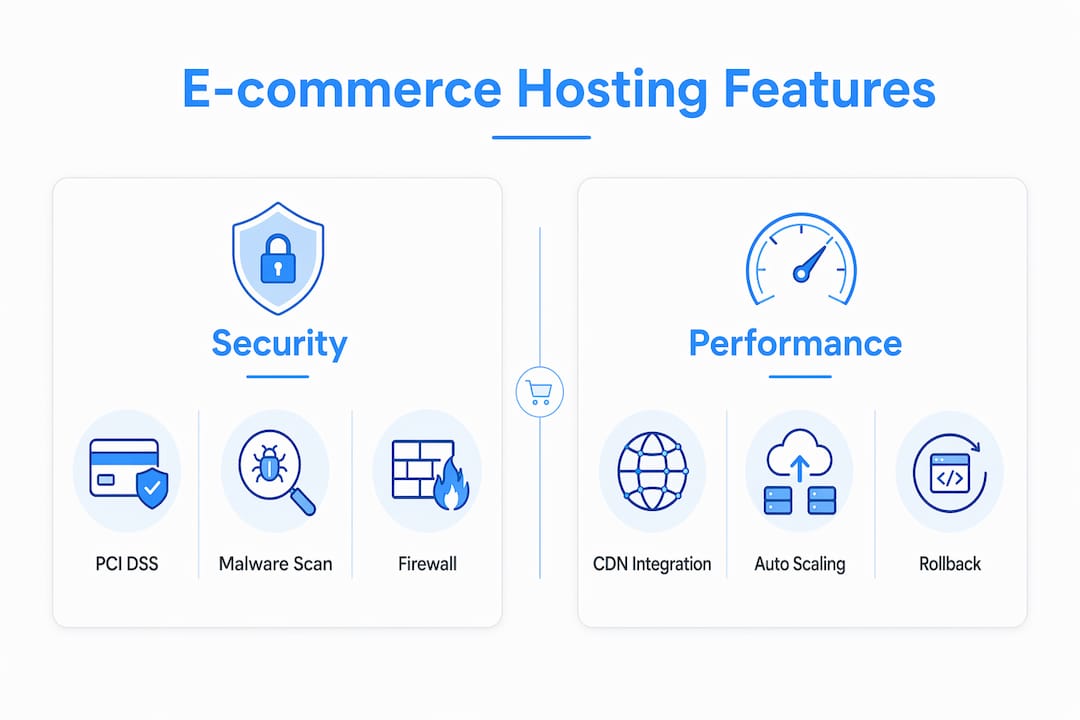
Not all hosting packages are built for online stores. A general-purpose hosting plan lacks the security, compliance, and performance features that e-commerce specifically requires.
Security and compliance
Managed hosting offloads complex security tasks such as PCI DSS compliance, malware scanning, and firewall setup, reducing legal and reputational risk for merchants. PCI DSS (Payment Card Industry Data Security Standard) is the global framework governing how card payment data must be handled. Without it, your store faces fines and potential loss of payment processing rights. SSL/TLS encryption protects data in transit between your customer’s browser and your server. These are non-negotiable for any store processing payments. Read more about protecting e-commerce trust through secure data management practices.
Performance and scalability
CDN integration distributes your store’s static assets across multiple global servers, reducing load times for customers regardless of their location. For South African stores serving customers across Gauteng, the Western Cape, and beyond, a CDN makes a measurable difference. Flexible resource allocation means your hosting can handle a traffic surge during a Black Friday campaign without crashing. Cloud hosting offers on-demand scalability with high availability, making it ideal for growing brands with fluctuating traffic patterns.

Managed hosting advantages
One-click rollback features in managed hosting enable fast recovery from code errors or plugin conflicts, which is critical for high-traffic stores. Without this capability, a faulty plugin update can take your store offline for hours. Automated backups, proactive security patching, and expert support mean your team focuses on selling rather than server management.
Pro Tip: When evaluating hosting packages, ask specifically about server-side tracking support. Accurate marketing attribution depends on your server’s response speed and reliability.
What types of e-commerce hosting exist and how do you choose?
Hosting decisions must reflect your growth plans and technical resources, with SaaS, headless, and Infrastructure-as-a-Service (IaaS) models each offering a different balance of control and ease of management. Choosing the wrong type at the wrong stage of growth is a common and costly mistake.
| Hosting type | Cost | Scalability | Control | Maintenance | Uptime suitability |
|---|---|---|---|---|---|
| Shared hosting | Low | Limited | Low | Self-managed | Entry-level stores |
| Managed hosting | Medium to high | Good | Medium | Provider-managed | Growing stores |
| Cloud hosting | Variable | High | High | Shared | High-traffic stores |
| SaaS platforms | Subscription | Built-in | Low | Fully managed | Non-technical teams |
Shared hosting places your store on a server shared with many other websites. It is affordable for a new store with low traffic, but resource limits become a problem as you grow. A traffic spike from a single campaign can slow your site to a crawl.
Managed hosting acts as a concierge service. Managed hosting lets entrepreneurs focus on sales rather than server management, delivering faster pages and less downtime. This is the right choice for stores that generate consistent revenue and cannot afford technical disruptions.
Cloud hosting gives you dynamic resource allocation. When traffic spikes, the cloud environment scales up automatically. This suits stores running aggressive marketing campaigns or seasonal promotions. Explore the key benefits of cloud hosting for a deeper look at how this model supports e-commerce growth.
SaaS platforms bundle hosting with the store platform itself. They require minimal technical knowledge but offer limited control over server configuration. They suit early-stage entrepreneurs who prioritise speed to market over customisation. For guidance on choosing the right hosting for your specific business stage, the decision framework matters more than the price tag.
How do hosting decisions impact long-term growth and customer experience?
Hosting is not a one-time decision. It is an ongoing commitment that shapes your store’s reputation, marketing performance, and ability to scale. Businesses that treat hosting as a commodity often pay the price during their most important trading periods.
Consider these long-term implications:
- Revenue protection during campaigns: A store that goes down during a paid advertising push loses both the ad spend and the potential sales. 99.9% uptime is the minimum standard to protect revenue during sales spikes.
- Customer trust and brand reputation: Security failures expose customer data. The reputational damage from a data breach far exceeds the cost of proper hosting.
- Marketing ROI accuracy: Hosting-related site speed directly affects return on ad spend. Slow sites cause visitor drop-off before conversion, wasting your marketing budget.
- Adaptation to market changes: A hosting environment that cannot scale limits your ability to respond to demand surges, new product launches, or market expansion.
- Proactive support: Hosting providers with 24/7 technical support prevent small issues from becoming major outages. Reactive support is not sufficient for a revenue-generating store.
Advanced hosting features like automated backups and rollback prevent hours of downtime and protect revenue from errors introduced by updates or third-party integrations. The long-term implications of hosting platform choice drive the current trend toward managed and cloud architectures, precisely because they reduce operational risk while supporting growth.
Key takeaways
Web hosting is the foundation of e-commerce performance, and the right hosting environment directly determines your store’s speed, security, uptime, and long-term revenue potential.
| Point | Details |
|---|---|
| Speed drives conversions | A one-second load delay cuts conversion rates by 7%, making hosting a direct revenue lever. |
| Uptime protects revenue | A minimum of 99.9% uptime is the industry standard for stores running marketing campaigns. |
| Security is non-negotiable | PCI DSS compliance and SSL/TLS encryption are baseline requirements for any store processing payments. |
| Hosting type must match growth stage | Shared hosting suits new stores; managed and cloud hosting suit growing and high-traffic stores. |
| Hosting affects marketing ROI | Slow server response distorts attribution data and wastes ad spend before a single conversion happens. |
The hosting decision most e-commerce owners get wrong
From working with South African online stores across multiple industries, I have seen the same pattern repeat itself. A store invests heavily in design, product photography, and Google Ads, then hosts the entire operation on the cheapest shared plan available. The result is predictable: campaigns drive traffic, the server buckles under load, and the conversion rate tells a story of wasted budget.
The uncomfortable truth is that hosting is not a background cost. It is a performance variable with a direct line to your revenue. I have seen stores recover significant conversion losses simply by migrating to a managed cloud environment, with no changes to their product range or marketing. The store did not change. The infrastructure did.
My practical advice: evaluate your hosting with the same rigour you apply to your ad spend. Ask your provider for uptime guarantees in writing. Test your server response time with tools like Google PageSpeed Insights before and after any migration. If your hosting provider cannot answer questions about PCI DSS compliance or CDN configuration, that is a signal to look elsewhere.
Managed hosting costs more than shared hosting. That cost is justified the moment your store generates consistent monthly revenue. Treating hosting as a commodity is a decision that compounds negatively over time.
— Anton
Cloudfusion’s hosting solutions for South African e-commerce
Cloudfusion builds and hosts online stores for South African businesses that need reliable, fast, and secure infrastructure. Our web hosting packages are designed specifically for e-commerce, with 99.9%+ uptime guarantees, SSL/TLS encryption, and local support expertise. Whether you are launching a new store or migrating an existing one, we match your hosting environment to your traffic demands and growth plans. Our custom web development team integrates hosting, security, and performance from the ground up. Give us a shout to discuss your store’s requirements and get a hosting solution that works as hard as you do.
FAQ
What is e-commerce web hosting?
E-commerce web hosting is the infrastructure that stores your online store’s files, databases, and media, making them accessible to customers at all times. It includes the server environment, security configuration, and performance features that support payment processing and high-traffic operations.
Does e-commerce need custom hosting?
Yes. Standard shared hosting lacks the PCI DSS compliance, scalability, and uptime guarantees that online stores require. Custom or managed hosting environments are built to handle payment security, traffic spikes, and the performance demands of a live store.
How does web hosting impact online sales?
Hosting directly affects page load speed, checkout performance, and uptime. A one-second load delay reduces conversion rates by 7%, and downtime during peak traffic periods results in direct revenue loss.
What is the minimum uptime standard for e-commerce hosting?
Enterprise-grade hosting providers guarantee a minimum of 99.9% uptime. This standard protects stores from revenue loss during high-traffic events such as sales campaigns or product launches.
How do I choose the right hosting for my online store?
Match your hosting type to your current traffic volume, technical resources, and growth plans. New stores can start on managed shared environments, while growing stores benefit from cloud or fully managed hosting with automated backups, CDN integration, and 24/7 support.
Recommended