TL;DR:
- Most South African businesses struggle with off-the-shelf software that doesn’t align with their unique workflows or complex integrations. Custom application development offers tailored solutions centered around specific business needs, ensuring operational efficiency and competitive differentiation. Success depends on deep business understanding, continuous stakeholder involvement, and choosing an adaptable technology stack aligned with requirements.
Most South African businesses reach a point where off-the-shelf software stops fitting. The workflows are too specific, the integrations too complex, or the vendor’s roadmap simply doesn’t align with where the business is heading. Custom application development services exist precisely for this situation. They give you software built around your processes, not the other way around. This article unpacks what custom app development actually involves, when it makes sense, how the process works, and what it realistically costs — so you can make a well-informed decision before spending a rand.
Table of Contents
- Key takeaways
- What are custom application development services?
- The custom application development process
- Technology stacks and architecture choices
- Cost, risks, and success factors
- Mobile apps within a custom development strategy
- My perspective on what actually makes these projects work
- How Cloudfusion can help your business
- FAQ
Key takeaways
| Point | Details |
|---|---|
| Build only what is unique | Use platforms like Salesforce or Power Apps for commodity needs; custom-build only workflows that differentiate your business. |
| Stakeholder involvement drives success | Teams that include business stakeholders in every two-week sprint deliver software that users actually adopt and trust. |
| Timelines are predictable | Discovery takes 3 to 6 weeks, an MVP 8 to 16 weeks, and a full application 16 to 40 weeks. |
| Technology follows requirements | Select your tech stack based on what your business needs, not what is trending. |
| Mobile is part of the strategy | Custom mobile application development services must align with your wider digital architecture, not operate in isolation. |
What are custom application development services?
At its core, custom app development means building software specifically for your business rather than purchasing a packaged product and adapting your processes to fit it. The distinction matters more than most people realise. When you understand custom web app development, it becomes clear that the goal is always to solve a specific, well-defined business problem — not to replicate generic functionality that already exists in the market.
The decision between build, buy, and configure is the first strategic question every business should answer honestly. A build-vs-buy assessment should happen before any code is written. If a platform like Salesforce, Microsoft Power Apps, or a well-supported SaaS product can address 80% or more of your requirements, buying or configuring is almost always the smarter choice. Custom development earns its place when your workflows are genuinely unique, when integration complexity exceeds what packaged tools can handle, or when off-the-shelf platforms lack capabilities your operation depends on.
Here are the business scenarios where tailored application services consistently justify the investment:
- Unique operational workflows that no packaged software addresses without heavy customisation
- Complex system integrations across ERP, CRM, third-party APIs, or legacy infrastructure
- Competitive differentiation where the software itself is part of the value proposition
- Regulatory or compliance requirements specific to your industry or the South African market
- Scalability demands that packaged platforms cannot meet without prohibitive licensing costs
South African enterprises in sectors like financial services, logistics, mining, and healthcare frequently find themselves in precisely these situations. The business case for custom development is rarely about prestige. It is about operational efficiency and competitive advantage that generic software cannot deliver.
The custom application development process
The difference between a project that delivers value and one that spirals into rework usually comes down to process. Teams that work closely with business analysts and stakeholders in every sprint deliver software that users actually adopt. The process below reflects how disciplined custom application development companies structure their delivery.
- Business process analysis. Before any technical decisions are made, map the workflows the software must support. Document pain points, data flows, and integration touchpoints. This phase surfaces requirements that stakeholders often haven’t articulated yet.
- Build-vs-buy assessment. Evaluate whether existing platforms can meet your needs before committing to custom development. This saves significant cost when the answer is yes.
- Technical architecture and stack selection. Technology choices follow from requirements, not the other way around. Define the architecture, data model, and integration strategy before writing a line of code.
- Agile sprint delivery. Work in two-week cycles with defined deliverables, stakeholder demonstrations, and feedback loops. Iterative delivery with stakeholder reviews every two weeks produces software that stays aligned with real business outcomes.
- Quality assurance and security testing. Each sprint includes automated and manual testing. Security is addressed throughout, not bolted on at the end.
- Deployment and knowledge transfer. Production deployment is planned, not rushed. Teams hand over documentation, training, and operational runbooks so your staff can manage and evolve the system.
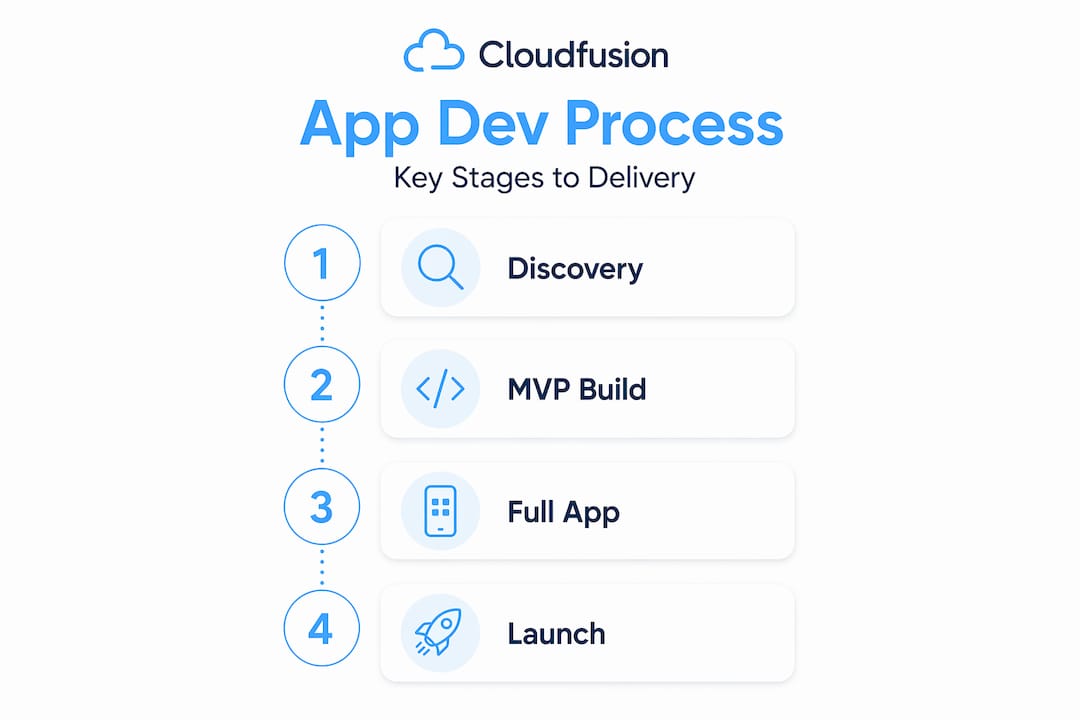
In terms of realistic timelines, discovery runs 3 to 6 weeks, an MVP 8 to 16 weeks, a full application 16 to 40 weeks, and a modernisation project 12 to 24 weeks. These ranges allow for regular feedback cycles rather than a single high-stakes delivery at the end.
Pro Tip: Do not skip the discovery phase to save time. A well-run discovery typically uncovers scope changes that would have cost three times as much to fix mid-build.

Technology stacks and architecture choices
Selecting the right technology is one of the most consequential decisions in any custom app project. The principle is consistent: technology stacks should follow business requirements, not lead them. With that in mind, here is how common choices compare across the main architectural layers.
| Layer | Common options | Best suited for |
|---|---|---|
| Frontend | React, Angular, Vue.js | Web apps, dashboards, complex UIs |
| Backend | .NET, Node.js, Python, Java | APIs, business logic, data processing |
| Cloud infrastructure | Azure, AWS | Hosting, scalability, managed services |
| Orchestration | Kubernetes, Docker | Containerised microservices environments |
| Low-code platforms | Microsoft Power Apps | Departmental apps, internal tools |
| AI capabilities | Azure OpenAI, TensorFlow | Document recognition, NLP, analytics |
Modern custom applications are increasingly built on microservices architectures rather than monolithic codebases. This means individual components can be updated, scaled, or replaced independently without touching the rest of the system. Legacy system modernisation using microservices and cloud migration can reduce operational costs by up to 40% while extending the useful life of the software considerably.
For South African enterprises running on Azure or AWS, the practical benefits are immediate: managed security patching, autoscaling, and geographic redundancy without maintaining on-premise server infrastructure. AI-enhanced features such as document recognition and predictive analytics are now practical additions to business applications, not just demonstrations. They solve real problems when scoped correctly from the start.
The low-code bracket deserves honest consideration too. Power Apps and similar platforms work well for internal tools and departmental workflows. They are not replacements for purpose-built enterprise applications, but they are genuinely cost-effective for the right use cases.
Cost, risks, and success factors
Custom application development cost varies significantly based on scope, complexity, and the calibre of the team you engage. Typical ranges run from R90,000 to R360,000 for basic applications, R360,000 to R900,000 for moderate complexity, and upwards of R7 million for enterprise-grade solutions. These figures reflect features, integrations, platform complexity, and ongoing maintenance requirements.
Understanding where projects go wrong is as valuable as knowing what they cost. The most common failure modes are predictable and avoidable:
- Feature bloat. Starting with too large a scope delays delivery and dilutes focus. Build the MVP first and extend from there.
- Insufficient stakeholder involvement. Development teams that work in isolation consistently build the wrong thing, even when their technical execution is excellent.
- Selecting a vendor that doesn’t understand your business. Technology skill is necessary but not sufficient. A good custom application development company must understand your industry well enough to challenge your assumptions.
- Neglecting post-launch maintenance. Applications require ongoing care. Budget for this from the start or the software will degrade in quality and security over time.
- Skipping documentation and knowledge transfer. If only the development team understands the system, you have a dependency that creates ongoing cost and risk.
The factors that consistently lead to successful outcomes are the mirror image of these pitfalls. Use-case driven development, continuous feedback, and a development partner who invests time understanding the business problem before prescribing a solution are the clearest indicators of a project that will deliver measurable value.
Pro Tip: Before signing with any development partner, ask them to walk you through their discovery process in detail. The depth and quality of that conversation will tell you more about their capability than any portfolio.
Mobile apps within a custom development strategy
Mobile application development services do not exist in isolation from your broader digital strategy. The most effective custom mobile applications are built with the same architectural discipline as their web counterparts, sharing APIs, authentication systems, and data models rather than duplicating logic across platforms.
The native versus cross-platform question is where most businesses start. Mobile app development uses native iOS and Android or cross-platform approaches depending on performance requirements, budget, and target device ecosystems. React Native and Flutter have matured to the point where cross-platform is a credible choice for most business applications. Native development still wins when you need maximum performance or deep platform integration, such as AR features or hardware-level access.
Key business-facing capabilities that drive adoption and retention in custom mobile apps include:
- Offline data synchronisation, critical for field teams in areas with unreliable connectivity
- Real-time push notifications for approvals, alerts, and status updates
- Single-click payments and embedded analytics that improve both user engagement and business intelligence
- Biometric authentication for secure, frictionless access to sensitive business data
- Role-based interfaces that surface only the information relevant to each user’s function
Mobile software development services must also account for the South African connectivity context. Designing for lower-bandwidth environments and incorporating offline-first architecture is not optional for applications serving field teams or rural-based users. It is a fundamental design requirement.
My perspective on what actually makes these projects work
I’ve worked on enough custom application projects to be direct about this: the single greatest predictor of success is how well the development team understands the business problem. Not the technology stack. Not the methodology. The domain understanding.
I’ve seen technically impressive projects fail because the developers built exactly what they were asked for, without ever questioning whether the requirements actually addressed the underlying problem. And I’ve seen modest-looking applications deliver extraordinary business value because the team spent real time with the people doing the work before writing a single line of code.
The danger of rebuilding commodity functionality from scratch is real and underappreciated. Every hour spent recreating something like user authentication, file storage, or email notifications is an hour not spent on the workflows that genuinely differentiate your business. Successful digital transformation means leveraging commodity platform capabilities and reserving custom development for the parts that are actually unique to your operation.
What I’ve learned is that the businesses who get the most value from custom app projects are the ones who stay involved. They attend sprint reviews, challenge assumptions, and treat the development team as an extension of their own operation rather than an external supplier ticking boxes. That relationship, more than any technology choice, is what determines whether the software gets used or gets shelved.
— Anton
How Cloudfusion can help your business
If you are evaluating custom application development services and want a partner who will invest time understanding your business before recommending a solution, Cloudfusion is worth a conversation. The team builds custom web applications and offers dedicated mobile app development in South Africa tailored to local business requirements. Beyond development, Cloudfusion supports the full digital environment with web hosting, cloud file storage, and Microsoft Office 365 for a complete solution. Give us a shout or request a personalised app development consultation to discuss what the right approach looks like for your specific situation.
FAQ
What is custom app development?
Custom app development is the process of building software specifically designed for a business’s unique workflows, integrations, and requirements, rather than adapting a packaged product. It is the right choice when off-the-shelf tools cannot address your operational needs without significant compromise.
When should a business choose custom over off-the-shelf software?
Choose custom development when your workflows are genuinely unique, when integration complexity exceeds what packaged tools can handle, or when platforms cannot meet 80% of your requirements without costly workarounds. For standard business functions, buying or configuring an existing platform is usually faster and more cost-effective.
How long does custom application development take?
Timelines depend on scope. Discovery typically takes 3 to 6 weeks, a minimum viable product 8 to 16 weeks, and a full application 16 to 40 weeks. Modernisation projects generally run 12 to 24 weeks.
How much does a custom application cost?
Costs range from approximately R90,000 for basic applications to over R7 million for enterprise-grade solutions, depending on features, integrations, and ongoing maintenance requirements. Getting a detailed discovery phase completed before committing to a full build is the best way to arrive at an accurate budget.
What is the difference between mobile and web custom app development?
Web applications run in browsers and are accessible across devices, while mobile applications are built specifically for iOS or Android and can leverage device-native features like offline sync, push notifications, and biometric authentication. The most effective strategies integrate both under a shared API architecture.
Recommended