

Custom software development consulting: 2026 guide
Unlock your business potential with our 2026 guide on custom software development consulting. Learn effective strategies to thrive!
Start reading
TL;DR:
- Effective custom software consulting focuses on architecture, strategy, and knowledge transfer, not just coding.
- It helps align your technology with business goals, reducing long-term costs and building internal capabilities.
Most business leaders assume custom software development consulting means hiring someone to write code. That misconception costs companies time, money, and competitive ground. Real custom software development consulting shapes how your organisation thinks about technology, not just what it builds. It aligns your architecture with your business goals, reduces the risk of costly rewrites, and builds the internal capability your team needs to sustain growth. This guide breaks down what consulting actually delivers, how to choose the right partner, and what South African businesses specifically need to consider before signing any engagement.
Table of Contents
- Key takeaways
- What custom software development consulting actually involves
- The business case for engaging software consultants
- How to choose software consultants worth trusting
- Consulting engagement models that fit different needs
- The South African context for software consulting
- My perspective on what truly makes consulting succeed
- How Cloudfusion supports your consulting journey
- FAQ
Key takeaways
| Point | Details |
|---|---|
| Consulting goes beyond code | Effective consulting addresses architecture, culture, and strategy, not just feature delivery. |
| Knowledge transfer is non-negotiable | Consultants who build your team’s capability prevent black-box solutions you cannot maintain. |
| Partner selection matters enormously | The wrong software partner causes budget overruns, technical debt, and missed deadlines. |
| Engagement model shapes outcomes | Choosing between project-based, sprint-based, or ongoing consulting affects cost, speed, and sustainability. |
| Local context reduces delivery risk | South African consultants familiar with regional regulation and market dynamics improve relevance and outcomes. |
What custom software development consulting actually involves
There is a widespread belief that a software consultant arrives, builds something, and leaves. The reality is quite different. Custom software consulting focuses on building scalable, maintainable architectures aligned with business goals, not on delivering one-off solutions. The work spans technical, strategic, and human dimensions simultaneously.
Here is what qualified software development advisors typically deliver across an engagement:
- Architecture analysis and system design. Consultants assess your existing systems, identify structural weaknesses, and design architectures that can support your growth trajectory without constant rework.
- Codebase audits and quality improvement. A technical audit surfaces hidden problems before they become production failures. This includes reviewing test coverage, dependency management, and security posture.
- Development lifecycle optimisation. This covers continuous integration and deployment pipelines, branching strategies, and release management. Faster, safer releases are a direct operational outcome.
- Technical mentorship and team capability building. As hands-on coaching paired with strategic advisory leads to superior technology decisions, skilled consultants actively develop your internal engineers, not just your product.
- Technology roadmap planning. Consultants help you sequence technology investments in a way that balances short-term operational needs with long-term scalability. This is where software development strategy becomes a genuine business asset.
Pro Tip: Ask any prospective consultant to walk you through a previous codebase audit they conducted. How they explain it tells you far more about their communication style and depth of expertise than any proposal document.
Understanding custom software development at this level of depth is what separates a vendor relationship from a true advisory partnership.
The business case for engaging software consultants
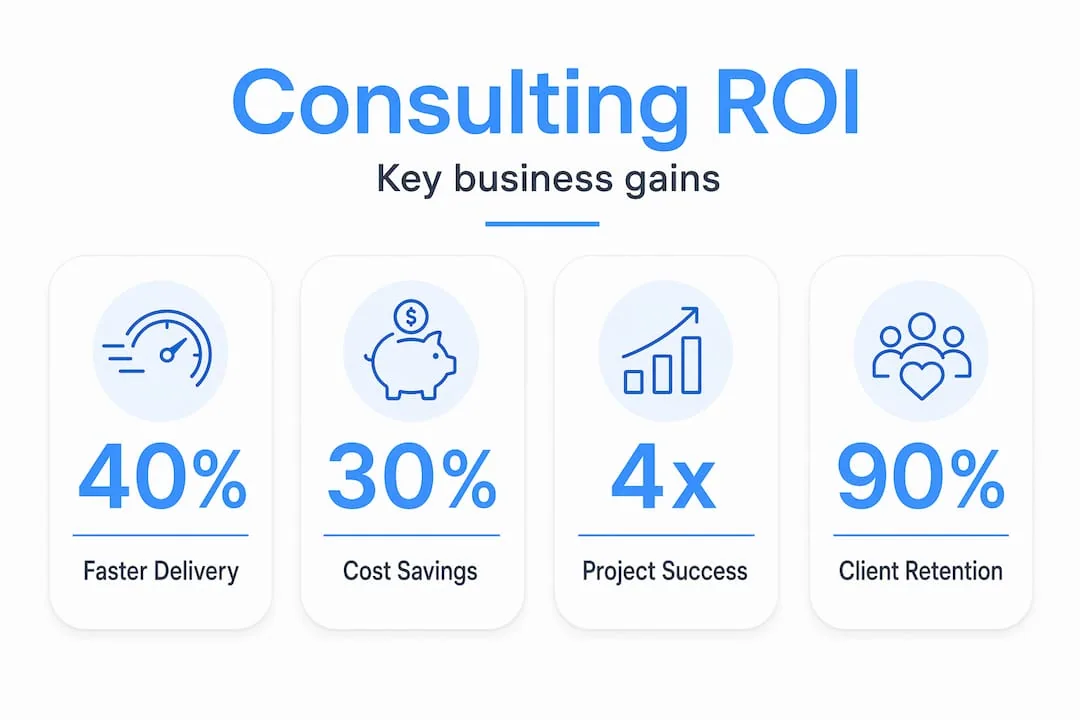
Beyond fixing technical problems, tailored software consulting delivers measurable business value across several dimensions. The case is not abstract. It shows up in your P&L, your release cycle, and your team’s confidence.
Here are five concrete business benefits your organisation can expect from a well-structured software engineering consulting engagement:
-
Architectural alignment with business goals. Bespoke software aligns precisely with business workflows, enabling process optimisation and future growth in ways off-the-shelf solutions simply cannot match. When your architecture mirrors your operations, inefficiencies become visible and fixable.
-
Reduction of technical debt and long-term cost. Technical debt accumulates silently. Consultants surface it early, quantify its cost, and create a remediation plan that prevents the full rewrite scenario, which commonly costs three to five times what the original build did.
-
Faster, more reliable releases. Optimised development pipelines and cleaner codebases translate directly into shorter release cycles and fewer production incidents. Your business moves faster when your software infrastructure is not fighting you.
-
In-house team skill development. Ongoing collaboration enables continuous optimisation and alignment with evolving business needs. When consultants mentor your internal engineers, the capability stays in your organisation long after the engagement ends.
-
Digital transformation with reduced risk. Long-term partnerships with consultants deliver better outcomes than one-off projects. Sustained advisory relationships allow your transformation to adapt as your market and requirements shift.
On the cost side, software consultant rates in the US range from R900 to R4,500 per hour depending on expertise and region. South African rates are generally more competitive, which makes local software project consulting an attractive value proposition for organisations with constrained budgets but ambitious technology goals.
You can explore the top benefits of custom software investment in more detail to build a stronger internal business case before approaching consultants.
How to choose software consultants worth trusting
Choosing a software consulting partner is one of the highest-stakes decisions a business leader makes in a transformation journey. The wrong choice does not just slow you down. It actively sets you back.
Use this comparison framework to evaluate candidates across the criteria that matter most:
| Evaluation criterion | What to look for | Red flag |
|---|---|---|
| Industry experience | Demonstrable work in your sector or similar operational complexity | Generic portfolios with no domain depth |
| Technical expertise | Modern toolsets, cloud-native experience, current engineering practices | Reliance on outdated frameworks without clear rationale |
| Knowledge transfer approach | Structured mentoring plans and co-development methodologies | Proprietary systems that your team cannot access or maintain |
| Communication style | Regular updates, transparent reporting, collaborative decision-making | Consultants who resist scope discussion or avoid documentation |
| Long-term scalability focus | Architectures designed for growth, not just current requirements | Solutions that solve today’s problem while creating tomorrow’s constraint |
| Pricing structure | Clear, milestone-based or retainer models with defined deliverables | Hourly-only billing with no accountability for outcomes |
Enterprise software firms vary significantly in focus, from cloud-native AI solutions to legacy modernisation and mobile-first development. Knowing which specialisation aligns with your needs before you start evaluating partners saves significant time.

A custom application development partner worth engaging will always begin by understanding your business processes before touching system design. They build the solution around your workflow, not the other way around.
Pro Tip: Request references specifically from clients who continued working with the consultant after the initial project ended. Repeat engagement is the most honest signal of genuine value delivered.
Consulting engagement models that fit different needs
Not every business needs the same type of consulting relationship. The engagement model you choose determines the pace, cost, and sustainability of your technology outcomes. Understanding your options before committing prevents misalignment from the start.
-
Project-based consulting. A defined scope, timeline, and deliverable set. Suited to businesses with a clear, bounded problem such as a platform migration, architecture redesign, or greenfield application build. Cost is predictable, but ongoing support requires a separate arrangement.
-
Fixed-scope sprints or audits. A focused engagement of two to six weeks designed to deliver a specific output: a codebase audit report, a technical due diligence assessment, or an architecture review document. These are ideal for organisations who need clarity before committing to a larger transformation.
-
Ongoing mentorship and co-development partnerships. Consulting engagements that integrate co-development foster skill transfer, reduce the risk of isolated black-box solutions, and ensure technical sustainability. This model suits organisations that want to build internal capability while simultaneously advancing their product.
-
Hands-on training and architecture review. Structured sessions where consultants work directly with your engineering team on real problems in your codebase. The output is both a better system and a more capable team. This is particularly valuable for organisations with existing developers who need to grow into more senior technical roles.
-
Retained strategic advisory. A lightweight, ongoing relationship where the consultant functions as a fractional CTO or technical board adviser. Monthly or quarterly engagements to review direction, evaluate technology decisions, and provide external perspective on strategic choices.
The model you choose should reflect both your budget and your maturity. An organisation with no internal engineering team will get far more from a co-development model than from a pure advisory retainer.
The South African context for software consulting
Businesses in South Africa operate within a specific set of constraints and opportunities that offshore consulting partners often miss entirely. Regulatory requirements, local payment infrastructure, connectivity considerations, and the realities of the South African enterprise procurement environment all affect how software should be designed and delivered.
Local consultants familiar with regional regulation, market specifics, and cost structures improve delivery relevance and partnership success in ways that generic offshore engagements rarely achieve. The difference is not just cultural familiarity. It is practical knowledge of what works in the local environment.
“The most effective software consulting partnerships in South Africa combine globally recognised technical standards with a deep understanding of local business realities. Organisations that prioritise this combination consistently outperform those that treat consulting as a purely technical commodity.”
Cost is also a meaningful factor. South African rates for software development advisors are typically more accessible than US or European equivalents, without sacrificing technical quality. For businesses exploring ROI from custom development, local engagement often delivers a stronger return precisely because the consultant understands the market the software serves.
Cloudfusion works with South African businesses at every stage of their digital transformation, from initial scoping and architecture advisory through to full-scale custom development and post-launch support.
My perspective on what truly makes consulting succeed
I’ve spent years working across software consulting engagements of every shape and size, and the pattern that separates successful outcomes from frustrating ones is rarely about technical skill alone. The consultants who consistently deliver real value are those who understand that architectural and cultural challenges are the largest bottlenecks in software projects, not just technical issues.
Here is the uncomfortable truth most consulting pitches won’t tell you. A technically brilliant consultant who builds a system your team cannot understand or maintain has not helped you. They’ve created dependency. The measure of great consulting is how much stronger your organisation is after the engagement ends, not during it.
I’ve also seen businesses make the mistake of choosing consultants based on price alone. The short-term saving almost always results in longer-term cost. High-performing consulting requires balancing technical depth with strategic business insight and leadership development. You cannot get that at the lowest market rate.
My strongest advice to any business leader considering a software consulting engagement is this: treat it as a partnership from day one. Share your business context openly, ask hard questions about knowledge transfer, and evaluate success not just by what gets built, but by what your team learns in the process.
— Anton
How Cloudfusion supports your consulting journey
If you’ve recognised that your business needs more than a development vendor and is ready for a genuine technology partner, Cloudfusion is worth a conversation. Cloudfusion’s approach to custom web development is built around understanding your business first and your technology requirements second. That sequencing matters.
From mobile application development to full-scale web platforms and cloud services, Cloudfusion delivers solutions designed for the South African market with the technical standards of a global practice. The team prioritises knowledge transfer and collaborative engagement, because the goal is always a client who can sustain and grow what gets built. Give us a shout to start a conversation about your project. No commitment required, just a clear look at where your business is headed and how we can help you get there.
FAQ
What does custom software development consulting include?
Custom software development consulting includes architecture analysis, codebase audits, development lifecycle optimisation, technical mentorship, and technology roadmap planning. It goes well beyond writing code to address the structural and strategic needs of your organisation.
How do I choose software consultants for my business?
Evaluate consultants on industry experience, technical expertise, their approach to knowledge transfer, communication transparency, and long-term scalability focus. Avoid choosing based on price alone, as the wrong development partner commonly causes technical debt and missed deadlines.
What engagement model suits a small South African business?
A fixed-scope audit or a mentorship-based co-development model typically suits smaller businesses well. These models deliver specific, measurable outputs without requiring a long-term commitment, while still building internal capability over time.
Why is knowledge transfer important in software project consulting?
Consultants who include knowledge transfer and mentorship prevent the creation of black-box solutions that clients cannot maintain. Without it, you remain dependent on the consultant indefinitely, which defeats the purpose of building internal capability.
How does tailored software consulting support digital transformation?
Tailored software consulting aligns your technology architecture with your strategic business goals, reduces the risk of costly rewrites, and builds the internal team capability needed to sustain transformation over time rather than delivering a one-off solution.